 Tajweed Basics
Idgham Kabir is one of the most distinctive features of Quranic recitation — and one of the least understood outside specialist circles. If you’ve ever heard a reciter merge two consecutive moving letters into a single stressed sound mid-verse, you’ve heard Idgham Kabir in action. But what exactly is it, who applies it, and how do its rules actually work?
This guide answers all of that, drawn directly from classical Tajweed scholarship including the Al-Wafi commentary on the Shatibiyya.
What you’ll learn in this article
- The precise definition of Idgham Kabir and why it earned that name
- Who reads it and from which transmission chain
- The three causes that trigger it and the three conditions that block it
- How it applies to similar, homorganic, and neighboring letters
- The role of Rawm and Ishmam within assimilation
What Is Idgham Kabir?
Idgham Kabir إدغام كبير is the merging of two consecutive vowel letters into one stressed (shaddah) sound during connected recitation.
Ibn Al-Jazari defined it as: “what occurs when the first of the two letters carries a vowel, regardless of whether they are identical, homorganic, or neighboring in articulation.” The first letter is stripped of its vowel, made temporarily silent, then merged into the second — producing a single doubled consonant.
It is called kabir (major) for several reasons documented in classical scholarship: because voweled letters occur more frequently than silent ones, making this type of assimilation more prevalent; because it requires silencing a moving letter before merging it, which is a more demanding phonetic operation; and because it encompasses all three categories of letter relationship — identical (Muthaalayn), homorganic (Mutajaanisayn), and neighboring (Mutaqaaribaayn).
Information gain note: Most introductory resources simply say it is “called major because it is difficult.” The classical explanation is more precise: the three-part categorization is itself the reason for its scope and name.
Join our Quran Tarteel Course and get a free trial

What Tilawah Uses The Rule Of Idgham Kabir?
Idgham Kabir is primarily associated with Abu Amr Al-Basri, and within his transmission it is carried specifically by Al-Susi — not Al-Duri.
Al-Sakhawi, student of Imam Al-Shatibiy, recorded explicitly: “Abu Al-Qasim Al-Shatibiy used to teach Idgham Kabir from the path of Al-Susi, because that is how he himself recited.” This is the chain followed in the Shatibiyya and Al-Taysir — the two foundational texts of this reading tradition.
Al-Duri’s path carries only Idhar (clear pronunciation) of these letters, with no Idgham Kabir.
Two other readers apply a limited form of Idgham Kabir: Yaqub and Hamzah in specific positions. All seven readers, without exception, agree on the assimilation of ﴿تَأْمَنَّا﴾ in Surah Yusuf (verse 11) .
The Three Permitted Modes for Al-Susi via the Shatibiyya Path
From the Tayyiba path, Abu Amr is transmitted with three valid combinations:
- Idhar (clear pronunciation) with Hamzah substitution
- Idgham (assimilation) with Hamzah substitution
- Idhar with actual Hamzah
A fourth combination — Idgham with full Hamzah — is impermissible and not transmitted. The Shatibiyya path specifically carries only one mode: Idgham with Hamzah substitution.
The Three Causes of Idgham Kabir
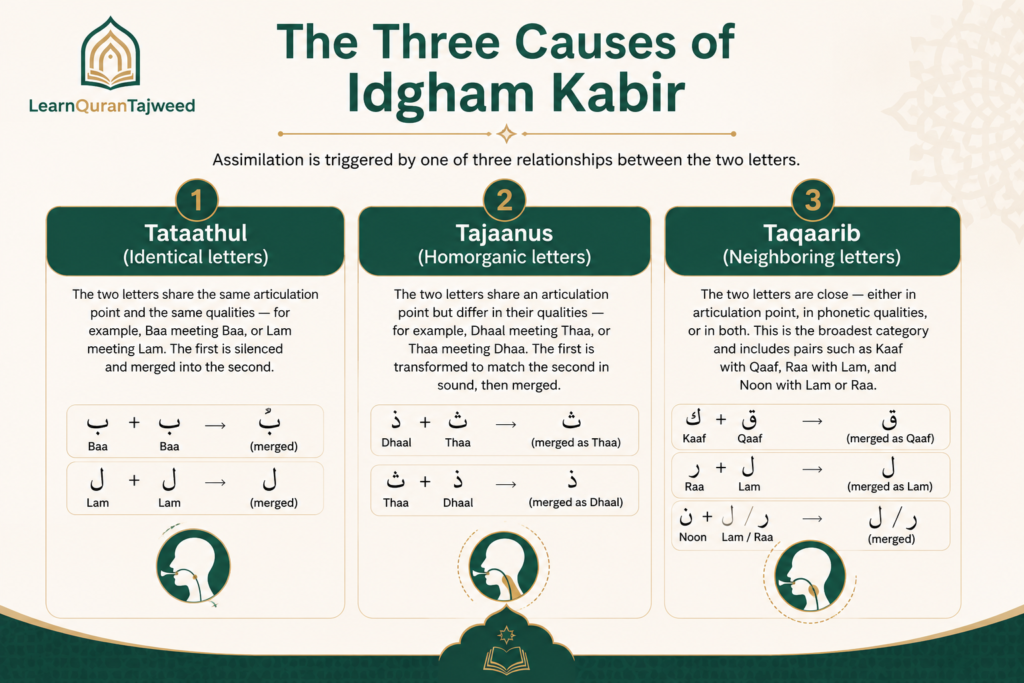
Assimilation is triggered by one of three relationships between the two letters.
Tataathul (Identical letters):
The two letters share the same articulation point and the same qualities — for example, Baa meeting Baa, or Lam meeting Lam. The first is silenced and merged into the second.
Tajaanus (Homorganic letters):
The two letters share an articulation point but differ in their qualities — for example, Dhaal meeting Thaa, or Thaa meeting Dhaa. The first is transformed to match the second in sound, then merged.
Taqaarib (Neighboring letters):
The two letters are close — either in articulation point, in phonetic qualities, or in both. This is the broadest category and includes pairs such as Kaaf with Qaaf, Raa with Lam, and Noon with Lam or Raa.
Begin your Tajweed journey with a free lesson
The Three Conditions That Block Idgham Kabir
Even when a valid letter pair exists, assimilation is blocked by three specific conditions. These are the mawaani — the preventers — agreed upon across the schools of Tajweed.
First: The Pronoun Taa
When the first letter is a Taa functioning as a speaker or addressee pronoun, Idgham is blocked regardless of what letter follows. Examples:
- ﴿كُنْتُ تُرَابًا﴾ (An-Naba 40) — speaker pronoun Taa before Taa
- ﴿خَلَقْتَ طِينًا﴾ (Al-Isra 61) — addressee pronoun Taa before Taa
- ﴿جِئْتِ شَيْئًا﴾ (Maryam 27) — feminine addressee Taa before Sheen
This exclusion exists because the grammatical function of the pronoun must remain audible; merging it would collapse meaning.
Second: The Shaddah (Already-Stressed Letter)
A letter that already carries a shaddah cannot be assimilated. Merging a stressed letter into the next would create an unresolvable phonetic compounding. Examples:
- ﴿رَبِّ بِمَا﴾ (Al-Qasas 17)
- ﴿مَسَّ سَقَرٍ﴾ (Al-Qamar 48)
Third: The Tanween (Nunation)
A letter followed by Tanween cannot be assimilated, because Tanween is an independent phonetic unit attached to the word and separates the two consonants in question. Examples:
- ﴿غَفُورٌ رَحِيمٌ﴾
- ﴿سَمِيعٌ عَلِيمٌ﴾
How Idgham Kabir Works in Practice?
Idgham Kabir occurs in specific Quranic cases where identical, neighboring, or related letters merge during recitation, with rules depending on letter position and word boundaries. It includes limited in-word cases and many cross-word applications, requiring careful distinction from Idhar to avoid incorrect assimilation.
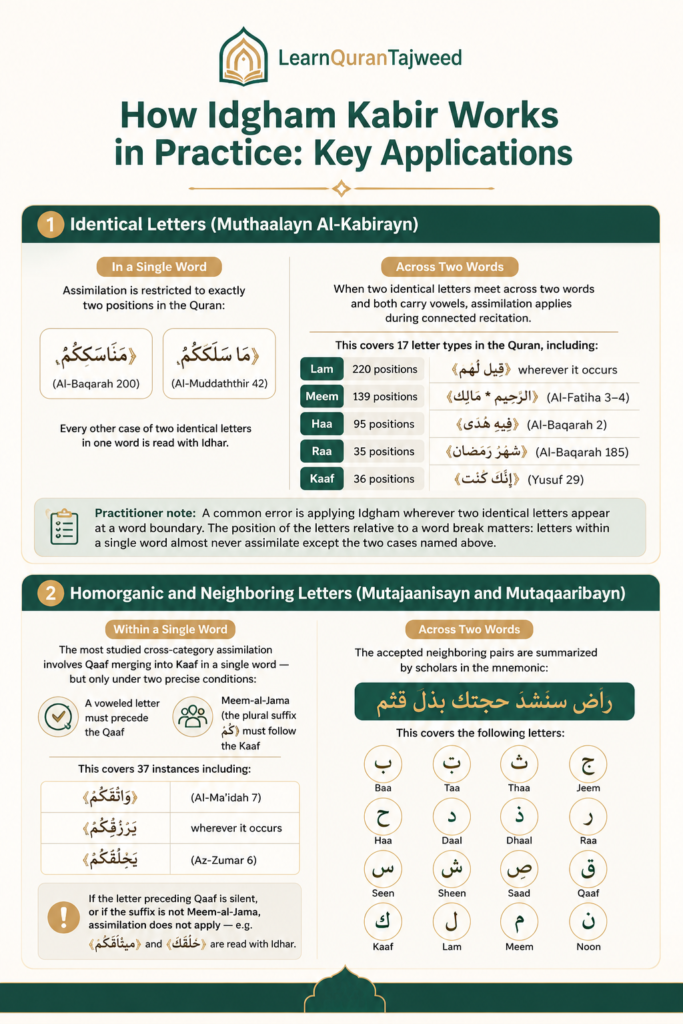
1. Identical Letters (Idgham Of Mutmathilyn – متماثلين)
When two identical letters meet in a single word, assimilation in the Quran is restricted to exactly two positions: ﴿مَنَاسِكَكُمْ﴾ (Al-Baqarah 200) and ﴿مَا سَلَكَكُمْ﴾ (Al-Muddaththir 42). Every other case of two identical letters in one word — such as ﴿جِبَاهَهُمْ﴾ or ﴿بِشِرْكِكُمْ﴾ — is read with Idhar.
When two identical letters meet across two separate words and both carry vowels, assimilation applies during connected recitation. This covers seventeen letter types in the Quran, including:
- Lam: the most frequent, with 220 positions — e.g.
﴿قِيلَ لَهُمْ﴾ wherever it occurs - Meem: 139 positions — e.g.
﴿الرَّحِيمِ * مَالِكِ﴾ (Al-Fatiha 3–4) - Haa: 95 positions — e.g.
﴿فِيهِ هُدًى﴾ (Al-Baqarah 2) - Raa: 35 positions — e.g.
﴿شَهْرُ رَمَضَانَ﴾ (Al-Baqarah 185) - Kaaf: 36 positions — e.g.
﴿إِنَّكَ كُنْتَ﴾ (Yusuf 29)
Practitioner Tajweed note: A common error is applying Idgham wherever two identical letters appear at a word boundary. The position of the letters relative to a word break matters: letters within a single word almost never assimilate except the two cases named above.
Read also: Madd vs Qasr in Tajweed – Differences, Types, Rules, and Examples
See Our Classrooms in Action
Watch these short clips from our live, interactive Quran courses to see how our students learn and interact with our expert tutors.
Perfect Your Quran Recitation Today
Join expert-led Tajweed classes, and recite the Quran with confidence and clarity.
Start Your Free Trial2. Homorganic (Mutajaanisayn) and Neighboring (Mutaqaaribaayn) Letters and)
The most studied cross-category assimilation involves Qaaf merging into Kaaf in a single word — but only under two precise conditions: a voweled letter must precede the Qaaf, and Meem-al-Jama (the plural suffix ـكُمْ) must follow the Kaaf.
This covers 37 instances including:
- ﴿وَاثَقَكُمْ﴾ (Al-Ma’idah 7)
- ﴿يَرْزُقُكُمْ﴾ wherever it occurs
- ﴿يَخْلُقُكُمْ﴾ (Az-Zumar 6)
If the letter preceding Qaaf is silent, or if the suffix is not Meem-al-Jama, assimilation does not apply — e.g.
﴿مِيثَاقَكُمْ﴾ and ﴿خَلَقَكَ﴾ are read with Idhar.
Across two words, the accepted neighboring pairs are summarized by scholars in the mnemonic: راض سنشد حجتك بذل قثم — covering Baa, Taa, Thaa, Jeem, Haa, Daal, Dhaal, Raa, Seen, Sheen, Saad, Qaaf, Kaaf, Lam, Meem, and Noon.
Read also: What Is the Difference between Tarteel and Tajweed?
Rawm, Ishmam, and the Degree of Madd in Idgham Kabir
Two subtle phonetic signals — Rawm and Ishmam — may accompany Idgham Kabir in specific vowel conditions.
Rawm (partial vocalization – الرَّوم):
Rawm or partial vocalization – الرَّوم is permitted when the first letter carries a Dammah or Kasrah. It involves producing roughly two-thirds of the vowel sound before the merge. When Rawm is applied, the assimilation is partially released — it cannot coexist with a full merge. Rawm is not possible when both letters are labial (Meem with Meem, Baa with Baa, etc.) due to the physical closure of the lips.
Ishmam (lip rounding – إشمام):
Ishmam is permitted when the first letter carries a Dammah only. Unlike Rawm, it is compatible with full assimilation and does not require releasing the merge. It is also impossible in the labial cases listed above.
On the degree of Madd (elongation) when a long vowel precedes the first letter, three positions exist among the Adaa scholars:
- The Madd within Idgham is longer than in Idhar — because the sound is continuous in assimilation and interrupted in Idhar.
- The Madd in Idhar is longer — the dominant position of Imam Ibn Al-Jazari and the majority, who hold that the cause is the same in both (meeting of two silent letters), so the duration should be equal.
- No difference between the two — the mainstream view according to Ibn Al-Jazari.
A nuance rarely mentioned in standard Tajweed courses: when a long vowel precedes the first letter in Idgham, up to seven permissible modes exist (short, medium, long — each with or without Ishmam — plus Rawm on the short). This is the most combinatorially rich position in Quranic recitation.
Read also: Idgham Saghir in Tajweed With Examples
Inside Learn Quran Tajweed Academy
Curious about how online learning works? Peek inside our actual Quran classes and hear the beautiful recitation of our students and teachers.
Start Learning Idgham Kabir with an Ijazah-Certified Teacher
Idgham Kabir cannot be learned from text alone. The merge, the degree of Madd, the points of Rawm and Ishmam — these must be heard from a teacher who carries a chain back to Abu Amr Al-Basri himself.
At LearnQuranTajweed, our instructors hold verified Ijazah in the ten Qira’at and teach live, one-to-one sessions you can join from anywhere in the world — no commute, no scheduling headaches.
Courses we offer:
- Tajweed Course for Kids
- Tajweed Course for Adults
- Tajweed Course for Ladies
- Tajweed ul Quran Course
- Quran Recitation with Tajweed Course
- Quran Tarteel Course
- Tajweed Ijazah Program
Perfect Your Quran Recitation Today
Join expert-led Tajweed classes, and recite the Quran with confidence and clarity.
Start Your Free Trial
Conclusion
Idgham Kabir is the merging of two consecutively voweled letters into a single stressed consonant, and it is one of the most structurally significant rules in the reading of Abu Amr Al-Basri via Al-Susi. Its causes are three — identity, homorganism, and neighborliness — and its blockers are three: the pronoun Taa, the Shaddah, and the Tanween. Within those boundaries, the rule covers hundreds of positions across the Quran, with the Lam-Lam merge alone appearing 220 times.
What distinguishes a competent student of Idgham Kabir from a beginner is not knowing the rule in the abstract — it is knowing precisely where the exceptions fall, which combinations admit Rawm or Ishmam, and how the degree of Madd shifts according to what precedes the merged letter. That level of precision is built through sustained practice with a qualified teacher, not through reading alone.
Frequently Asked Questions
What is Idgham Kabir?
Idgham Kabir is a Tajweed rule in which two consecutively voweled letters — identical, homorganic, or neighboring — are merged into a single stressed (shaddah) letter during connected Quranic recitation. The first letter’s vowel is absorbed, and the two sounds become one.
Who applies Idgham Kabir in Quranic recitation?
Idgham Kabir is principally the reading of Abu Amr Al-Basri, transmitted through his student Al-Susi via the Shatibiyya chain. Al-Duri, the other transmitter from Abu Amr, carries only Idhar in these positions. Yaqub and Hamzah also apply limited forms of the rule.
What are the conditions that prevent Idgham Kabir?
Three conditions block Idgham Kabir even when two qualifying letters meet: (1) the first letter is a pronoun Taa (speaker or addressee), (2) the first letter already carries a Shaddah, or (3) the first letter carries Tanween. These three blockers are agreed upon across all schools of Tajweed.
What is the difference between Idgham Kabir and Idgham Saghir?
In Idgham Kabir, both letters are voweled before the merge — the first is then silenced and assimilated into the second. In Idgham Saghir, the first letter is already silent and merges into the voweled second letter. Idgham Saghir applies to Mutaqaaribaayn and Mutajaanisayn only; Idgham Kabir covers all three categories.
Is Idgham Kabir found in all copies of the Quran?
Idgham Kabir is a reading-level rule — it affects pronunciation, not the written Rasm (Uthmanic script). All standard Quran copies follow the same text. The assimilation is a feature of recitation in the Al-Susi transmission, reflected in certain annotated editions with Tajweed color-coding.
Can Rawm and Ishmam be applied with Idgham Kabir?
Yes. Rawm (partial vowel signal) is permitted with Dammah and Kasrah vowels on the first letter, but requires slightly releasing the full merge. Ishmam (lip rounding) is permitted with Dammah only and is compatible with a complete merge. Both are physically impossible when the letters involved are labial (Baa, Meem, Faa meeting each other), because lip closure prevents the signals from being visible.
Related Articles
Tajweed Basics