 Tajweed Rules
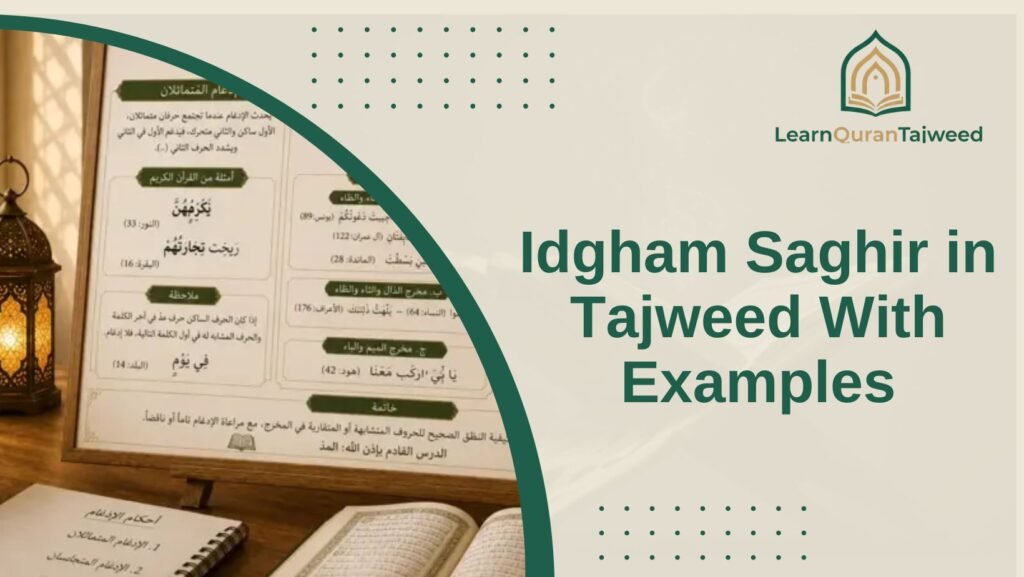
Idgham Saghir in Tajweed is one of the essential rules that helps Quran reciters achieve a smoother and more accurate pronunciation. It explains how a sakin letter merges into the following voweled letter across two words, creating a single emphasized sound during recitation.
In this guide, you will learn the meaning of Idgham Saghir, its three types (Mutamathhilayn, Mutajanisayn, and Mutaqaribayn), Quranic examples, the difference between complete and incomplete merging, and the key exception that prevents this rule from applying inside a single word. By understanding these principles, you can recognize Idgham Saghir in the Mushaf and apply it correctly in your Quran recitation.
What You’ll Learn in This Article
- The exact definition of Idgham Saghir and why it is called “minor”
- Its three types with Quranic examples
- The difference between complete and incomplete merging
- The one exception that prevents the rule from applying
What Is Idgham Saghir?
Idgham Saghir is the merging of a sukoon (stationary) letter into the voweled letter that immediately follows it across two adjacent words, so that both become a single doubled letter.
It is called Saghir (minor) because the first letter already carries a sukoon, requiring less effort to merge than stopping a moving letter would. In the Mushaf, this is marked by removing the sukoon from the first letter and placing a shaddah on the second.
The Three Types of Idgham Saghir
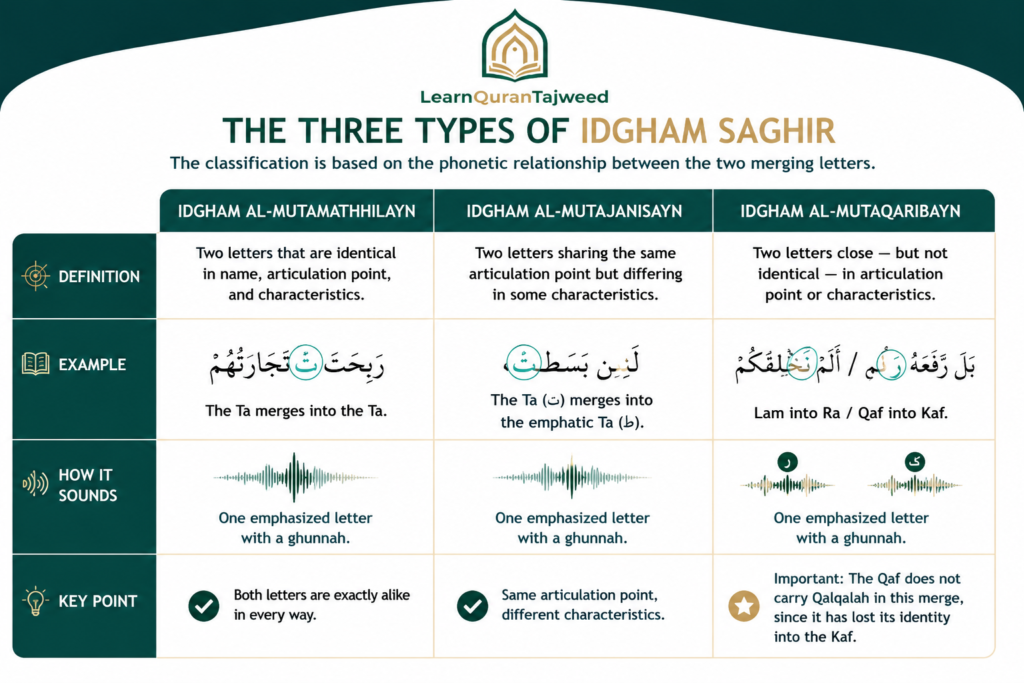
The classification is based on the phonetic relationship between the two merging letters.
1. Idgham al-Mutamathhilayn
Idgham al-Mutamathhilayn إدغام المتماثلين occurs with two letters that are identical in name, articulation point, and characteristics. Example: ﴿رَبِحَت تِّجَارَتُهُمْ﴾ — the Ta merges into the Ta, producing one emphasized Ta.
2. Idgham al-Mutajanisayn
Idgham al-Mutajanisayn إدغام المتجانسين occurs with two letters sharing the same articulation point but differing in some characteristics. Example: the Ta (ت) merging into the emphatic Ta (ط) in ﴿لَئِن بَسَطتَ﴾.
3. Idgham al-Mutaqaribayn
Idgham al-Mutaqaribayn occurs with two letters close — but not identical — in articulation point or characteristics. Key pairs: Lam into Ra ﴿بَل رَّفَعَهُ﴾, and Qaf into Kaf ﴿أَلَمْ نَخْلُقكُّم﴾. One important practitioner note: the Qaf does not carry Qalqalah in this merge, since it has lost its identity into the Kaf — a common error among intermediate students.
Idgham Kamil (Complete) vs. Idgham Naqis (Incomplete)
The main difference between Idgham Kamil (Complete Idgham) and Idgham Naqis (Incomplete Idgham) is whether the first letter disappears completely or leaves behind some of its characteristics.
In Idgham Kamil, the first letter is fully absorbed into the following letter, losing both its sound and attributes. In Idgham Naqis, the letter’s sound disappears, but one of its characteristics — such as ghunnah or an emphatic quality — remains audible.
Idgham Kamil (Complete): the first letter disappears in both identity and characteristics. Example: ﴿أُجِيبَت دَّعْوَتُكُمَا﴾ — the Ta vanishes entirely.
Idgham Naqis (Incomplete): the letter’s sound disappears but a residual characteristic remains. This occurs in four cases — Nun merging into Waw or Ya (ghunnah remains), and Ta merging into ط or Qaf merging into Kaf (emphatic characteristics remain). The Ta and Qaf also carry no Qalqalah in these merges.
check all the rules of Idgham.
Read also: Madd vs Qasr in Tajweed – Differences, Types, Rules, and Examples
See Our Classrooms in Action
Watch these short clips from our live, interactive Quran courses to see how our students learn and interact with our expert tutors.
Perfect Your Quran Recitation Today
Join expert-led Tajweed classes, and recite the Quran with confidence and clarity.
Start Your Free TrialIdgham Saghir vs. Idgham Kabir
The main difference between Idgham Saghir and Idgham Kabir is the condition of the letters before merging and where each type is commonly found in recitation.
Idgham Saghir occurs when a sakin letter merges into the following voweled letter across two words and is widely applied in Hafs recitation.
Idgham Kabir occurs when two voweled letters meet, requiring the first letter to become sakin before merging, and is mainly found in specific Qira’at such as the narration of Imam Abu Amr.
| Aspect | Idgham Kabir | Idgham Saghir |
| Definition | Two voweled letters meet; the first is silenced then merged | A sukoon letter merges directly into the following voweled letter |
| Examples | Found in specialized Qira’at (e.g., Abu Amr’s recitation) | ﴿رَبِحَت تِّجَارَتُهُمْ﴾البقره, ﴿بَل رَّفَعَهُ﴾النساء ﴿نَخْلُقكُّم﴾ |
Read also: What Is At -Tafashi In Tajweed? The Rule Behind The Letter Shin
The Exception You Must Know
Idgham Saghir never applies inside a single word. Words like الدُّنْيَا and بُنْيَانٌ are read with a clear Noon — not merged — because both letters belong to the same word. Always confirm the letters span two separate words before applying the rule.
Inside Learn Quran Tajweed Academy
Curious about how online learning works? Peek inside our actual Quran classes and hear the beautiful recitation of our students and teachers.
Master Idgham Saghir with a Qualified Teacher
Knowing the rule is the first step. Applying it correctly during Salah — without Qalqalah where it shouldn’t appear, with ghunnah where it should remain — requires live correction from a certified instructor.
At Learn QuranTajweed Academy, our Ijazah-certified teachers guide you from rule knowledge to consistent, accurate recitation.
Book your free trial lesson today
Courses we offer:
- Tajweed Course for Kids
- Tajweed Course for Adults
- Tajweed Course for Ladies
- Tajweed ul Quran Course
- Quran Recitation with Tajweed Course
- Quran Tarteel Course
- Tajweed Ijazah Program
Perfect Your Quran Recitation Today
Join expert-led Tajweed classes, and recite the Quran with confidence and clarity.
Start Your Free TrialConclusion
Idgham Saghir merges a sukoon letter into the voweled letter that follows it, across two words, producing one doubled sound. Its three types cover identical, same-origin, and phonetically close letter pairs. Merging can be complete or partial depending on whether residual characteristics carry over. The rule never applies within a single word. With this foundation in place, you will begin to recognize Idgham Saghir naturally throughout your recitation.
Read also: Idgham Kabir – Full Guide With Examples
Frequently Asked Questions
What is Idgham Saghir in simple terms?
Idgham Saghir is when a non-voweled letter merges into the voweled letter that immediately follows it across two words, so both become one doubled sound. It is called “minor” because the first letter is already at rest, making the merge straightforward.
What are the three types of Idgham Saghir?
The three types are Mutamathhilayn (identical letters), Mutajanisayn (same articulation point, different qualities), and Mutaqaribayn (close in articulation or qualities). All three require the first letter to be sakin and the second to be voweled, across adjacent words.
Does Idgham Saghir apply inside one word?
No. It only applies across two separate words. Letters within the same word — like the Noon and Ya in الدُّنْيَا — are always pronounced clearly, never merged.
Does the Qaf carry Qalqalah when it merges into Kaf?
No. Once Qaf merges into Kaf in Idgham Mutaqaribayn, it loses its independent identity, and Qalqalah does not apply. The same is true for Ta merging into the emphatic ط.