 Tajweed Rules
| Key Takeaways |
| Makharij al-Huruf refers to the precise articulation points in the mouth, throat, and lips where each Arabic letter originates. |
| Arabic letters are grouped into five main articulation zones: the throat (Halq), tongue (Lisan), lips (Shafatayn), nose (Khayshum), and oral cavity (Jawf). |
| Each letter carries fixed attributes (Sifat) that are inseparable from correct pronunciation and Tajweed application. |
| Mispronouncing a letter from the wrong makhraj can alter a word’s meaning in the Quran, making Makharij mastery an act of religious obligation. |
| Non-Arabic speakers consistently confuse letter pairs like Haa/Kha, Ain/Hamzah, and Dhad/Dhaa — errors correctable only through certified instructor guidance. |
Mastering Makharij al-Huruf — the articulation points of Arabic letters — is the foundation every serious Quranic reciter must build before any other Tajweed rule can be properly applied.
Without knowing precisely where each letter originates in your mouth, throat, or lips, even memorized rules produce distorted recitation. This is where pronunciation accuracy and Tajweed scholarship intersect most directly.
Each Arabic letter is produced from a specific point of contact or constriction in the vocal tract. That point is its makhraj. Alongside the makhraj, every letter carries fixed phonetic attributes — its Sifat — which give it its distinctive sound quality. Together, makhraj and sifat define a letter completely, and both must be correct simultaneously for valid Quranic recitation.
What Are Makharij al-Huruf?
Makharij al-Huruf (مَخَارِجُ الحُرُوف) are the specific anatomical points from which Arabic letters are articulated. Classical Tajweed scholars identify seventeen distinct articulation points grouped across five major zones of the vocal tract.
Mispronouncing a letter by shifting its makhraj — even slightly — can change a word’s meaning entirely in the Quran.
This is why the science of Makharij is not merely academic — it directly governs the correctness of every recitation.
At Learn Quran Tajweed Academy, students enrolled in the Beginner Tajweed Course spend their foundational weeks exclusively on Makharij before advancing to rules like Ikhfa or Idgham. This sequencing is intentional — and it reflects decades of accumulated instructional wisdom.
Begin your Tajweed journey with a free lesson

What Are The Five Articulation Zones of Arabic Alphabet Pronunciation?
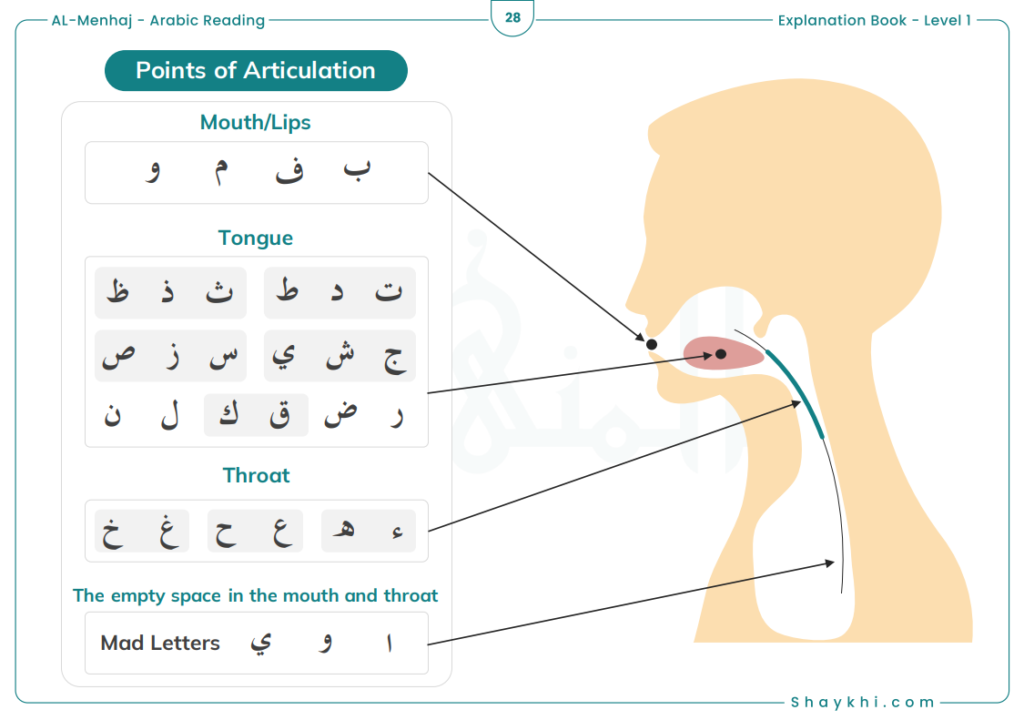
The seventeen articulation points in classical Tajweed scholarship are organized within five primary zones. Understanding the zone before the individual letter helps students build a mental map of their own vocal anatomy.
| Zone | Arabic Name | Letters Originating Here |
| Oral Cavity | Al-Jawf | Alif madda, Waw madda, Ya madda |
| Throat | Al-Halq | Hamzah, Ha, Ain, Ha, Ghain, Kha |
| Tongue | Al-Lisan | Qaf, Kaf, Jim, Shin, Ya, Dhad, Lam, Nun, Ra, Ta, Dal, Taa, Dhaa, Dhal, Tha, Sad, Sin, Za |
| Lips | Al-Shafatayn | Fa, Ba, Mim, Waw (non-extended) |
| Nose | Al-Khayshum | Ghunnah (nasalization accompanying Mim and Nun) |
Explore Al-Menhaj Book for Free (Learn to Read Quran)
1. Al-Jawf Letters: The Three Extended Vowel Sounds From the Oral Cavity
The Jawf (جَوف) — the hollow of the mouth and throat — is the articulation zone for the three Huruf al-Madd (letters of extension). These are not produced by any physical contact point; they flow freely from the open oral cavity.
A- Alif al-Maddiyah (الألف المدية)
Alif al-Maddiyah produces a pure, open, elongated “aa” sound. Its attributes are: Jahr, Rakhawah, Istifal, Infitah, and Ismat. It only appears after a Fathah and carries no Tafkhim or Tarqiq of its own — it mirrors the heaviness or lightness of the letter before it.
B- Waw al-Maddiyah (الواو المدية)
Waw al-Maddiyah is the extended “oo” sound after a Dhammah. It shares all five attributes with Alif al-Maddiyah — Jahr, Rakhawah, Istifal, Infitah, and Ismat — and must be produced with rounded lips without any tension breaking the vowel extension. For a full explanation of how these letters govern elongation rules, see Tajweed Madd Rules.
C- Ya al-Maddiyah (الياء المدية)
Ya al-Maddiyah is the extended “ee” sound after a Kasrah. Its phonetic attributes mirror Alif and Waw Maddiyah identically. A recurring mistake I observe in students is compressing Ya al-Maddiyah into a short vowel under pressure — a habit that collapses Madd rules and distorts the verse’s rhythm entirely.
Join our Practical Tajweed Course and get a free trial

2. Al-Halq Letters: Six Letters From Three Throat Positions
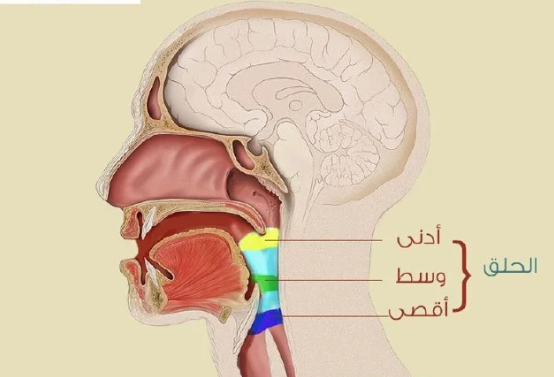
The Halq (حَلق — throat) produces six letters distributed across three anatomical positions: the deepest part of the throat, the middle, and the closest to the mouth.
A- Letters From the Deepest Throat Position (Aqsa al-Halq)
– Hamzah (ء) originates from the deepest point of the throat with complete glottal closure. Its attributes are: Jahrr, Shiddah, Istifal, Infitah, and Ismat. It carries Shiddah (complete obstruction of airflow), making it one of the strongest letters phonetically.
– Haa (هـ) shares the same deepest throat makhraj as Hamzah. Its attributes are: Hams, Rakhawah, Istifal, Infitah, and Ismat. The airflow continues without obstruction, distinguishing it sharply from Hamzah despite their shared origin point.
B- Letters From the Middle Throat Position (Wasat al-Halq)
– Ain (ع) originates from the middle of the throat. Its attributes are: Jahr, Bayniiyyah, Istifal, Infitah, and Ismat. The Bayniiyyah attribute — intermediate between Shiddah and Rakhawah — means airflow is partially restricted without being fully stopped.
– Haa (ح) shares the middle throat makhraj with Ain. Its attributes are: Hams, Rakhawah, Istifal, Infitah, and Ismat. Students frequently blur Haa and Khaa — a serious error. Haa carries Hams (voiceless airflow) and no Istila, while Khaa is produced closer to the mouth with Istila (elevation).
Before moving forward, if you are working on the interactions between these throat letters and Noon Sakinah or Tanween — the rule of Izhar applies specifically when Noon Sakinah meets any of the six throat letters. A full explanation is available in our Izhar full guide.
Shots Videos from Our Courses
Perfect Your Quran Recitation Today
Join expert-led Tajweed classes, and recite the Quran with confidence and clarity.
Start Your Free TrialC- Letters From the Closest Throat Position (Adna al-Halq)
– Ghain (غ) is produced at the closest part of the throat to the mouth. Its attributes are: Jahr, Rakhawah, Istila, Infitah, and Ismat. The Istila attribute causes the back of the tongue to rise, producing the characteristic “gargling” resonance non-Arabic speakers struggle to replicate.
– Kha (خ) shares the same closest throat position as Ghain. Its attributes are: Hams, Rakhawah, Istila, Infitah, and Ismat. The distinction between Ghain and Kha is voicing: Ghain carries Jahr (voiced), Kha carries Hams (voiceless).
3. Al-Lisan Letters: Tongue Articulation Across Multiple Positions
The tongue produces more letters than any other articulation zone. These letters are organized from the back of the tongue moving toward the tip.
A- Aqsa al-Lisan: The Two Back-Tongue Letters
– Qaf (ق) is produced at the very back of the tongue with elevation, meeting the upper palate. Its attributes are: Jahr, Shiddah, Istila, Infitah, Ismat, and Qalqalah. The Qalqalah attribute produces a distinctive echo-bounce when Qaf is vowelless or in waqf. For a detailed study of this attribute, see our guide on Qalqalah in Tajweed.
– Kaf (ك) is produced at the back of the tongue, slightly forward from Qaf’s position, meeting the upper palate. Its attributes are: Hams, Shiddah, Istifal, Infitah, and Ismat. The absence of Qalqalah and Jahr clearly distinguishes Kaf from Qaf — a pair non-Arabic speakers routinely confuse.
B- Wast al-Lisan: The Middle-Tongue Letters (Al-Huruf al-Shajariyah)
– Jim (ج) is produced from the middle of the tongue meeting the upper gum ridge. Its attributes are: Jahr, Shiddah, Istifal, Infitah, Ismat, and Qalqalah.
– Shin (ش) shares the middle tongue makhraj with Jim. Its attributes are: Hams, Rakhawah, Istifal, Infitah, Ismat, and Tafashi. The Tafashi attribute — meaning the spreading of air broadly across the palate — is unique to Shin and produces its characteristic “sh” dispersion sound.
– Ya (غير مدية — non-extended Ya) also originates from the middle tongue. Its attributes are: Jahr, Rakhawah, Istifal, Infitah, Ismat, and Lin when vowelless. The Lin attribute applies when Ya is sukoon preceded by a Fathah, creating the soft glide heard in words like “khawf” and “bayt.”
Read also: The Difference Between Shiddah, Tawassut, and Rakhawah in Tajweed
C- Al-Huruf al-Nutiyyah: Tip-of-Tongue Letters Meeting Upper Teeth Roots
– Taa (ط) is produced from the tip of the tongue meeting the roots of the upper front teeth. Its attributes are: Jahr, Shiddah, Istila, Itbaq, Ismat, and Qalqalah. The Itbaq attribute — full constriction between the tongue and palate — is one of four Itbaq letters and produces the distinctive heavy, pressed sound that distinguishes Taa from Dal.
– Dal (د) shares the same tip-of-tongue makhraj as Taa. Its attributes are: Jahr, Shiddah, Istifal, Infitah, Ismat, and Qalqalah. Without Istila and Itbaq, Dal sounds noticeably lighter — a critical distinction that affects the meaning of every word containing either letter.
– Taa (ت) is produced at the same anatomical point as Taa and Dal. Its attributes are: Hams, Shiddah, Istifal, Infitah, and Ismat. The voiceless Hams attribute sharply differentiates it from Dal (voiced, Jahr).
Perfect Your Quran Recitation Today
Join expert-led Tajweed classes, and recite the Quran with confidence and clarity.
Start Your Free TrialD- Al-Huruf al-Lathawiyah: Tip-of-Tongue Letters Meeting Upper Teeth Edges
– Dha (ظ) is produced from the tip of the tongue touching the edges (not roots) of the upper front teeth. Its attributes are: Jahr, Rakhawah, Istila, Itbaq, and Ismat. This is one of the most difficult letters for non-Arabic speakers — its Itbaq and Istila combination produces a heavy, voiced interdental sound with no English equivalent.
– Dhal (ذ) shares the same teeth-edge makhraj as Dha. Its attributes are: Jahr, Rakhawah, Istifal, Infitah, and Ismat. It is the voiced counterpart of Tha, with a lighter quality due to the absence of Istila and Itbaq.
– Tha (ث) is produced at the same teeth-edge position. Its attributes are: Hams, Rakhawah, Istifal, Infitah, and Ismat. It is the voiceless counterpart of Dhal — closest in sound to the English “th” in “think,” though the tongue placement in Arabic Tajweed is more precise and deliberate.
E- Al-Huruf al-Asaliyah: Letters From the Tongue Tip Above Lower Teeth
– Sad (ص) is produced from the tip of the tongue positioned above the lower front teeth, with a narrow channel allowing air to escape. Its attributes are: Hams, Rakhawah, Istila, Itbaq, Ismat, and Safir. The Safir attribute — a whistling resonance — is shared only with Sin and Za and requires conscious practice to produce accurately.
– Sin (س) shares the same tongue-tip makhraj as Sad. Its attributes are: Hams, Rakhawah, Istifal, Infitah, Ismat, and Safir. Its lighter quality compared to Sad is the direct result of lacking Istila and Itbaq.
– Za (ز) also originates from this tongue-tip position. Its attributes are: Jahr, Rakhawah, Istifal, Infitah, Ismat, and Safir. Za is the voiced counterpart of Sin — both carry Safir, but Za adds vocal cord vibration.
Read also: Isti’laa Vs Istifal In Tajweed
F- Al-Huruf al-Dhalqiyah: The Letters of the Tongue Edge and Tip
– Lam (ل) is produced from the nearest edge(s) of the tongue meeting the upper gum ridge. Its attributes are: Jahr, Bayniiyyah, Istifal, Infitah, Idhlaq, and Inhiraf. The Inhiraf attribute describes the slight lateral deflection of airflow, and Idhlaq marks Lam as one of six “easy-flowing” letters in Arabic phonology.
– Ra (ر) is produced from the tip of the tongue with some dorsal surface contact meeting the upper gum ridge. Its attributes are: Jahr, Bayniiyyah, Istifal, Infitah, Idhlaq, Inhiraf, and Takrir. The Takrir attribute — potential for trill/repetition — is something every student must be warned against: Ra can trill, but intentional rolling is forbidden in standard recitation. The tongue taps once, never vibrates repeatedly.
– Nun (ن) is produced from the tip of the tongue meeting the upper gum ridge. Its attributes are: Jahr, Bayniiyyah, Istifal, Infitah, and Idhlaq. Nun is inseparable from the Ghunnah (nasalization) — a phonetic attribute that appears prominently across multiple Tajweed rules. See our detailed guide on Ghunnah rules for full rule application.
– Dhad (ض): The Letter of Unique Arabic Articulation
Dhad (ض) is produced from one side of the tongue (the left side is typically easier) meeting the upper molars. Its attributes are: Jahr, Rakhawah, Istila, Itbaq, Ismat, and Istiitalah. The Istiitalah (elongation of contact along the tongue’s side) is exclusive to Dhad among all Arabic letters.
Classical scholars noted that Dhad is the most difficult Arabic letter for non-native speakers — so much so that Arabic was historically described as “the language of Dhad.” Most students at Learn Quran Tajweed Academy working through the Intermediate Tajweed Course spend dedicated weeks correcting Dhad before advancing, since confusing it with Dha (ظ) alters Quranic meaning.
Join our Intermediate Tajweed Course and get a free trial

Read Also: Tarqeeq Rules in Tajweed With Examples
4- Al-Shafatayn Letters: The Four Lip-Articulated Letters
The lips produce four letters, each with a distinct lip configuration and phonetic character.
– Fa (ف) is produced from the inner surface of the lower lip meeting the edges of the upper front teeth. Its attributes are: Hams, Rakhawah, Istifal, Infitah, and Idhlaq.
– Ba (ب) is produced from both lips pressing together and releasing. Its attributes are: Jahr, Shiddah, Istifal, Infitah, Idhlaq, and Qalqalah. The Qalqalah in Ba creates a noticeable bounce at stop positions.
– Mim (م) is also produced from both lips pressing together. Its attributes are: Jahr, Bayniiyyah, Istifal, Infitah, and Idhlaq. Mim carries the Ghunnah nasalization — a sound that flows through the nose simultaneously with lip closure. This nasalization governs rules like Iqlab and the rules of Meem in Tajweed.
– Waw (غير مدية — non-extended Waw) is produced from both lips with an open (not pressed) configuration. Its attributes are: Jahr, Rakhawah, Istifal, Infitah, Ismat, and Lin when vowelless. Like Ya, it carries the Lin attribute when sukoon follows a Fathah.
Read Also: The Rules of Heavy and Light Letters in Tajweed (Tafkheem and Tarqeeq)
5- Al-Khayshum: The Nasal Passage and the Ghunnah
Al-Khayshum (الخيشوم) — the nasal passage — is the makhraj of Ghunnah (الغنة), the nasalization that accompanies Mim and Nun in specific phonetic conditions. Ghunnah is not a letter — it is a phonetic attribute with its own dedicated articulation point.
When Mim or Nun are doubled (Mushaddad), in Ikhfa, or in Idgham with Ghunnah, the nasalization resonates specifically through the nasal passage for two counts (two harakah duration).
A simple self-check: pinch your nose while producing the Ghunnah — the resonance should be noticeably affected, confirming the Khayshum is engaged. For complete rule application of Noon Sakinah and Tanween, see our guide on Noon Sakinah rules.
Our Students Reviews
Perfect Your Quran Recitation Today
Join expert-led Tajweed classes, and recite the Quran with confidence and clarity.
Start Your Free TrialRead Also: Difference Between Tafkheem and Tarqeeq With Examples
The Most Common Makharij Errors Non-Arabic Speakers Make
In years of working with students at Learn Quran Tajweed Academy, certain Makharij errors appear with near-universal consistency among non-Arabic speaking learners. Identifying these early prevents months of embedded mispronunciation.
| Confused Pair | Common Error | Correct Distinction |
| Ain (ع) / Hamzah (أ) | Producing Ain as a plain glottal stop | Ain requires partial throat constriction (Bayniiyyah); Hamzah is a full stop |
| Haa (ح) / Kha (خ) | Replacing both with a single “h” sound | Haa is from mid-throat voiceless; Kha is from upper throat with Istila |
| Sad (ص) / Sin (س) | Using Sin for both | Sad requires tongue elevation and full palate contact (Itbaq) |
| Dhad (ض) / Dha (ظ) | Treating them as identical | Dhad uses tongue side/molars with Istiitalah; Dha uses tongue tip/teeth edges |
| Qaf (ق) / Kaf (ك) | Producing Qaf as a back-palate “k” | Qaf requires fuller back-tongue elevation with audible Qalqalah |
| Ta (ط) / Ta (ت) | Producing both identically | Ta carries Istila and Itbaq producing heaviness; Ta is light and voiceless |
Before correcting jaw position and tongue placement in students struggling with Ain, almost every learner initially produces it as a plain “a” vowel with no pharyngeal constriction at all.
The correction comes through sustained, isolated practice with an instructor’s immediate audio feedback — not through written description alone.
Meet One of our Certified Teachers to Correct Your Pronunciation

Read Also: Tafkheem Rules in Tajweed With Examples
Begin Mastering Makharij al-Huruf With Certified Instruction at Learn Quran Tajweed Academy
Correct Makharij mastery cannot be self-taught from text alone — it requires trained ears and live correction.
Learn Quran Tajweed Academy offers:
- Ijazah-certified instructors specializing in Hafs ‘an ‘Asim recitation
- Personalized 1-on-1 sessions tailored to each student’s articulation level
- Flexible scheduling available 24/7 for global students
- Structured progression from foundational Makharij to full Tajweed Ijazah certification
- Specialized Tajweed focus — not a generalist Quran platform
Book your FREE trial lesson today and receive personalized Makharij assessment from a certified instructor. Insha’Allah, this is the step that changes your recitation permanently.
Check out the best tajweed course for your needs:
- Practical Tajweed Course
- Beginner Tajweed Course
- Intermediate Tajweed Course
- Advanced Tajweed Course
- Quran Tarteel Course
- Tajweed Ijazah Program
- Tajweed Course for Sisters
- Tajweed course for Kids
Book your free trial Tajweed lesson today

Conclusion
Every Tajweed rule a reciter applies — from Ghunnah to Qalqalah to Madd — ultimately depends on letters being produced from their correct articulation points. Makharij al-Huruf is not a preliminary chapter to pass through quickly; it is the permanent infrastructure beneath all recitation accuracy.
Alhamdulillah, this science is learnable for any sincere student willing to engage with real instruction. The seventeen articulation points, understood correctly and practiced consistently, transform recitation from approximate reading into precise, reverent engagement with the Quran’s words as they were revealed.
Perfect Your Quran Recitation Today
Join expert-led Tajweed classes, and recite the Quran with confidence and clarity.
Start Your Free TrialRead Also: Arabic Tajweed Letters
Frequently Asked Questions About Makharij al-Huruf and Arabic Alphabet Pronunciation
How Many Makharij (Articulation Points) Are There in Tajweed Scholarship?
Classical Tajweed scholars identify seventeen distinct articulation points grouped within five main zones: the oral cavity (Jawf), throat (Halq), tongue (Lisan), lips (Shafatayn), and nasal passage (Khayshum). Some scholars cite sixteen points, as a minority view combines certain positions, but seventeen is the accepted standard in Hafs ‘an ‘Asim scholarship.
Can Mispronouncing a Makhraj Change the Meaning of a Quranic Verse?
Yes — and this is precisely why Makharij mastery is treated as an obligation in Tajweed scholarship. Replacing Ain (ع) with Hamzah (أ), or Sad (ص) with Sin (س), produces different Arabic words entirely. In Quranic recitation, such substitutions can alter the intended divine meaning, making correct articulation a matter of religious precision, not merely phonetic preference.
What Is the Difference Between Makhraj and Sifah in Tajweed?
Makhraj is the physical anatomical point where a letter originates — the where of articulation. Sifah (attribute) describes the phonetic quality of that letter — the how of its sound production. Both must be correct simultaneously: a letter produced from the right point but with the wrong attribute (for example, Qaf without Qalqalah) is still incorrectly recited.
Is It Possible to Learn Makharij Without a Live Tajweed Teacher?
Written guides and audio recordings can support learning, but they cannot replace live, certified instruction for Makharij mastery. Articulation errors are often inaudible to the learner themselves — they require a trained instructor’s ear to detect and correct. Most students at Learn Quran Tajweed Academy discover their first significant makhraj error only after their first live session with a certified Qari.
Which Arabic Letters Are Most Difficult for Non-Arabic Speakers to Pronounce Correctly?
Consistently, the most challenging letters for non-Arabic speakers are Ain (ع), Ghain (غ), Haa (ح), Dhad (ض), Sad (ص), and Qaf (ق). These letters have no phonetic equivalent in English or most European languages. Dedicated Makharij training — particularly through programs like the Practical Tajweed Course at Learn Quran Tajweed Academy — is the most effective path to accurate pronunciation.