 Tajweed Basics
Have you ever wondered how a single sentence spoken in Madinah more than fourteen centuries ago reached your bookshelf today, with the name of every person who carried it still attached?
That is the work of the sanad chain, and it is one of the most remarkable record-keeping systems any civilization has produced.
For anyone learning Quran or Arabic, the sanad chain is not a museum piece. It is the reason your teacher can tell you exactly where their recitation came from, and it is the standard that separates verified religious knowledge from hearsay.
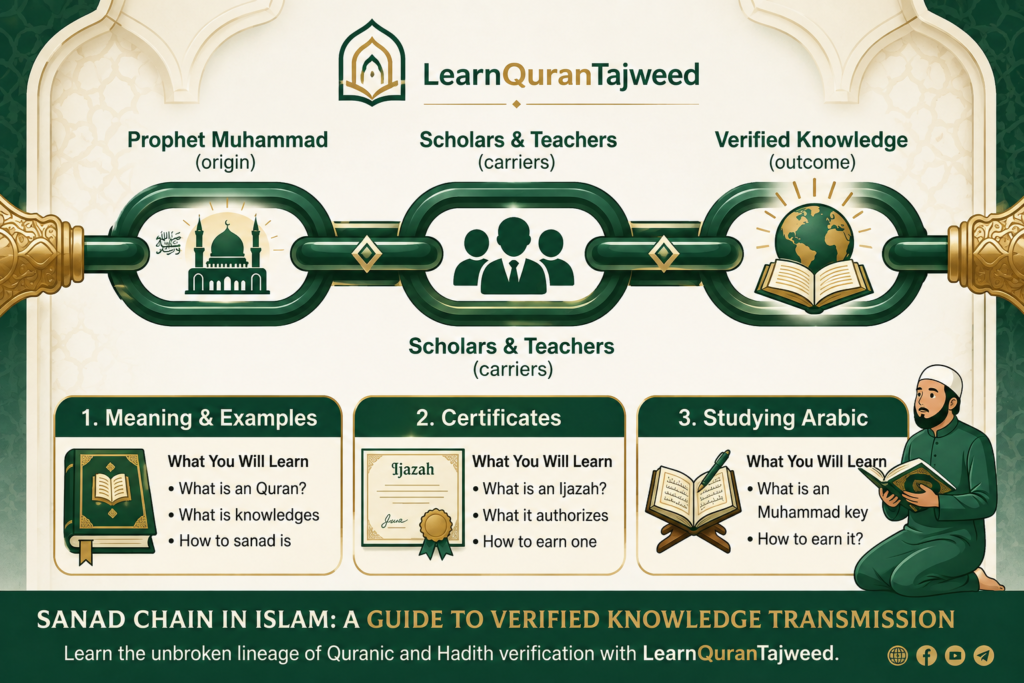
In this guide, you will learn what sanad means in Islam, how a sanad chain is built and evaluated, what a real hadith chain looks like line by line, and what a sanad certificate (ijazah) actually certifies.
By the end, you will also understand why studying Arabic is the key that unlocks these chains for yourself, instead of reading about them from a distance.
Take Away — What You Will Learn
- What the word sanad means in Islam and how it differs from isnad and matn.
- How scholars built, checked, and graded a sanad chain narrator by narrator.
- A complete, real example of a sanad hadith taken from Sahih al-Bukhari.
- What a sanad certificate (ijazah) is, what it authorizes, and how students earn one.
- Why Arabic literacy is the practical entry point into the whole science of transmission.
What Is a Sanad Chain?
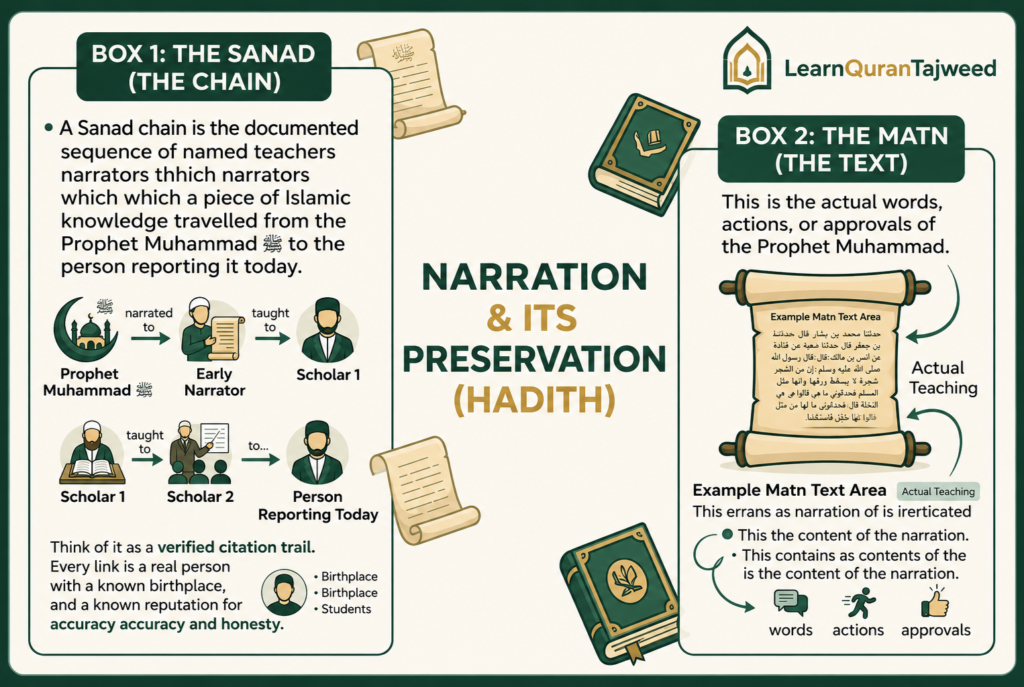
A sanad chain is the documented sequence of named teachers and narrators through which a piece of Islamic knowledge travelled from the Prophet Muhammad ﷺ to the person reporting it today.
Think of it as a verified citation trail. Every link is a real person with a known birthplace, known teachers, known students, and a known reputation for accuracy and honesty.
The Two Parts of Every Report
Classical scholars split each narration into two components. The sanad is the chain of transmitters, while the matn is the actual wording being transmitted.
Both parts are examined separately. A beautiful text with a broken chain is treated with caution, and a flawless chain attached to a contradictory text is also questioned.
Why Muslims Built This System
The chain existed to protect the message from unintentional error and deliberate invention. Because the Quran and Sunnah shape law, worship, and ethics, an unverified report carries real consequences.
Within two centuries, an entire discipline had grown up around it: biographical dictionaries cataloguing tens of thousands of narrators, their dates, their travels, and their reliability ratings.
How a Chain Was Graded
Scholars assessed each transmitter for two qualities: moral integrity (‘adalah) and precision of memory (dabt). They also checked that consecutive narrators actually met.
Chains with unbroken contact and trustworthy narrators throughout were classed as sahih (sound). Weaker links produced grades such as hasan (fair) or da’if (weak).
This vocabulary — muttasil, marfu’, mursal, mutawatir — is Arabic terminology with no clean English equivalent, which is exactly why serious students of the tradition invest in the language first.
What Is Sanad in Islam?
In Islam, sanad (سَنَد) literally means “support” or “something you lean on,” and technically it means the chain of authorities that supports the authenticity of a transmitted text.
The word appears across several Islamic sciences, not only in hadith. Its role changes slightly depending on what is being transmitted, so it helps to see each context clearly.
a. Sanad in the Science of Hadith
Here, the sanad is the list of narrators placed before the Prophet’s words. Scholars conventionally recite it in reverse order, from the most recent teacher back to the Companion who heard the statement directly.
The related word isnad refers to the act of attributing a report to its chain. In everyday usage, the two terms overlap, and many writers treat them as interchangeable.
b. Sanad in Quran Recitation
Recitation carries its own chains. Every canonical reading — Hafs ‘an ‘Asim, Warsh ‘an Nafi’, and the others — is preserved through a named line of reciters reaching back to the Prophet ﷺ.
This is why a qualified Quran teacher can name their silsilah, their unbroken line of recitation teachers. It is also why recitation is still taught face to face rather than from recordings alone.
c. Sanad in Books and Manuscripts
Scholars did not simply read books; they read them with a teacher and recorded that session. A manuscript’s sanad shows who read it to whom, in which city, and in which year.
If you have ever wanted to trace your own line of teachers, the first practical step is comfort with Arabic names, titles, and phrasing — the skill our Arabic classes are built to give you. Reading a chain such as haddathana … ‘an … qala becomes routine once the grammar clicks.
See Our Classrooms in Action
Watch these short clips from our live, interactive Quran courses to see how our students learn and interact with our expert tutors.
Perfect Your Quran Recitation Today
Join expert-led Tajweed classes, and recite the Quran with confidence and clarity.
Start Your Free TrialExample of Sanad Hadith
The clearest example of sanad hadith is the opening narration of Sahih al-Bukhari, the hadith on intentions, whose chain runs through six named transmitters before reaching the Prophet ﷺ.
Below is the chain laid out link by link, followed by the text it carries, so you can see how the two halves fit together.
a. The Chain, Link by Link
Al-Humaydi ‘Abdullah ibn al-Zubayr narrated to us → Sufyan ibn ‘Uyaynah narrated to us → Yahya ibn Sa’id al-Ansari informed us → Muhammad ibn Ibrahim al-Taymi → ‘Alqamah ibn Waqqas al-Laythi → ‘Umar ibn al-Khattab → the Prophet Muhammad ﷺ.
Six intermediaries, each one a documented figure in the biographical literature. Al-Bukhari recorded this chain in the 3rd Islamic century, roughly two hundred years after the words were spoken.
b. The Text It Carries
The matn reads: “Actions are only by intentions, and every person will have only what he intended…” — a statement that anchors the entire Islamic understanding of sincerity in worship.
Notice the proportion. The chain occupies as much space as the teaching itself, which tells you how seriously provenance was treated.
c. The “Golden Chain”
Some chains became famous for the calibre of their narrators. The best known is Ahmad ibn Hanbal → al-Shafi’i → Malik ibn Anas → Nafi’ → Ibn ‘Umar, nicknamed silsilat al-dhahab, the golden chain.
Four consecutive scholars of the highest rank made any report through this route exceptionally strong in the eyes of hadith critics.
d. Reading Chains in the Original
English translations usually compress or omit the chain entirely. To read one in full, you need the transmission verbs, the particles, and the honorific formulas — all of them Arabic.
Students in our Tarteel programs reach this point sooner than they expect, because the language of chains is formulaic and highly repetitive once you know the pattern.
Inside Learn Quran Tajweed Academy
Curious about how online learning works? Peek inside our actual Quran classes and hear the beautiful recitation of our students and teachers.
Perfect Your Quran Recitation Today
Join expert-led Tajweed classes, and recite the Quran with confidence and clarity.
Start Your Free TrialWhat Is a Sanad Certificate?
A sanad certificate, better known as an ijazah, is a written license issued by a qualified teacher authorizing a named student to transmit a specific text or recitation onward, listing the full chain back to the Prophet ﷺ.
It is a permission, not a diploma in the modern sense. The authority rests with the individual teacher who signs it, not with an institution.
What the Certificate Contains
A typical ijazah names the student, names the text or reading, records the date and place of completion, and then sets out the teacher’s own chain of transmission in sequence.
Some Quranic ijazah documents list thirty or more generations of reciters. The student’s name is added as the newest link in that line.
How Students Earn One
For the Quran, the student normally recites the entire text to the teacher from memory, with correct tajweed, and is corrected until the recitation is faultless.
The teacher then judges readiness. Because the chain is personal, no teacher signs lightly — their own reputation travels with every certificate they issue.
Ijazah and the History of Certification
Historians have noted that the ijazah tradition predates European academic degrees and may have influenced them, though the comparison is debated. The key difference is that an ijazah certifies a relationship, not a course completion.
If earning one is your long-term goal, treat Arabic as part of the preparation rather than an optional extra. Comfortable Arabic makes the memorization lighter, the tajweed rules more logical, and the teacher’s feedback immediately understandable.
Start Your Arabic Journey and Read the Sanad for Yourself
Join live one-to-one Arabic classes at Learn Quran Tajweed and move from reading about the sanad chain to reading it in the original.
Whether you’re just starting or aiming for mastery, our comprehensive online programs are designed to help you recite the Quran with confidence, accuracy, and beauty. Join thousands of students worldwide who are transforming their recitation through expert guidance and personalized support.
Courses we offer:
- Tajweed Course for Kids
- Tajweed Course for Adults
- Tajweed Course for Ladies
- Tajweed ul Quran Course
- Quran Recitation with Tajweed Course
- Quran Tarteel Course
- Tajweed Ijazah Program
Our qualified native teachers build your Quranic and Modern Standard Arabic step by step, at your pace, on your schedule — with a free trial session so you can meet your teacher before you commit.
Perfect Your Quran Recitation Today
Join expert-led Tajweed classes, and recite the Quran with confidence and clarity.
Start Your Free TrialConclusion
The sanad chain is Islam’s system for proving where knowledge came from: a named, checkable sequence of teachers stretching from today back to the Prophet ﷺ.
We saw that sanad means the supporting chain while matn means the transmitted text, and that the same principle governs hadith, Quran recitation, and classical manuscripts alike.
The example of sanad hadith from Sahih al-Bukhari showed six documented narrators standing behind one short sentence, and the sanad certificate — the ijazah — showed how a living student becomes the newest link in that line.
Takeaway Message: the sanad chain is not just history to be admired; it is an invitation to join it. And the door into it is Arabic — the language every link in the chain actually spoke.
FAQs
What is the difference between sanad and isnad?
Sanad refers to the chain of narrators itself, while isnad refers to the act of tracing or attributing a report to that chain.
Is the sanad chain used for the Quran as well as hadith?
Yes. Every canonical Quranic reading is preserved through a named chain of reciters, and teachers still transmit recitation face to face so the chain stays unbroken and verifiable.
Can a hadith be rejected because of its sanad alone?
It can be downgraded on that basis. If a link is missing, or a narrator is known for weak memory or unreliability, the report is classed as weak regardless of how appealing its wording sounds.
How long does it take to earn a sanad certificate in Quran?
It varies widely with memorization level, tajweed accuracy, and study hours per week — commonly two to five years for full-Quran ijazah. Strong Arabic and consistent weekly sessions shorten the road considerably.
Do I need to know Arabic to study sanad chains?
For serious study, yes. Chains, transmission verbs, and grading terminology exist only in Arabic, and translations almost always drop them, so Arabic is the practical prerequisite.
Is a sanad certificate recognized outside Islamic studies?
It is a religious authorization rather than an academic degree, so recognition sits within Islamic scholarly and teaching circles. Within those circles, it carries considerable weight, especially for anyone who wants to teach Quran.
Related Articles
Tajweed Basics