 Tajweed Rules
Idhlaaq vs Ismat in Tajweed is a comparison every serious Quran student eventually runs into, usually while memorizing the sifaat (letter characteristics) chart. Idhlaaq and Ismat differ from other qualities such as jahr and hams because they don’t change how a letter sounds when you recite.
Idhlaaq vs Ismat exist for a different reason. They help scholars tell whether a four- or five-letter Arabic word is genuinely Arabic or borrowed from another language.
This article breaks down what Idhlaaq (flowing) and Ismat (withholding) actually mean. You’ll learn which letters belong to each group, and why classical scholars built an entire rule around them. You’ll also learn real examples of Quranic words identified as foreign through this precise test.
What You’ll Learn In This Article
- The linguistic and technical definitions of Idhlaaq and Ismat
- The six Idhlaaq letters and the twenty-three Ismat letters
- Whether Idhlaaq and Ismat change how you pronounce a letter during recitation
- The rule linking these sifaat to identifying non-Arabic words in the Quran
- Why some Tajweed scholars leave these two sifaat out of their books entirely
What Is Idhlaaq (Flowing) In Tajweed?
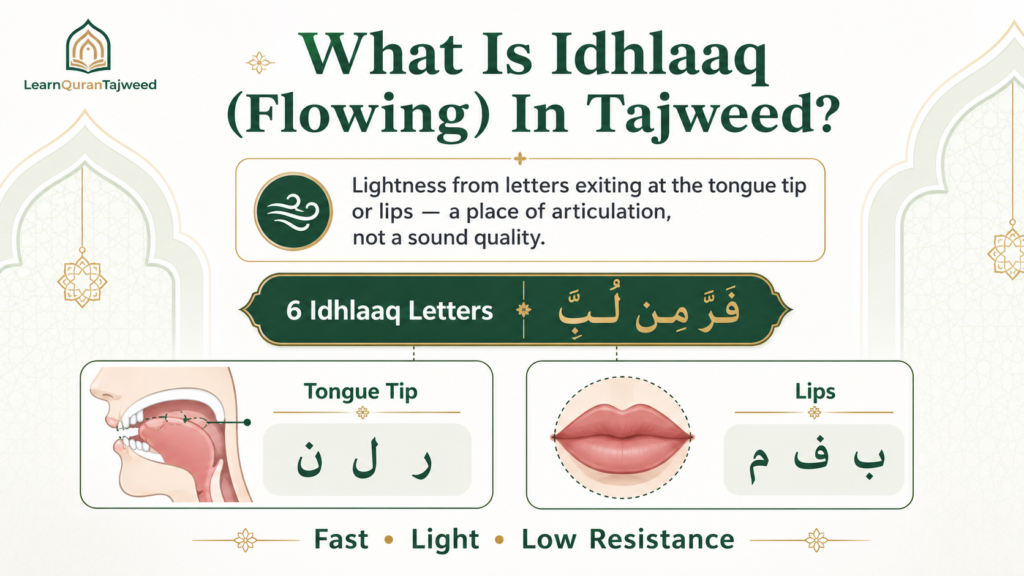
Idhlaaq is one of two opposite letter characteristics that describe how the letter exits the mouth relative to the tongue tip and lips, not how it sounds. If you understand its root meaning first, the technical definition will be easier to hold onto.
The Linguistic And Technical Meaning Of Idhlaaq
Idhlaaq is a linguistic characteristic before it is a technical one. In the Arabic language, “dhalaqa” means fluency, sharpness, and quickness of the tongue. The same root gives you “dhaliq al-lisan,” a sharp-tongued and articulate speaker.
Technically, Idhlaaq describes the lightness of a letter that results from it exiting the very tip (dhalq) of the tongue or the edge of the lips. Notice that Letters produced this way come out faster and with less resistance than letters formed deeper in the mouth.
Read also: The History of Tajweed
The Six Idhlaaq Letters And How To Remember Them
The Idhlaaq letters are six: ب
(baa), ر (raa), ف (faa), ل (laam), م (meem), and ن (noon)
Tajweed Scholars grouped them into the mnemonic phrase “Farra min lubb” (فَرَّ مِن لُبٍّ). This phrase contains all six letters in order.
These six are divided into two smaller groups based on exit point. Three exit from the tip of the tongue: ر, ل, ن, and three exit from the lips: ب, ف, م.
When you learn them as two groups of three, rather than one list of six, the recall will be far more reliable during a live recitation session.
That is exactly the kind of drilling a certified Tajweed instructor at Learn Quran Tajweed builds into one-on-one sessions until the grouping becomes automatic.
See Our Classrooms in Action
Watch these short clips from our live, interactive Quran courses to see how our students learn and interact with our expert tutors.
Perfect Your Quran Recitation Today
Join expert-led Tajweed classes, and recite the Quran with confidence and clarity.
Start Your Free TrialWhat Is Ismat (Withholding) In Tajweed?
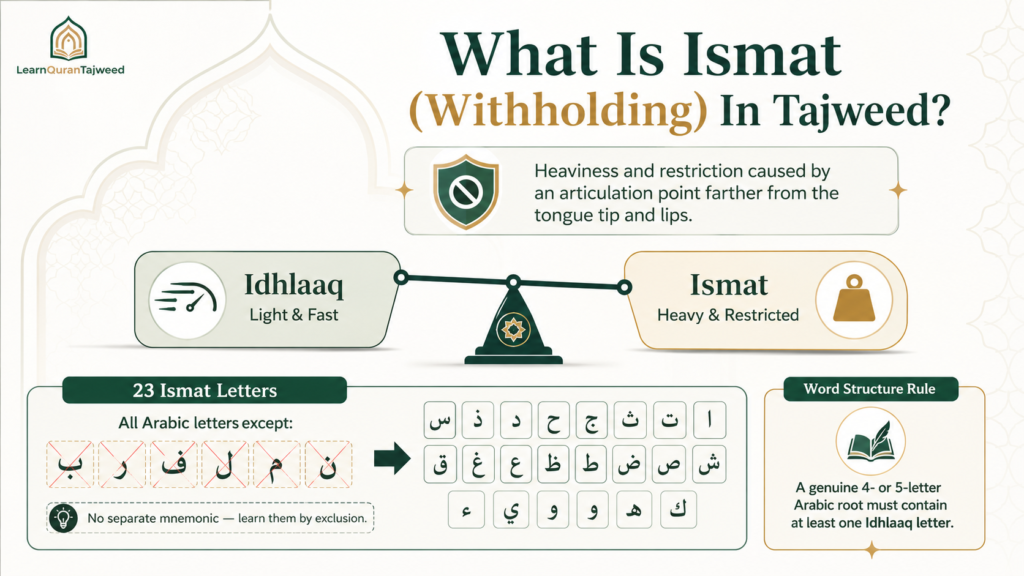
Ismat is the direct opposite of Idhlaaq. Its definition only makes sense once Idhlaaq is clear. Idhlaaq describes lightness and speed, while Ismat describes heaviness and restriction.
The Linguistic And Technical Meaning Of Ismat
In the Arabic language, the verb (fi’l) “samata” means to withhold or prevent, the same root behind “samt,” silence, as a silent person withholds speech.
Technically, Ismat means the heaviness of a letter caused by its exit point being farther from the tongue tip and lips than the Idhlaaq letters.
Classical scholars added a second layer to this definition. They said that Ismat also names the restriction that prevents a genuine four- or five-letter Arabic root from being built entirely out of Ismat letters. At least one Idhlaaq letter must appear to balance the word’s overall weight.
The Twenty-Three Ismat Letters
Every Arabic letter that isn’t one of the six Idhlaaq letters belongs to the Ismat group. Ismat letters are twenty-three in total.
There’s no separate mnemonic for this group. It’s simply the remainder of the alphabet once ب ر ف ل م ن are removed.
Read also: How to Improve Tajweed?
The Difference Between Idhlaaq And Ismat
There is a main difference between Idhlaaq and Ismat comes down to the exit point and resulting weight. Idhlaaq letters are produced from the tongue tip or lip edge and are pronounced quickly and lightly. Ismat letters are produced farther back and are pronounced with more effort and heaviness.
That single distinction, light versus heavy, based on where the letter is articulated, is what classical scholars, such as Ibn Jinni, used as the dividing line between the two groups.
Later grammarians relied on the same distinction when building the four/five-letter root rule described below.
Do Idhlaaq And Ismat Affect Quran Recitation?
No, Idhlaaq and Ismat do not affect how a letter is pronounced during Quran recitation. They rather belong to the category of “relative” (idafiyyah) characteristics (sifaat), tied to a letter’s exit point and morphological role, rather than “essential” (dhatiyyah) sifaat like jahr, hams, shiddah, and rakhawah, which do change the actual sound.
This is why a Quran reciter can produce a perfect, tajweed-correct recitation without ever consciously thinking about whether a letter is Idhlaaq or Ismat.
The classification exists for linguistic and lexicographic study, to sort genuine Arabic vocabulary from borrowed words. It does not aim to guide the mouth during recitation.
If you’re focused on the sifaat that do shape your recitation, a structured Tajweed course from Learn Quran Tajweed walks you through jahr, hams, shiddah, and rakhawah with live correction, which is where recitation accuracy actually comes from.
Read also: What Is Hams In Tajweed?
The Ismat Rule And Foreign Words In The Quran
Ismat produces a practical rule that scholars have used for centuries to test whether an Arabic word is native or borrowed, beyond defining a single letter’s weight.
Why Does A Four- Or Five-Letter Arabic Root Need An Idhlaaq Letter?
The rule declares that a genuine four-letter or five-letter Arabic root word cannot consist entirely of Ismat letters. It states that at least one of the six Idhlaaq letters must appear somewhere in the word to offset the cumulative heaviness of the Ismat letters.
There is a logical reason behind this, which is phonetic balance. Arabic speakers naturally avoided stacking multiple heavy letters together in longer root words. As a result, any word that violates this pattern stands out as unnatural to native Arabic word formation.
Examples Of Foreign-Origin Words Identified Through This Rule
Classical scholars such as As-Suyuti and Ibn Jarir At-Tabari applied this rule to specific words in the Quran and concluded that several were originally foreign, then absorbed into Arabic through common use.
A word like إستبرق (thick silk brocade) is Persian in origin, سجّيل (baked clay) is Persian, and سرادق (an enclosing canopy) is also Persian.
مشكاة (a niche in a wall) traces to Abyssinian origin, and قسطاس (a balance or scale) traces to Greek. Proper names such as إبراهيم, إسماعيل, إسحاق, and نوح fall into the same category, as long as foreign personal names were never expected to follow native Arabic root patterns in the first place.
It’s notable that the rule works in one direction only: it can prove a word is foreign when it lacks any Idhlaaq letter, but the presence of an Idhlaaq letter doesn’t automatically prove a word is originally Arabic. Scholars and linguists treat it as a strong indicator, not an absolute test in every case.
Read also: Lahn in Tajweed: Types, Rulings, and How to Correct Your Recitation
Why Some Tajweed Scholars Omit Idhlaaq And Ismat?
Not every classical Tajweed text necessarily includes Idhlaaq and Ismat in its list of letter characteristics. The reason is worth understanding rather than glossing over. These two sifaat don’t distinguish between letters at the level of actual sound production, unlike jahr/hams or shiddah/rakhawah.
Ghanim Qaduri and other scholars in Tajweed literature have noted that Idhlaaq and Ismat carry no acoustic distinguishing power. That’s why some earlier scholars and modern phoneticians left them out of their sifaat lists without straying from sound methodology.
Authors who do include them are generally doing so not because reciters need the classification to perfect their pronunciation, but for lexicographic completeness.
That’s a useful thing to know if you’re memorizing a sifaat chart and wondering why two different books don’t match; the discrepancy is not an error in either source, but a documented scholarly position.
Recognizing which sifaat actually change your pronunciation and which ones are purely academic saves real study time. That kind of prioritization, knowing what to drill and what to simply understand, is exactly what a one-on-one Tajweed teacher at Learn Quran Tajweed can map out for you from your very first session.
Read also: Best Tajweed Books
Inside Learn Quran Tajweed Academy
Curious about how online learning works? Peek inside our actual Quran classes and hear the beautiful recitation of our students and teachers.
Perfect Your Quran Recitation Today
Join expert-led Tajweed classes, and recite the Quran with confidence and clarity.
Start Your Free TrialStart Reciting With Confidence Today
You don’t need to memorize every classification in Tajweed theory to recite the Quran beautifully and correctly — you need a teacher who tells you which rules change your pronunciation and which ones don’t.
Learn Quran Tajweed connects you with certified, native Arabic-speaking instructors for live, one-on-one online classes that focus on the sifaat and makharij that actually shape your recitation, with real-time correction in every session.
Courses we offer:
- Online Tajweed Classes
- Learn Quran with Tajweed Online
- Beginner Tajweed Course
- Intermediate Tajweed Course
- Advanced Tajweed Course
- Amali (Practical) Tajweed Course
- Tajweed Course for Kids
- Tajweed Course for Adults
- Tajweed Course for Ladies
- Tajweed ul Quran Course
- Quran Recitation with Tajweed Course
- Quran Tarteel Course
- Tajweed Ijazah Program
Conclusion
Idhlaaq and Ismat are opposite letter characteristics: Idhlaaq covers six light, fast-exiting letters (ب ر ف ل م ن), while Ismat covers the remaining twenty-three, heavier letters.
Neither changes how you pronounce a letter in recitation — their real value lies in a centuries-old rule that helps scholars identify genuine Arabic words versus foreign loanwords like إستبرق, سجّيل, and مشكاة found in the Quran.
The one takeaway to carry forward from Idhlaaq vs Ismat in Tajweed is this: not every sifah exists to correct your tongue. Some exist to explain the language itself, and knowing the difference helps you study Tajweed more efficiently rather than treating every classification as equally urgent for your recitation.
Frequently Asked Questions
What Are The Six Idhlaaq Letters In Tajweed?
The six Idhlaaq letters are ب, ر, ف, ل, م, and ن, remembered through the phrase “Farra min lubb.” Three exit from the tongue tip (ر ل ن) and three from the lips (ب ف م).
Does Idhlaaq Or Ismat Change How I Pronounce A Letter?
No, neither Idhlaaq nor Ismat changes a letter’s pronunciation during recitation. They are relative sifaat used for lexical classification, not essential sifaat like jahr or hams that affect the actual sound.
What Is The Ismat Rule About Arabic Words?
The Ismat rule states a genuine four- or five-letter Arabic root cannot be made up entirely of Ismat letters; it must contain at least one Idhlaaq letter to balance the word’s weight.
Are There Foreign Words In The Quran Identified Through This Rule?
Yes, words such as إستبرق, سجّيل, سرادق, مشكاة, and قسطاس are considered foreign in origin because they lack any Idhlaaq letter in their four- or five-letter structure.
Why Do Some Tajweed Books Leave Out Idhlaaq And Ismat?
Some scholars omit them because they don’t distinguish letters acoustically the way jahr/hams or shiddah/rakhawah do, making them lexicographically useful but not essential to correct pronunciation.
Related Articles
Tajweed Rules