 Quran
Rawm in Tajweed is a special way of stopping on a Quranic word while preserving a faint audible trace of its final Dammah or Kasrah. Instead of pronouncing the final vowel fully or removing it completely, the reciter produces only a small portion of the vowel.
Traditionally, Tajweed scholars describe this remaining portion as approximately one-third of the original vowel, pronounced quietly enough for a nearby attentive listener to hear but not someone farther away.
Although the rules of Rawm in Tajweed can be explained in writing, its exact sound cannot be mastered from definitions alone. Like other precise recitation techniques, Rawm is fundamentally learned through Talaqqi and Mushafahah—direct listening and correction from a qualified Quran teacher.
This guide explains where Rawm is allowed, where it is prohibited, how to perform it correctly, and the important difference between Rawm vs Ishmam.
What You’ll Learn
- The exact definition of Rawm in Tajweed
- How to perform Rawm when stopping on Quranic words
- Which final vowels accept Rawm and which do not
- How Rawm affects Madd, Tanween, and Ha Al-Kinayah
- The practical difference between Rawm and Ishmam
What Is Rawm in Tajweed?
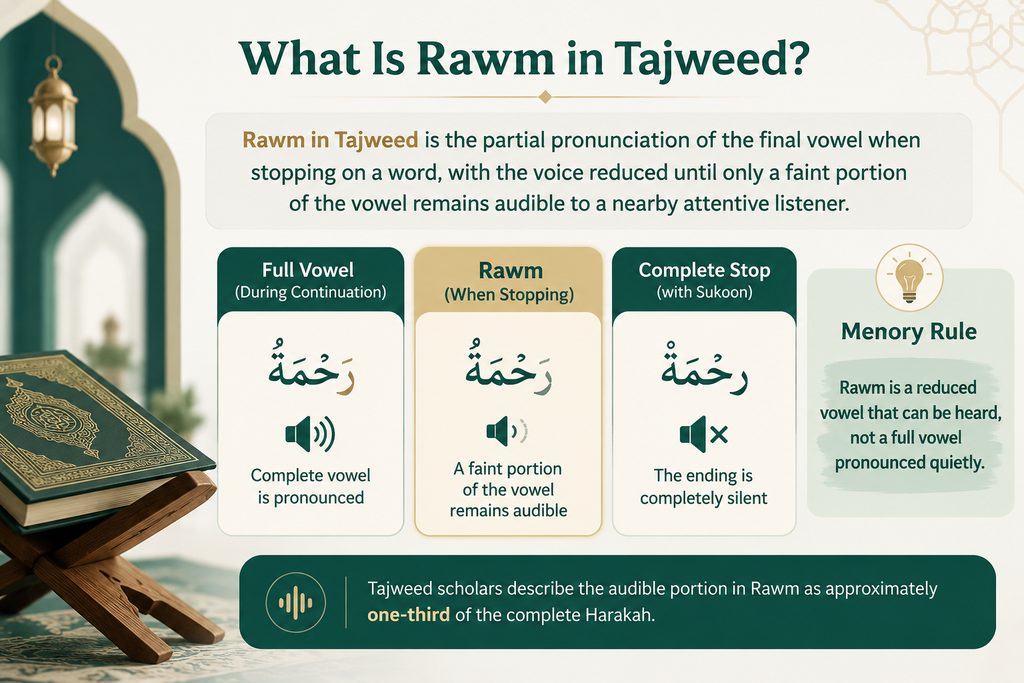
Rawm in Tajweed is the partial pronunciation of the final vowel when stopping on a word, with the voice reduced until only a faint portion of the vowel remains audible to a nearby attentive listener.
Tajweed scholars commonly describe the audible portion as approximately one-third of the complete Harakah. Most of the vowel disappears, but the reader does not make the ending completely silent.
This gives Rawm a specific function: it allows the listener to recognize the original grammatical or vocalic ending of a word even though the reciter is stopping.
For example, if a word ends with an original Dammah during continuation, Rawm allows the reciter to retain a very faint portion of that Dammah rather than stopping with complete Sukoon.
A useful memory rule is:
Rawm is a reduced vowel that can be heard, not a full vowel pronounced quietly.
That distinction matters. Simply lowering the volume of a complete Dammah or Kasrah does not produce correct Rawm.
Rules of Rawm in Tajweed When Stopping
The rules of Rawm in Tajweed depend primarily on the original final vowel of the word. Rawm applies to certain endings with Dammah or Kasrah, but it does not apply indiscriminately to every word on which a reader stops. Understanding the original movement of the final letter is therefore essential before deciding whether Rawm is available.
When Is Rawm Allowed?
Rawm can occur with an original Dammah or Kasrah, including relevant grammatical endings in inflected words and original Dammah or Kasrah in indeclinable words.
In traditional grammatical terminology, this includes appropriate:
- Marfu‘ (مرفوع) endings with Dammah
- Majrur (مجرور) endings with Kasrah
- Mabni (مبني) words whose relevant ending has an original Dammah or Kasrah
The critical word here is original. A temporary vowel introduced only because of pronunciation circumstances does not automatically qualify for Rawm. Knowing when Rawm is permitted requires more than recognizing Dammah and Kasrah on the page.
At Learn Quran Tajweed, the Practical Tajweed Course helps students apply stopping rules through guided recitation, direct pronunciation correction, and practical examples from the Quran.
Develop the confidence to identify when Rawm is allowed and perform it accurately through teacher-guided Tajweed practice.

When Is Rawm Not Allowed?
Rawm is not used simply because a letter happens to carry a vowel during connected recitation. Several endings are excluded.
| Ending or situation | Rawm? | Why? |
| Original Dammah | Yes | Dammah accepts partial pronunciation |
| Original Kasrah | Yes | Kasrah accepts partial pronunciation |
| Fatha | No | Fatha is not subject to Rawm |
| Original Sukoon | No | There is no vowel to reduce |
| Temporary Dammah | No | The vowel is not an original ending |
| Temporary Kasrah | No | The vowel disappears when its cause disappears |
A common learner error is therefore to see Dammah or Kasrah in the Mushaf and assume that Rawm is automatically possible. The origin of the vowel matters, not merely its visible shape.
Why Does Rawm Not Occur With Fatha?
Rawm does not apply to a final Fatha because the Fatha is treated as too light to be divided in the manner required for Rawm.
Rawm depends on preserving only a reduced portion of a vowel. The accepted application therefore concerns Dammah and Kasrah, not Fatha. This immediately gives students a useful decision test: if the relevant final movement is Fatha, do not perform Rawm.
See Our Classrooms in Action
Watch these short clips from our live, interactive Quran courses to see how our students learn and interact with our expert tutors.
Perfect Your Quran Recitation Today
Join expert-led Tajweed classes, and recite the Quran with confidence and clarity.
Start Your Free TrialHow to Perform Rawm Correctly
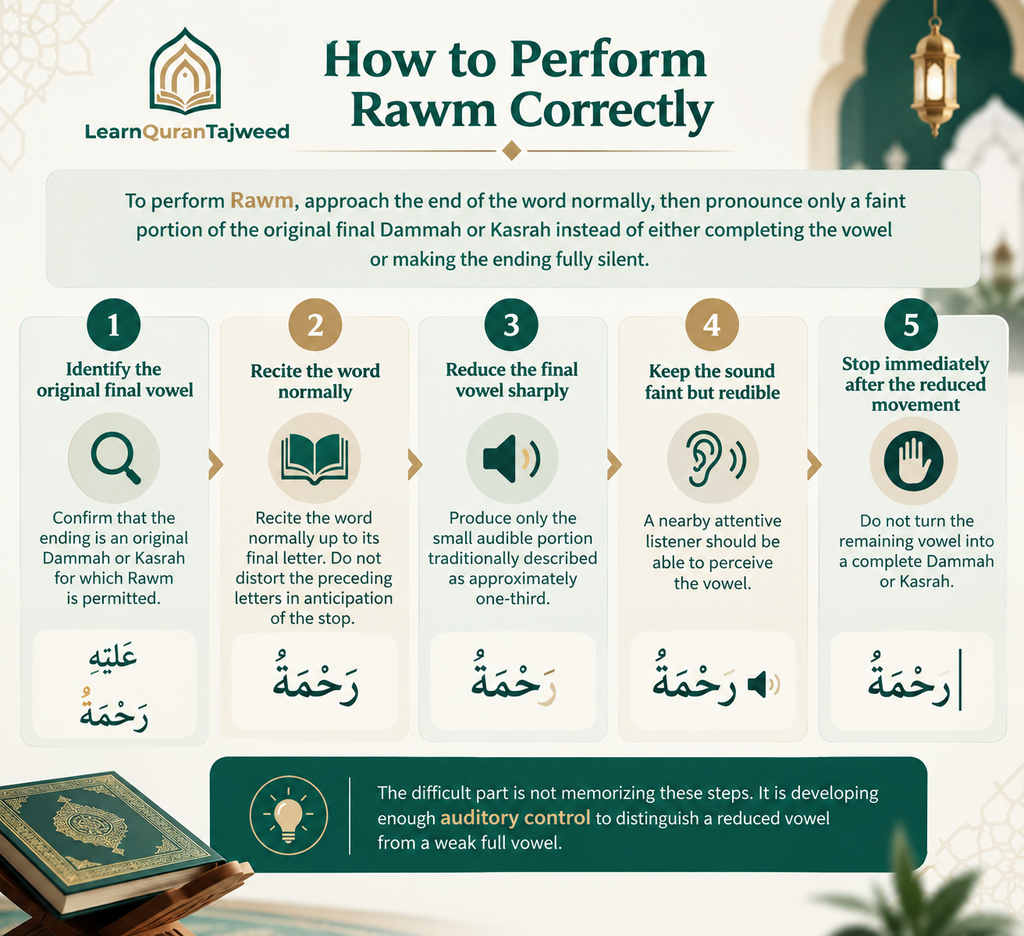
To perform Rawm, approach the end of the word normally, then pronounce only a faint portion of the original final Dammah or Kasrah instead of either completing the vowel or making the ending fully silent.
The basic process can be understood in five steps:
- Identify the original final vowel. Confirm that the ending is an original Dammah or Kasrah for which Rawm is permitted.
- Recite the word normally up to its final letter. Do not distort the preceding letters in anticipation of the stop.
- Reduce the final vowel sharply. Produce only the small audible portion traditionally described as approximately one-third.
- Keep the sound faint but audible. A nearby attentive listener should be able to perceive the vowel.
- Stop immediately after the reduced movement. Do not turn the remaining vowel into a complete Dammah or Kasrah.
The difficult part is not memorizing these steps. It is developing enough auditory control to distinguish a reduced vowel from a weak full vowel.
How Does Rawm Affect Madd When Stopping?
Rawm is performed with Qasr when the relevant stopping situation involves Madd ‘Arid lis-Sukun, because Rawm is treated in this respect like continuation rather than a complete stop with Sukoon.
In practical terms, the reader should not combine Rawm with the longer stopping lengths that depend on the final letter becoming fully silent.
This detail is frequently missed when students study Rawm as an isolated “one-third vowel” rule. Correct Rawm can change the available recitational treatment of the letters immediately before the ending.
For learners already studying Madd and Waqf, this is a strong reason to practice Rawm inside complete Quranic phrases rather than on isolated final letters.
What Happens to Tanween When Stopping With Rawm?
When Rawm is applied to an eligible word carrying Tanween of Damm or Kasr, the Tanween itself is removed at the stop.
The reciter does not preserve the full Tanween sound and then add Rawm. Instead, the stopping form is considered first, and the permitted reduced movement is performed accordingly.
Rawm vs Ishmam What Is the Difference?
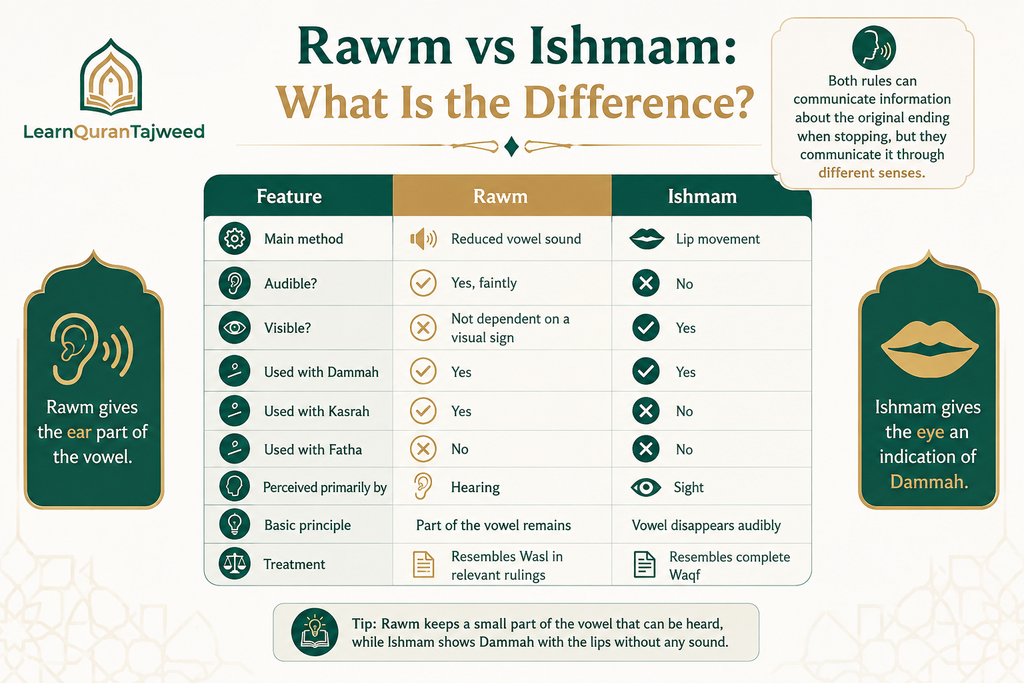
The main difference between Rawm and Ishmam is that Rawm preserves a faint audible portion of the vowel, while Ishmam indicates Dammah through silent lip movement.
Both rules can communicate information about the original ending when stopping, but they communicate it through different senses.
| Feature | Rawm | Ishmam |
| Main method | Reduced vowel sound | Lip movement |
| Audible? | Yes, faintly | No |
| Visible? | Not dependent on a visual sign | Yes |
| Used with Dammah | Yes | Yes |
| Used with Kasrah | Yes | No |
| Used with Fatha | No | No |
| Perceived primarily by | Hearing | Sight |
| Basic principle | Part of the vowel remains | Vowel disappears audibly |
| Treatment | Resembles Wasl in relevant rulings | Resembles complete Waqf |
The simplest way to remember the distinction is:Rawm gives the ear part of the vowel; Ishmam gives the eye an indication of Dammah.
What Is the Difference Between Rawm and Ikhtilas?
Rawm and Ikhtilas both involve partial vowels, but Rawm belongs to stopping and retains roughly one-third of the movement, whereas Ikhtilas may occur during connected pronunciation and retains a larger portion of the vowel.
Traditional explanations describe Ikhtilas as preserving approximately two-thirds of the movement, compared with approximately one-third in Rawm.
| Feature | Rawm | Ikhtilas |
| Approximate vowel retained | One-third | Two-thirds |
| Associated primarily with | Waqf | Pronunciation during recitation |
| Fatha possible? | No | Yes |
| Dammah possible? | Yes | Yes |
| Kasrah possible? | Yes | Yes |
| Remaining vowel | Less than what disappears | More than what disappears |
The practical difference cannot be mastered by counting fractions mentally. Both require Mushafahah, because the student must learn the proportion by hearing and imitation. Understanding the difference between Rawm and Ikhtilas is easier than producing each one accurately in recitation.
At Learn Quran Tajweed, our teachers provide direct pronunciation guidance and personalized correction, helping students hear, imitate, and apply subtle vowel proportions through proper Mushafahah rather than relying on written explanations alone.

Common Mistakes When Learning Rawm in Tajweed
Most mistakes with Rawm happen because students understand the written rule but have not yet developed the auditory precision required to perform it.
Common errors include:
- Pronouncing a complete vowel quietly instead of reducing the vowel itself.
- Making the ending completely silent, which turns the performance into ordinary Waqf rather than Rawm.
- Applying Rawm to a Fatha.
- Applying it to a Dammah or Kasrah whose movement is temporary rather than original.
- Retaining Tanween as though the word were still being connected.
- Keeping a Ha Al-Kinayah Silah that should disappear at the stop.
- Using an inappropriate Madd length before the Rawm ending.
- Trying to learn the exact sound entirely from written descriptions.
The most useful correction test is simple: Can a qualified teacher hear a small but genuine remainder of the vowel without hearing a complete Harakah? If not, the Rawm needs adjustment.
Inside Learn Quran Tajweed Academy
Curious about how online learning works? Peek inside our actual Quran classes and hear the beautiful recitation of our students and teachers.
Perfect Your Quran Recitation Today
Join expert-led Tajweed classes, and recite the Quran with confidence and clarity.
Start Your Free TrialStart Mastering Rawm With Guided Tajweed Practice
Knowing the rules of Rawm in Tajweed tells you where the technique belongs; performing its faint one-third movement accurately requires trained listening and direct correction.
Study with Learn Quran Tajweed through the Learn Quran with Tajweed online course to practice Rawm, Ishmam, Waqf, Madd, and other advanced recitation details with guided feedback instead of relying on written explanations alone.
Courses we offer:
- Tajweed Course for Kids
- Tajweed Course for Adults
- Tajweed Course for Ladies
- Tajweed ul Quran Course
- Quran Recitation with Tajweed Course
- Quran Tarteel Course
- Tajweed Ijazah Program

Conclusion
Rawm in Tajweed is the faint pronunciation of part of an eligible final Dammah or Kasrah when stopping, traditionally described as approximately one-third of the original vowel. It is audible to a nearby attentive listener and helps preserve information about the word’s original ending.
The most important distinction is that Rawm is heard, while Ishmam is seen but not heard. Rawm also differs from Ikhtilas in both the amount of vowel retained and the context in which it occurs.
Because these differences depend on precise sound rather than definitions alone, Rawm is one of the Tajweed rules where direct oral transmission and teacher correction remain essential.
FAQs About Rawm in Tajweed
What is the definition of Rawm in Tajweed?
Rawm is the faint pronunciation of part of an eligible final vowel when stopping, traditionally estimated at one-third of the full movement. It is audible to a nearby attentive listener but may not be heard by someone farther away.
Which vowels allow Rawm in Tajweed?
Rawm applies to eligible original Dammah and Kasrah endings. It does not apply to Fatha, original Sukoon, or movements that are merely temporary in the relevant stopping situation.
How do you perform Rawm when stopping?
Perform Rawm by pronouncing only a faint portion of the final Dammah or Kasrah before stopping. Do not pronounce the full vowel quietly and do not remove the movement completely.
What is the difference between Rawm and Ishmam?
Rawm is audible, whereas Ishmam is silent and visible through lip movement. Rawm can occur with eligible Dammah and Kasrah endings, while Ishmam is associated with Dammah.
Can Rawm be learned without a teacher?
The rules can be studied independently, but accurate Rawm pronunciation should be learned through direct listening and correction. Its reduced vowel cannot be reliably mastered by interpreting “one-third” mathematically.
Does Rawm occur with Fatha?
No, Rawm does not occur with Fatha. Its accepted application concerns eligible Dammah and Kasrah endings rather than final Fatha.