 Tajweed Basics
Ask most students which surah they memorised first, and Surah Al-Masad is somewhere near the top of the list. Five short verses, easy to hold in memory, and finished in under thirty seconds.
Yet those thirty seconds contain qalqalah, idgham, ikhfa, ghunnah, and two kinds of madd. Learning Surah Lahab tajweed properly means you have quietly rehearsed most of the rules you will need for the rest of the Qur’an.
This guide walks through the surah twice. First, we recite it, verse by verse and rule by rule, with the mistakes learners usually make. Then we look at what the words actually mean: the story behind the revelation, who Abu Lahab was, and why his wife is described as “the carrier of firewood”.
Take Away: What You Will Learn
- The complete tajweed breakdown of Surah Al-Masad, verse by verse, with the number of counts for each madd and ghunnah.
- The four qalqalah stops in the surah and how to make them sound clean instead of forced.
- The three most common recitation errors in this surah and the drill that fixes each one.
Surah Lahab Tajweed: A Verse-by-Verse Guide
Surah Al-Masad is the 111th chapter of the Qur’an, revealed in Makkah, and it contains five verses. The rulings below follow the recitation of Hafs ‘an ‘Asim by way of the Shatibiyyah, which is the reading most students learn worldwide.
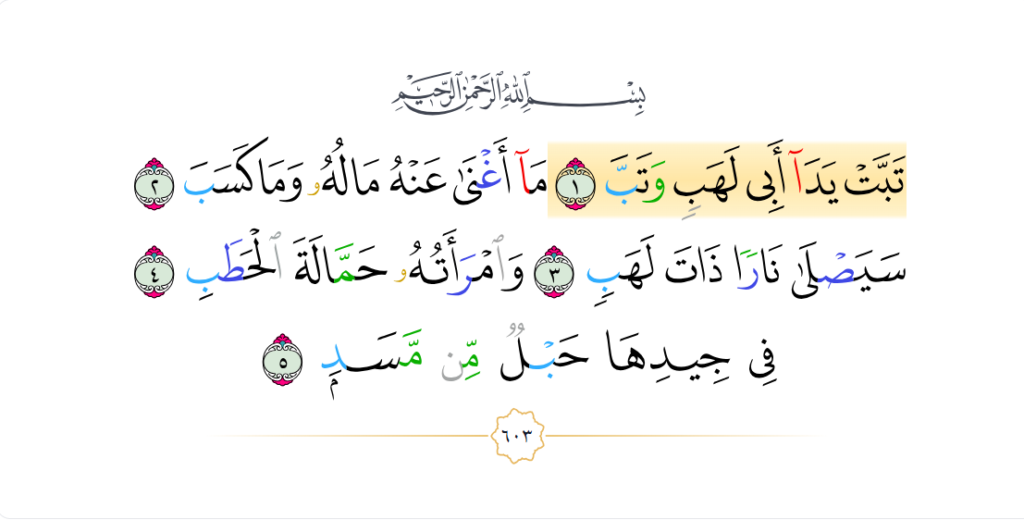
Verse 1: تَبَّتْ يَدَا أَبِي لَهَبٍ وَتَبَّ
The doubled ba in تَبَّتْ is a shaddah, so the letter is held for roughly two counts of pressure. There is no nasal sound here, because ghunnah belongs to meem and noon alone.
The word ends in a silent ta (ت). Close it cleanly and do not add a bounce; ta is not one of the qalqalah letters.
Between يَدَا and أَبِي you have a madd letter at the end of one word and a hamzah at the start of the next. That is madd jaiz munfasil, stretched four or five counts.
The tanween on لَهَبٍ meets the waw of وَتَبَّ, resulting in idgham with ghunnah: the noon sound merges into the waw, while the nasal hum is held for two counts.
When you stop on وَتَبَّ, the final ba carries both a shaddah and a sukun. This is the strongest form of qalqalah kubra in the whole surah: press, then release with a firm, echoing bounce.
Read about: types of ghunnah
Verse 2: مَا أَغْنَىٰ عَنْهُ مَالُهُ وَمَا كَسَبَ
مَا أَغْنَىٰ repeats the madd jaiz munfasil of the previous verse, again four or five counts. Students who rushed the first one usually rush this one too.
In عَنْهُ the noon is silent and is followed by the throat letter ha. That is izhar halqi: the noon is pronounced clearly and separately, with no nasal stretch and no merging.
Notice the two ha pronouns and how differently they behave. The ha of عَنْهُ follows a silent noon, so it stays short, while the ha of مَالُهُ sits between two voweled letters and is lengthened two counts as silah sughra.
Stopping on كَسَبَ turns the final ba into a sukun, producing another qalqalah kubra.
Verse 3: سَيَصْلَىٰ نَارًا ذَاتَ لَهَبٍ
The silent sad in سَيَصْلَىٰ is a heavy letter of isti’la with full itbaq. Keep the back of the tongue raised so the sound does not collapse into an ordinary seen.
The alif maqsurah at the end of سَيَصْلَىٰ is a natural madd of two counts, no more.
نَارًا ذَاتَ is the clearest ikhfa in the surah. The tanween meets dhal, one of the fifteen ikhfa letters, so the noon sound is hidden and a two-count ghunnah is held while the tongue prepares for the dhal.
Give the dhal its own place of articulation, with the tip of the tongue touching the edge of the upper front teeth. Turning it into a zay or a dal changes the word. Stopping on لَهَبٍ gives you qalqalah once more.
Verse 4: وَامْرَأَتُهُ حَمَّالَةَ الْحَطَبِ
The silent meem in وَامْرَأَتُهُ is followed by ra, which produces izhar shafawi: the lips close on the meem and open cleanly, without any hum being dragged along.
Pronounce the hamzah in the middle of the word crisply. Softening it into a long vowel is one of the most frequent slips in this verse.
حَمَّالَةَ carries a meem with shaddah, and that is ghunnah mushaddadah, an obligatory nasal sound of two full counts, the most prominent hum in the surah.
الْحَطَبِ begins with a lunar lam, so the lam is pronounced clearly and never merged. The ta here is the heavy letter ṭa, and the final ba once again gives qalqalah on the stop.
Verse 5: فِي جِيدِهَا حَبْلٌ مِّن مَّسَدٍ
فِي جِيدِهَا contains three natural madds, each exactly two counts. The jeem is vowelized here, so it does not undergo qalqalah despite being a qalqalah letter.
In حَبْلٌ the ba is silent in the middle of the word, which produces qalqalah sughra, a light and contained bounce, much softer than the one you make when stopping.
The tanween of حَبْلٌ meets the meem of مِّن, and then the silent noon of مِّن meets the meem of مَّسَدٍ. Both are complete idgham with ghunnah, each held for two counts, which is why the meems are written with a shaddah.
Stopping on مَّسَدٍ leaves a silent dal, and dal is a qalqalah letter, so the surah closes on a clean bounce.
See Our Classrooms in Action
Watch these short clips from our live, interactive Quran courses to see how our students learn and interact with our expert tutors.
Perfect Your Quran Recitation Today
Join expert-led Tajweed classes, and recite the Quran with confidence and clarity.
Start Your Free TrialHow to Recite Surah Lahab with Tajweed Without the Usual Mistakes
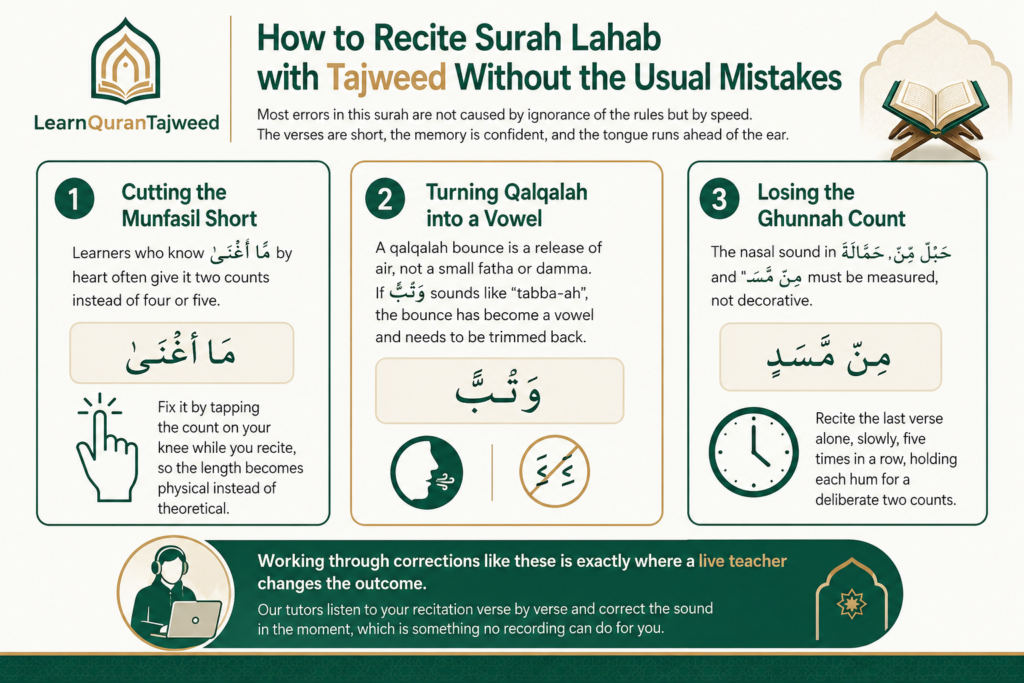
Most errors in this surah are not caused by ignorance of the rules but by speed. The verses are short, the memory is confident, and the tongue runs ahead of the ear.
1. Cutting the Munfasil Short
Learners who know مَا أَغْنَىٰ by heart often give it two counts instead of four or five. Fix it by tapping the count on your knee while you recite, so the length becomes physical instead of theoretical.
2. Turning Qalqalah into a Vowel
A qalqalah bounce is a release of air, not a small fatha or damma. If وَتَبَّ sounds like “tabba-ah”, the bounce has become a vowel and needs to be trimmed back.
3. Losing the Ghunnah Count
The nasal sound in حَمَّالَةَ, حَبْلٌ مِّن and مِّن مَّسَدٍ must be measured, not decorative. Recite the last verse alone, slowly, five times in a row, holding each hum for a deliberate two counts.
Working through corrections like these is exactly where a live teacher changes the outcome. At Learn Quran Tajweed, tutors listen to your recitation verse by verse and correct the sound in the moment, which is something no recording can do for you.
Inside Learn Quran Tajweed Academy
Curious about how online learning works? Peek inside our actual Quran classes and hear the beautiful recitation of our students and teachers.
Perfect Your Quran Recitation Today
Join expert-led Tajweed classes, and recite the Quran with confidence and clarity.
Start Your Free TrialLearn Quran with Tajweed: Why Surah Al-Masad Is a Good Starting Point
Teachers choose this surah early for a practical reason: it is short enough to master and dense enough to be worth mastering. Five verses cover a large share of the beginner syllabus.
1. For Children
Children respond to sound before they respond to terminology. Let a child feel the bounce of qalqalah and the hum of ghunnah first, and attach the names to those sensations afterwards.
The story attached to the surah also helps enormously. A verse a child understands is a verse a child remembers.
2. For Adults and Reverts
Adults tend to learn faster when the rule is named, explained, and then drilled. Surah Al-Masad lets you practise nine or ten named rules inside a passage you can already recite from memory.
That combination of familiar text and unfamiliar precision is the quickest route into fluent recitation of longer chapters.
Start Learning Surah Lahab Tajweed With a Qualified Tutor
Reading about qalqalah is useful. Having a teacher stop you mid-verse and show you the difference between a bounce and a vowel is what actually changes your recitation.
Learn Quran Tajweed offers one-to-one Qur’an classes with certified tutors for both children and adults. Lesson times are flexible, the tajweed levels run from beginner to ijazah, and the plan follows your own pace.
Whether you’re just starting or aiming for mastery, our comprehensive online programs are designed to help you recite the Quran with confidence, accuracy, and beauty.
Courses we offer:
- Online Tajweed Classes
- Learn Quran with Tajweed Online
- Beginner Tajweed Course
- Intermediate Tajweed Course
- Advanced Tajweed Course
- Amali (Practical) Tajweed Course
- Quran Recitation with Tajweed Course
- Quran Tarteel Course
Book a trial class and recite Surah Al-Masad with a teacher who can hear what the page cannot show.
Perfect Your Quran Recitation Today
Join expert-led Tajweed classes, and recite the Quran with confidence and clarity.
Start Your Free TrialConclusion
Surah Al-Masad may contain only five verses, but it brings together several essential Tajweed rules, including qalqalah, idgham with ghunnah, ikhfa, izhar, and different types of madd.
This makes it an excellent short Surah for both beginners and children to practise accurate Quran recitation.
The key is not to rush because the Surah feels familiar. Recite each verse slowly, give every madd and ghunnah its correct count, and pay close attention to qalqalah when stopping.
Regular practice with a qualified Tajweed teacher can help correct small pronunciation mistakes before they become permanent habits.
FAQs
How many verses are in Surah Al-Masad?
Surah Al-Masad has five verses. It is the 111th chapter of the Qur’an and was revealed in Makkah, which places it among the Makkan surahs.
Which tajweed rules appear in Surah Lahab?
The surah contains madd jaiz munfasil, natural madd, silah sughra, izhar halqi, izhar shafawi, ikhfa haqiqi, idgham with ghunnah, ghunnah mushaddadah, qalqalah sughra, and qalqalah kubra.
How long should the madd in “ma aghna” be held?
Four or five counts. In the recitation of Hafs by way of the Shatibiyyah, it is a madd jaiz munfasil, so it is held for four or five counts. Two counts is the most common learner error in this surah.
Is Surah Al-Masad suitable for children to memorise first?
Yes. It is short, rhythmically clear, and rich in basic tajweed rules, and the story behind it can be explained in simple terms that help children remember what they recite.
What is the difference between Surah Al-Masad and Surah Al-Lahab?
There is no difference: they are two names for the same chapter. Both names are drawn from words that appear in the surah itself.