 Tajweed Rules

Naql in Tajweed is the transfer of the vowel of a Hamzah to the silent letter immediately before it. The Hamzah is then omitted in pronunciation, creating a smoother connection between the sounds. This rule is particularly associated with Warsh ‘an Nafi’.
Instead of pronouncing the silent letter and Hamzah separately, the Hamzah’s vowel moves to the preceding letter. For example, in قَدْ أَفْلَحَ, the Fatḥah moves to the silent دْ. The pronunciation then becomes approximately قَدَفْلَحَ.
Applying Naql correctly requires more than simply identifying a Hamzah after a silent letter. The reciter must consider the narration, the preceding letter, and the position of the Hamzah. Certain cases may also have specific exceptions.
What Is Naql in Tajweed?
The Arabic word Naql (النقل) means “transfer” or “moving something from one place to another.”
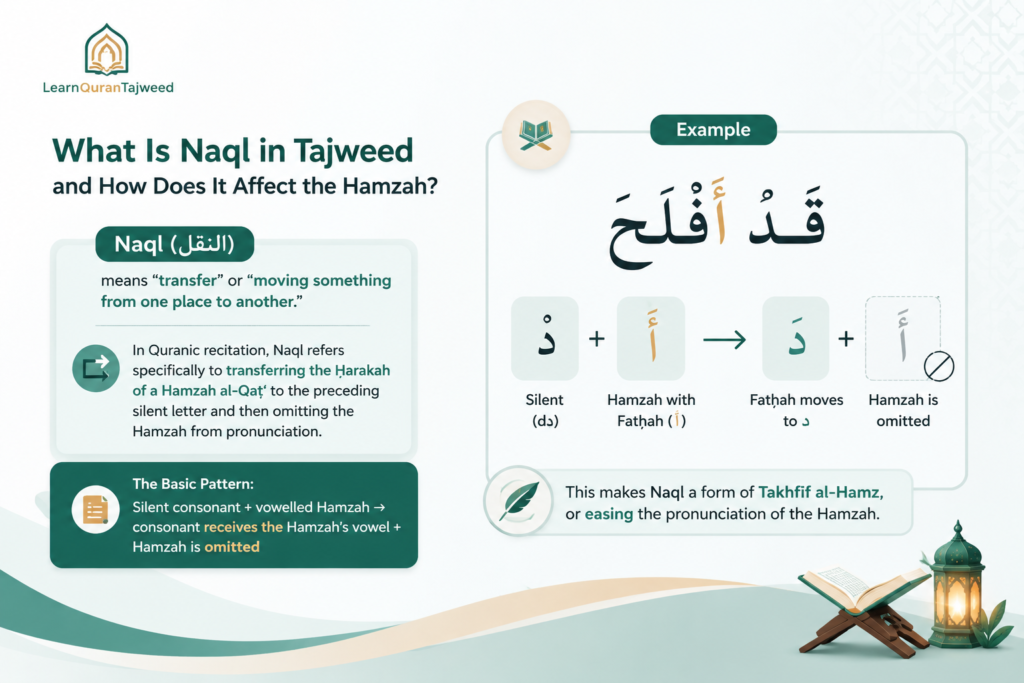
In Quranic recitation, Naql refers specifically to transferring the Ḥarakah of a Hamzah al-Qaṭ‘ to the preceding silent letter and then omitting the Hamzah from pronunciation.
The basic pattern can be represented as: Silent consonant + vowelled Hamzah → consonant receives the Hamzah’s vowel + Hamzah is omitted
For example: قَدْ أَفْلَحَ The دْ is originally silent, while the Hamzah carries Fatḥah: دْ + أَ. With Naql, the Fatḥah moves to the د: دَ. The Hamzah is no longer pronounced. This makes Naql a form of Takhfīf al-Hamz, or easing the pronunciation of the Hamzah.
Why Is Naql Used to Ease the Pronunciation of Hamzah?
Hamzah is articulated from the deepest region of the throat and can require a strong, distinct interruption of the voice.
Because of this characteristic, Arabic pronunciation historically included several methods of making Hamzah easier to articulate. Quranic Qira’at preserve different authentic forms of these pronunciation patterns.
Among the major methods of treating Hamzah are:
- Naql (النقل): transferring its vowel to the preceding silent letter and omitting the Hamzah.
- Ibdal (الإبدال): replacing the Hamzah with another suitable letter.
- Tashil (التسهيل): pronouncing the Hamzah in a softened manner between a full Hamzah and a corresponding vowel sound.
- Isqat (الإسقاط): omitting a Hamzah in particular recitational circumstances.
Naql therefore belongs to the broader study of Qira’at and the different authentic methods of Quranic performance, rather than being a rule that every reader automatically applies whenever a Hamzah appears.
How Naql Works in the Warsh ‘an Nafi’ Recitation
Naql is most famously associated with Imam Warsh in his narration from Imam Nafi‘.
Imam Ibn Barri summarized the principle in his well-known lines:
حَرَكَةُ الْهَمْزِ لِوَرْشٍ تَنْتَقِلْ
لِلسَّاكِنِ الصَّحِيحِ قَبْلُ الْمُنْفَصِلْ
The meaning is that, according to Warsh, the vowel of the Hamzah is transferred to the preceding appropriate silent consonant when the required conditions are fulfilled.
This distinction is especially important for students who originally learned Quran through Hafs ‘an ‘Asim and later begin studying Warsh. They should not simply apply familiar Hafs pronunciation habits to Warsh or assume that every Tajweed rule functions identically in both narrations.
For adult learners who want to build these distinctions systematically rather than learning individual examples in isolation, structured online Tajweed classes for adults can help connect theoretical rules with corrected recitation.

How Is the Hamzah Vowel Transferred During Naql?
The mechanism of Naql involves two actions performed together. First, the vowel of the Hamzah moves backward to the preceding silent consonant. Second, after its vowel has been transferred, the Hamzah is omitted from pronunciation.
Consider: مَنْ آمَنَ. When the conditions of Naql are fulfilled, the vowel of the following Hamzah is transferred to the final silent نْ of the preceding word, and the Hamzah is then omitted.
The important point is that the vowel does not disappear; it simply changes position. This distinguishes Naql from simply deleting or ignoring the Hamzah.
Read also: How to Recite Surah Al-Mulk With Tajweed?
Why Is the Hamzah Omitted After Naql?
Once its vowel has been transferred, the Hamzah would be left without its original movement.
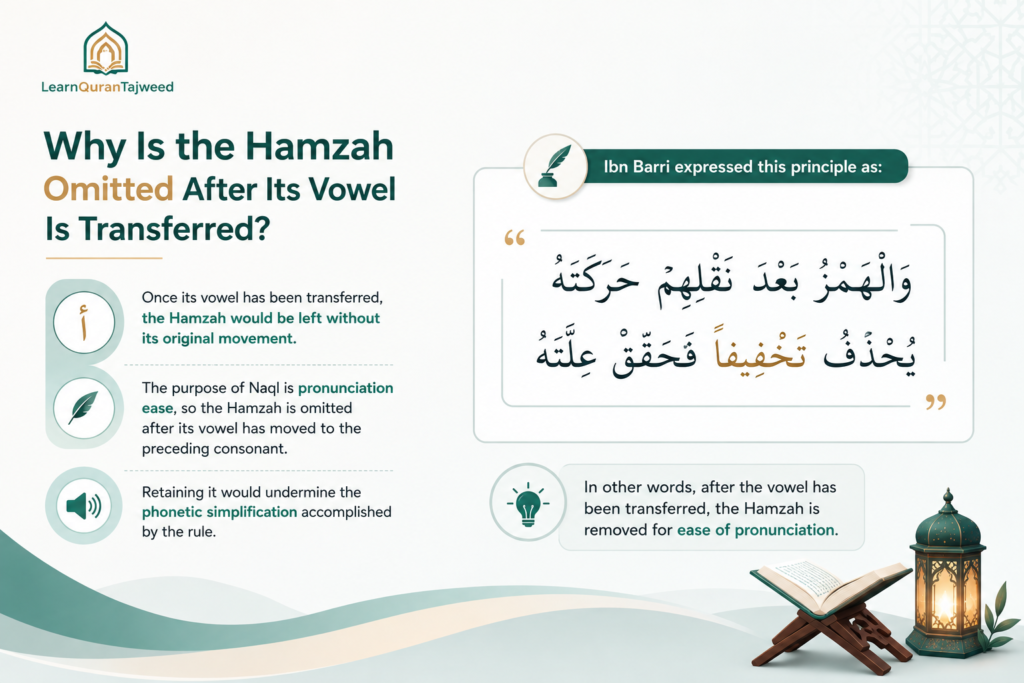
The purpose of Naql is pronunciation ease, so the Hamzah is omitted after its vowel has moved to the preceding consonant. Retaining it would undermine the phonetic simplification accomplished by the rule.
Ibn Barri expressed this principle as:
وَالْهَمْزُ بَعْدَ نَقْلِهِمْ حَرَكَتَهْ
يُحْذَفُ تَخْفِيفاً فَحَقِّقْ عِلَّتَهْ
In other words, after the vowel has been transferred, the Hamzah is removed for ease of pronunciation.
Conditions for Applying Naql in Warsh Recitation
For the regular form of Naql in the narration of Warsh, several conditions must be met together.
A student should not apply Naql simply because a Hamzah appears; the surrounding letters and their vowel markings must also be considered.
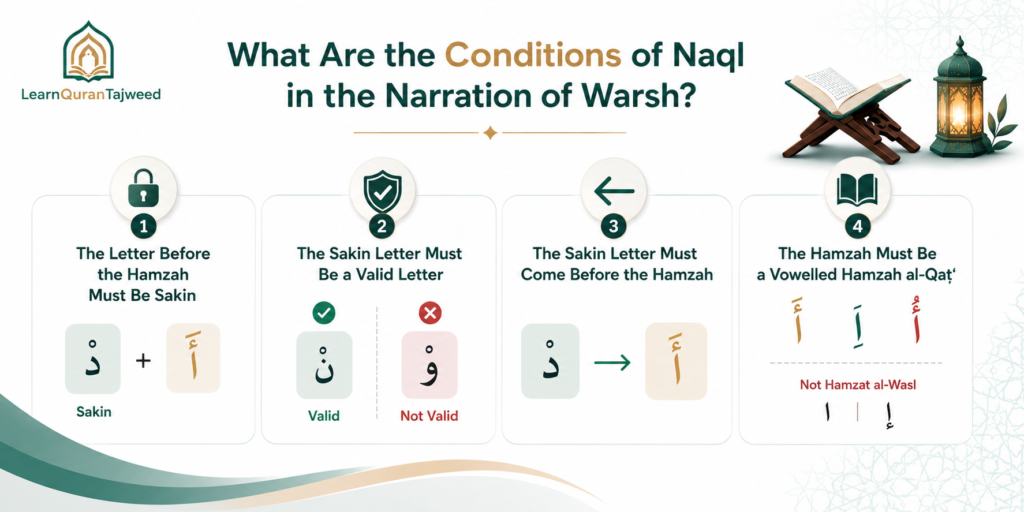
The Letter Before the Hamzah Must Be Sakin
The letter immediately before the Hamzah must originally carry Sukoon. If it is already vowelled, the normal Naql pattern does not apply because there is no silent consonant to receive the Hamzah’s vowel.
1. The Sakin Letter Must Be Eligible to Receive the Vowel
In the regular rule, the preceding letter is a Sakin Sahih, meaning an appropriate silent consonant rather than a Madd letter. Therefore, not every silent-looking Waw or Ya automatically receives the vowel under the standard Warsh rule.
2. The Sakin Letter Must Come Before the Hamzah
The direction of Naql is always backward: the vowel moves from the Hamzah to the preceding silent letter. The basic pattern is:
Silent consonant → Hamzah
3. The Hamzah Must Be a Vowelled Hamzah al-Qaṭ‘
The Hamzah involved is Hamzah al-Qaṭ‘ (همزة القطع) carrying Fatḥah, Kasrah, or Ḍammah. Its vowel is transferred to the preceding appropriate letter, and the Hamzah is then omitted from pronunciation. This differs from Hamzat al-Wasl, which follows different pronunciation rules.
How Fathah, Dammah, and Kasrah Are Transferred in Naql
The vowel transferred in Naql depends on the original Harakah of the Hamzah. If the Hamzah carries Fatḥah, Ḍammah, or Kasrah, that same vowel moves to the qualifying silent consonant immediately before it. The Hamzah is then omitted from pronunciation.
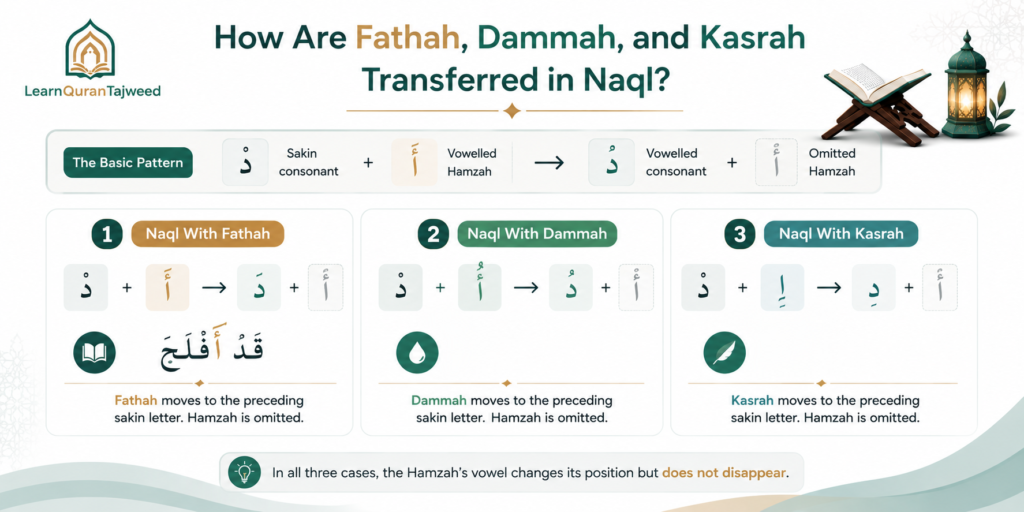
The basic pattern is: Sakin consonant + vowelled Hamzah → vowelled consonant + omitted Hamzah
Naql With Fathah
When the Hamzah carries Fatḥah, the Fatḥah is transferred to the preceding Sakin consonant.
Consider:
قَدْ أَفْلَحَ
Here, the دْ is Sakin and the following Hamzah carries Fatḥah:
دْ + أَ → دَ
The Dal therefore receives the Fatḥah, while the Hamzah is omitted in pronunciation.
Naql With Dammah
When the Hamzah carries Ḍammah, the preceding qualifying Sakin consonant receives the same Ḍammah:
Sakin consonant + أُ → consonant with Ḍammah
After the vowel has been transferred, the Hamzah is omitted from pronunciation.
Naql With Kasrah
When the Hamzah carries Kasrah, the Kasrah moves to the preceding qualifying Sakin consonant:
Sakin consonant + إِ → consonant with Kasrah
The Hamzah is then omitted, while its original Kasrah remains preserved on the preceding consonant.
In all three cases, the principle is the same: the Hamzah’s vowel changes its position but does not disappear.
How Is Naql Applied to Lam Al-Ta‘rif in Warsh Recitation?
An especially important category is Naql involving the Lam of the definite article ال.
Although the definite article is written together with the noun that follows it, classical discussions of Warsh treat its Lam specially for the purpose of Naql.
When a Hamzah al-Qaṭ‘ follows the Lam, the movement of the Hamzah may be transferred to the Lam and the Hamzah omitted according to the rules of the narration.
Examples commonly discussed in this chapter include words involving forms such as:
الْأَرْض
الْآخِرَة
الْأُولَى
الْإِيمَان
The Lam, which was originally silent, receives the movement of the following Hamzah.
This is one reason Naql can sound strikingly different to a student accustomed exclusively to Hafs.
Inside Learn Quran Tajweed Academy
Curious about how online learning works? Peek inside our actual Quran classes and hear the beautiful recitation of our students and teachers.
Perfect Your Quran Recitation Today
Join expert-led Tajweed classes, and recite the Quran with confidence and clarity.
Start Your Free TrialHow to Begin a Word After Naql to Lam Al-Ta‘rif ?
A particularly advanced issue arises when the reciter begins directly with a word whose Lam receives a movement through Naql during connected recitation.
Classical scholars discuss two accepted approaches depending on whether the transferred vowel is taken into account when beginning.
One approach begins with the now-vowelled Lam without bringing Hamzat al-Wasl The other considers the transferred vowel incidental and begins with Hamzat al-Wasl.
Traditional examples include words such as:
الآخرة
الأولى
الإيمان
This is an example of why advanced Qira’at cannot safely be learned from spelling alone. A student must know whether the discussion concerns Wasl (connecting), Waqf (stopping), or Ibtida’ (beginning), because the permitted performance can change accordingly.
What Is the Difference Between Naql and Ibdal in Tajweed?
Naql and Ibdal are two distinct methods used in Qira’at to ease the pronunciation of Hamzah, but each treats the Hamzah differently.
In Naql, the vowel of the Hamzah is transferred to the preceding qualifying Sakin consonant, after which the Hamzah is omitted from pronunciation. In Ibdal, the Hamzah itself is replaced with another suitable letter according to the applicable Qira’ah rule.
The distinction can be summarized simply:
- Naql: transfers the vowel of the Hamzah.
- Ibdal: replaces the Hamzah itself.
Understanding this difference is important because confusing Naql with Ibdal can result in a pronunciation that does not correspond to the transmitted recitation.
What Is the Difference Between Naql and Tashil of the Hamzah?
Naql and Tashil are both methods of easing the Hamzah in Quranic recitation, but they affect it in different ways.
In Naql, the vowel of the Hamzah is transferred to the preceding qualifying Sakin consonant, and the Hamzah is then omitted from pronunciation. In Tashil (التسهيل), the Hamzah itself remains but is pronounced in a softened manner rather than with full Tahqiq, according to the applicable Qira’ah rule.
The key difference is:
- Naql: changes where the Hamzah’s vowel is pronounced.
- Tashil: changes how the Hamzah itself is pronounced.
This distinction helps students recognize whether a Qira’ah rule requires transferring the Hamzah’s movement or softening its pronunciation.
How Naql During Waqf Differs From the General Warsh Rule ?
Students should distinguish Naql in Warsh during connected recitation from discussions of Naql when stopping on words containing Hamzah in other Qira’at.
Classical Qira’at works discuss several treatments of Hamzah for reciters such as Hamzah and Hisham when stopping. Depending on the structure of the word, possibilities can involve Naql, Ibdal, Idgham, Sukoon, Rawm, or Ishmam.
Examples discussed in the books of Qira’at include words such as:
دِفْءٌ
مِلْءُ
الْمَرْءُ
جُزْءٌ
شَيْءٌ
These discussions belong to the broader science of the Qira’at and should not be confused with the basic Warsh rule in which a Hamzah at the beginning of a following word transfers its movement to the preceding silent consonant.
For this reason, a student should always identify the reciter, narration, transmission route, and whether the verse is being connected or stopped upon before applying a Hamzah rule.
Naql When Hamzah Is Preceded by an Original Ya or Waw
Advanced chapters of Qira’at discuss situations where Hamzah is preceded by an original Waw or Ya, including cases where these letters function as Madd or Lin letters.
Examples found in discussions of Waqf on Hamzah include:
وَجِيءَ
يُضِيءُ
تَبُوءَ
لَتَنُوءُ
سُوءٍ
شَيْءٌ
The possible recitational faces in these words can differ considerably from ordinary Warsh Naql between two words. Depending on the word and transmitted reading, the discussion may involve Naql, Ibdal, Idgham, Sukoon, Rawm, or Ishmam.
These examples reinforce an important principle: Not every rule called Naql is applied in exactly the same context or by exactly the same reciter.
Quranic Examples of Naql in Warsh Recitation
The clearest way to understand Naql is through Quranic examples. In each case, focus on three elements: the Sakin letter, the following Hamzah, and the vowel carried by the Hamzah.
When the conditions of Naql are met, that vowel moves to the preceding letter and the Hamzah is omitted from pronunciation.
Naql in قَدْ أَفْلَحَ
In قَدْ أَفْلَحَ, the Dal دْ is Sakin and the Hamzah in أَفْلَحَ carries Fatḥah.
Before Naql:
دْ + أَ
After Naql:
دَ
The Fatḥah is transferred from the Hamzah to the Dal, and the Hamzah is omitted. The reciter therefore continues directly from the now-vowelled Dal to the Fa without pronouncing a separate Hamzah.
Naql in مَنْ آمَنَ
In مَنْ آمَنَ, the Noon نْ is Sakin and is followed by a Hamzah carrying Fatḥah.
With Naql, the Fatḥah of the Hamzah is transferred to the Noon, and the Hamzah is omitted from pronunciation. The two words are then connected smoothly without introducing a separate Hamzah or an artificial pause between them.
Naql in الْأَرْض
The example الْأَرْض illustrates Naql with the Lam of the definite article ال. The Lam is originally Sakin, while the following Hamzah carries Fatḥah.
With Naql, the Fatḥah of the Hamzah is transferred to the Lam, and the Hamzah is omitted according to the applicable Warsh rule. This produces a pronunciation noticeably different from the familiar Hafs realization.
Because differences like these are best understood through listening and corrected recitation, a Practical Tajweed Course can help students apply Naql accurately in real Quranic passages.

Special Naql Words Reported From Both Warsh and Qalun
Although Warsh is especially known for Naql, classical Qira’at texts also discuss a limited number of transmitted forms from Nafi‘ through both Warsh and Qalun that involve Naql.
Among the famous examples are:
رِدْءًا
آلْآن
عَادًا الْأُولَى
These should be treated as specific transmitted cases rather than evidence that Qalun follows the general Warsh Naql rule throughout the Quran.
That distinction matters Students should learn general rules as general rules and exceptional transmitted words as exceptional words.
How Is عَادًا الْأُولَى Recited According to Warsh and Qalun?
The expression:
عَادًا الْأُولَى
in Surah An-Najm is one of the best-known advanced examples connected with Naql.
Its recitation involves several interacting elements, including the Tanween at the end of عَادًا, the Lam of الْأُولَى, and the movement associated with the Hamzah.
Classical works also discuss particular differences between the transmitted performances of Warsh and Qalun in this expression.
This example demonstrates why advanced Qira’at cannot always be reduced to one Tajweed rule at a time. Multiple phonetic and transmitted rules may interact within a single phrase.
Read More: Surah Nas With Tajweed
Common Mistakes Students Make When Applying Naql
Students learning Naql often understand its definition but still make errors during actual Quran recitation.

1. Transferring the Vowel but Still Pronouncing the Hamzah
This produces a mixture of two different treatments Once Naql is correctly applied in its normal form, the student should not transfer the vowel and then pronounce a full Hamzah as well.
The movement has already moved to the preceding consonant, and the Hamzah is omitted.
2. Omitting the Hamzah Without Transferring Its Vowel
Naql does not mean simply removing the Hamzah Its defining feature is the transfer of the Hamzah’s Harakah to the preceding qualifying letter.
Deleting the Hamzah without transferring its movement is therefore not correct Naql.
3. Applying Naql Whenever a Hamzah Appears
The existence of a Hamzah alone is not enough The reader must check the preceding letter, its state, the relationship between the words, the narration being read, and any applicable exception.
4. Using Warsh Naql Rules While Reciting Hafs
The general Naql rule described here is strongly associated with Warsh and should not be inserted casually into Hafs recitation.
Mixing recitational systems without knowledge can produce a pronunciation that does not accurately represent the narration being recited.
5. Relying on Transliteration Instead of Correct Oral Recitation
English transliterations may help explain the mechanism, but they cannot accurately represent every Arabic articulation or Qira’ah detail The final reference must be correct oral transmission from a qualified teacher.
How to Practice Naql Correctly in Quran Recitation ?
Practicing Naql effectively requires two skills: recognizing where the rule applies and performing it correctly during connected recitation.
Students should first identify the Hamzah and its vowel, then check whether the preceding Sakin letter meets the conditions of Naql.
Once the pattern is identified, the phrase should be practiced slowly before moving to a natural recitation speed.
The goal is to transfer the Hamzah’s vowel accurately to the preceding consonant while removing the audible Hamzah without creating an unnatural pause.
A practical sequence is:
- Identify the Hamzah and determine whether it carries Fatḥah, Kasrah, or Ḍammah.
- Check the preceding letter and confirm that it qualifies for Naql.
- Transfer the vowel of the Hamzah to the preceding Sakin consonant.
- Omit the Hamzah from pronunciation after its vowel has been transferred.
- Connect the words slowly without introducing a pause between them.
- Repeat at normal recitation speed while preserving the transferred vowel.
- Apply the rule within the complete Ayah so that Naql becomes natural during continuous Quran recitation.
Students who understand Tajweed theory but struggle to apply it spontaneously can benefit from a Quran Recitation with Tajweed Course, where rules can be practiced within complete Quranic recitation rather than only as isolated definitions.

Why Naql Should Be Learned With a Qualified Quran Teacher ?
Naql appears simple on paper: transfer one movement and remove one Hamzah.
In actual recitation, however, the student must coordinate several details at once. The consonant must receive the correct vowel, the Hamzah must disappear without creating an unnatural break, and the surrounding letters must retain their proper Makharij and Sifat.
Advanced cases may also depend on the exact Riwayah, Tariq, Wasl, Waqf, or Ibtida’.
A teacher can detect errors that written explanations cannot reveal, such as retaining a trace of the Hamzah, adding an unnecessary Madd, incorrectly changing the preceding sound, or accidentally mixing Hafs and Warsh pronunciation.
Meet our Arabic and Quran teachers.

Naql in Warsh vs. Hafs: Key Pronunciation Differences
The easiest practical difference is that Warsh applies Naql in established contexts where Hafs generally maintains the pronounced Hamzah.
A student moving from Hafs to Warsh must therefore retrain the instinct to pronounce every familiar Hamzah in exactly the same way.
This difference can be particularly noticeable when a word beginning with Hamzah follows a word ending in an appropriate silent consonant, as well as in words involving the definite article.
The difference does not represent a modification of the Quran. It belongs to the authentically transmitted variation in Quranic recitation preserved through the Qira’at.
See Our Classrooms in Action
Watch these short clips from our live, interactive Quran courses to see how our students learn and interact with our expert tutors.
Perfect Your Quran Recitation Today
Join expert-led Tajweed classes, and recite the Quran with confidence and clarity.
Start Your Free TrialStart Your Journey with Learn Quran Tajweed Academy Today
Ready to perfect your Quran recitation and strengthen your connection with the Book of Allah? At Learn Quran Tajweed Academy, we make it simple, structured, and spiritually uplifting to learn from qualified Tajweed teachers—no matter your age or level.
Whether you’re just starting out or aiming for mastery, our comprehensive online programs are designed to help you recite the Quran with confidence, accuracy, and beauty.
Join thousands of students worldwide who are transforming their recitation through expert guidance and personalized support.
Take the first step today, enroll now and experience the difference that proper Tajweed makes.
Courses we offer:
- Online Tajweed Classes
- Learn Quran with Tajweed Online
- Beginner Tajweed Course
- Intermediate Tajweed Course
- Advanced Tajweed Course
- Amali (Practical) Tajweed Course

Conclusion
Naql in Tajweed involves transferring the vowel of a Hamzah to a qualifying silent letter before it and then omitting the Hamzah from pronunciation.
The rule is particularly important in the narration of Warsh ‘an Nafi’ and forms part of the wider Quranic tradition of easing the articulation of Hamzah.
The basic mechanism is straightforward, but correct application requires attention to the preceding letter, the type and position of the Hamzah, word boundaries, the narration being followed, and special transmitted cases.
Students should therefore combine theoretical study with listening, repetition, and corrected oral recitation.
Once Naql is practiced in real Quranic passages rather than memorized only as a definition, recognizing and applying the rule becomes much more natural.
Frequently Asked Questions About Naql in Tajweed
What Is Naql in Tajweed?
Naql is the transfer of the vowel of a Hamzah to a qualifying silent consonant immediately before it. After the movement has been transferred, the Hamzah is omitted from pronunciation. The rule is particularly associated with the narration of Warsh ‘an Nafi’.
Which Quranic Narration Is Most Commonly Associated With Naql?
Naql is most commonly associated with Warsh ‘an Nafi’. Warsh applies the rule in established contexts when its conditions are fulfilled, although other Qira’at also contain specific treatments described as Naql in particular situations.
Is Naql Applied in Hafs ‘an ‘Asim?
The general Naql rule associated with Warsh is not applied in the standard recitation of Hafs ‘an ‘Asim. Hafs normally retains the pronounced Hamzah in many places where Warsh applies Naql.
What Happens to the Hamzah After Naql?
After the Hamzah’s vowel has been transferred to the preceding appropriate consonant, the Hamzah is omitted from pronunciation in the normal Naql form.
Can Fathah, Kasrah, and Dammah All Be Transferred Through Naql?
Yes. The transferred movement depends on the original movement carried by the Hamzah. Fatḥah, Kasrah, or Ḍammah can therefore be transferred when the relevant conditions of the rule are fulfilled.
Is Naql the Same as Ibdal?
No. Naql transfers the vowel of the Hamzah to the preceding consonant and then omits the Hamzah. Ibdal involves replacing the Hamzah itself with another letter according to a specific Qira’ah rule.
Related Articles
Tajweed Rules