 Quran
Quran
When you open a Quran printed in Morocco and compare it to one printed in Egypt, the vowel markings look different. Yet both are completely correct — both trace back to the Prophet Muhammad ﷺ. That difference is explained entirely by understanding Riwayat vs Qira’at.
These two terms are the most consistently confused in Tajweed study. Most students treat them as synonyms. Getting the distinction right is foundational to understanding how the Quran has been preserved across fourteen centuries with extraordinary precision.
What You Will Learn in This Article
- The precise classical definition of Qira’at and Riwayat
- Why Qira’at, Riwayat, and Turuq sit at three separate levels
- Three conditions that make any Qira’ah valid
- Why the same Quran produces different Mushafs worldwide
- Which Riwayah most Muslims recite today and why
- How this distinction applies directly to your Tajweed study
Riwayat vs Qira’at in Quranic Sciences
The difference between Riwayat and Qira’at describes a hierarchy, not a contradiction. Both terms refer to authentic Quranic transmission — but they name different levels in the chain between the Prophet Muhammad ﷺ and the student reciting today.
A Qira’ah is attributed to one of the Ten Imams of recitation. A Riwayah is attributed to a primary narrator who took directly from one of those Imams. Every Qira’ah contains two main Riwayat, named after the two narrators of each Imam.
Qira’ah Defined Precisely
A Qira’ah is every recitation difference attributed to one of the Ten Imams of recitation, where all narrators and transmission lines from that Imam agree on that difference. The Ten Imams are: Nafi’, Ibn Kathir, Abu ‘Amr, Ibn ‘Amir, ‘Asim, Hamzah, Al-Kisa’i, Abu Ja’far, Ya’qub, and Khalaf.
The Imam’s name marks the transmission chain, not the source. These Imams did not create their Qira’at. They received them through unbroken chains of scholarship reaching the Prophet ﷺ himself.
Riwayah Defined Precisely
A Riwayah is every recitation difference attributed specifically to the narrator who took directly from one of the Ten Imams. Imam ‘Asim had two narrators — Hafs and Shu’bah. Each transmitted a distinct Riwayah. Both are the Qira’ah of ‘Asim, but they differ in hundreds of recitation details across the entire Quran.
Imam Nafi’ similarly had two narrators — Warsh and Qalun. Warsh ‘an Nafi’ dominates the Maghreb. Qalun ‘an Nafi’ is the standard in Libya. Same Qira’ah, two distinct Riwayat.
Learn Quran Tajweed offers a Beginner Tajweed Course that builds correct letter articulation before introducing any Riwayah-specific rules — so your foundation is solid from day one.

Build your Tajweed foundation the right way with the Beginner Course
Three Levels Below the Imam
Classical scholarship records four levels in the Quranic transmission hierarchy, each named after the scholar at that level.
The first level is the Qira’ah, attributed to the Ten Imams. The second is the Riwayah, attributed to the two primary narrators from each Imam. The third is the Tariq, attributed to the students of those narrators. Below Turuq sit the Wujuh — optional variant choices left to the reciter’s discretion, not mandatory transmissions.
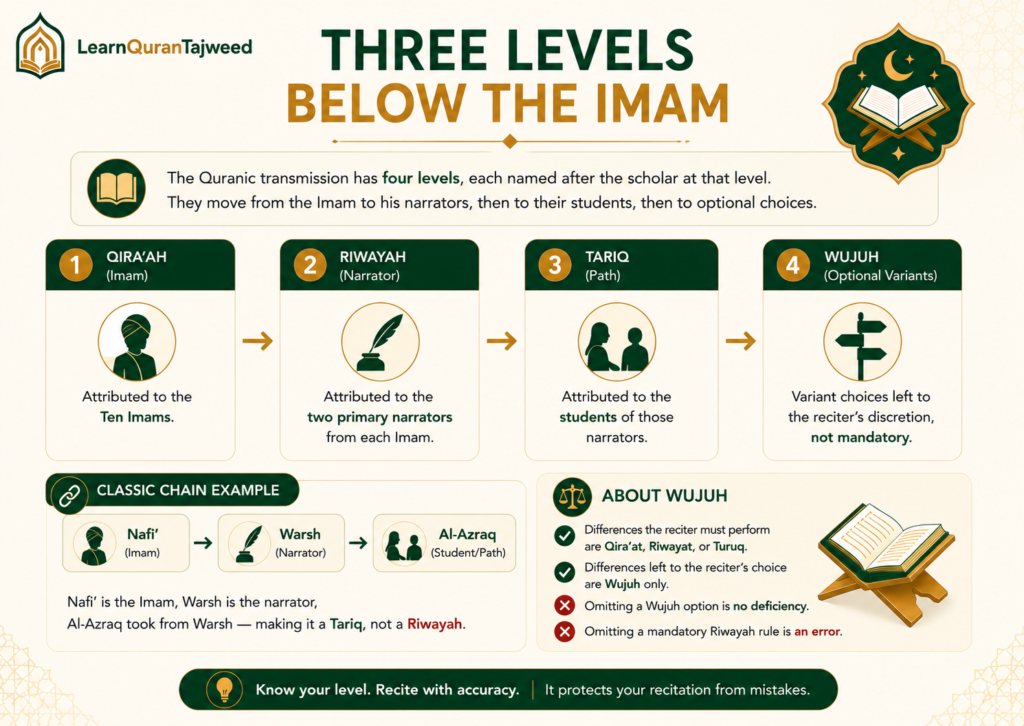
The classic full-chain example used in every classical text is: Qira’at Nafi’ — Riwayat Warsh — Tariq Al-Azraq. Nafi’ is the Imam. Warsh is the narrator. Al-Azraq is the one who took from Warsh, making his chain a Tariq, not a Riwayah.
The Wujuh are different in nature. The classical text Al-Wafi fi Kayfiyyat Tartil Al-Quran Al-Karim states it clearly: differences the reciter must perform to honor the Riwayah are called Qira’at, Riwayat, or Turuq. Differences left to the reciter’s free choice are Wujuh only. Omitting a Wujuh option is no deficiency. Omitting a mandatory Riwayah rule is an error.
Comparing Riwayat vs Qira’at Directly
The core distinction: Qira’at names what an Imam taught as a complete recitation system. Riwayat names what a specific narrator transmitted from that Imam. Below Riwayat, Turuq record sub-transmissions. Below Turuq, Wujuh record free choices.
| Level | Named After | Example |
| Qira’ah | Ten Imams of recitation | Qira’at Nafi’, Qira’at ‘Asim |
| Riwayah | Primary narrator from Imam | Riwayat Warsh, Riwayat Hafs |
| Tariq | Student of the narrator | Tariq Al-Azraq from Warsh |
| Wajh | Optional choice | Pause options, vowel variants |
The classical Arabic formulation is precise: every difference attributed to one of the Ten Imams is a Qira’ah. Every difference attributed to a narrator from that Imam is a Riwayah. Every difference attributed to those below the narrator is a Tariq.
Conditions for an Authentic Qira’ah
Not every recitation variation qualifies as a Qira’ah. Imam Ibn al-Jazari established three binding conditions in Al-Nashr fi al-Qira’at al-‘Ashr that every accepted Qira’ah must meet.
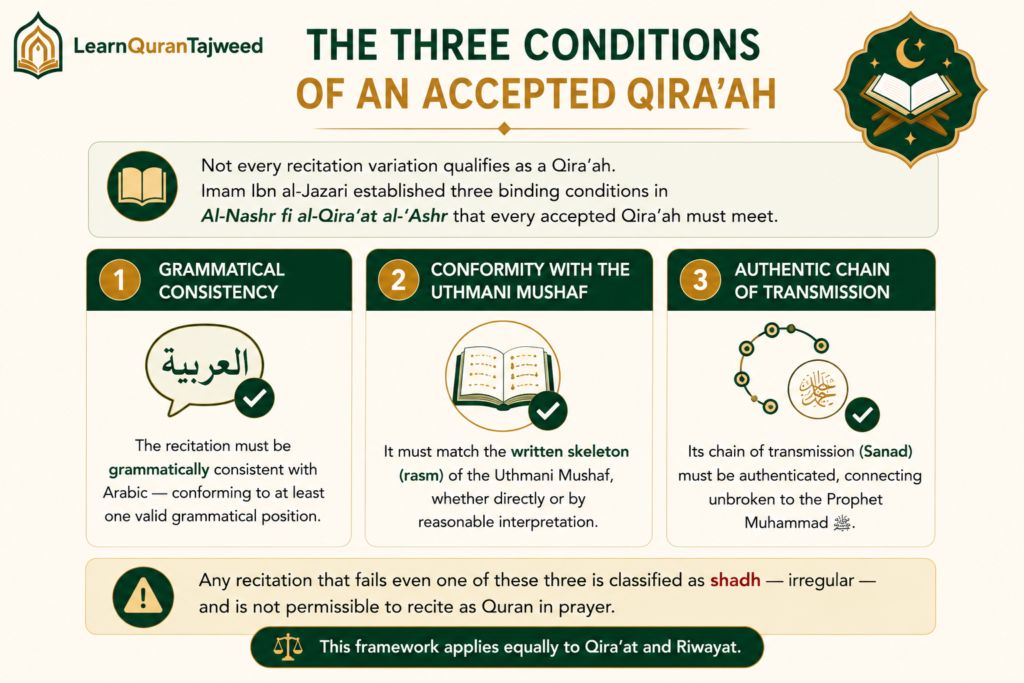
- First, the recitation must be grammatically consistent with Arabic — conforming to at least one valid grammatical position.
- Second, it must match the written skeleton (rasm) of the Uthmani Mushaf, whether directly or by reasonable interpretation.
- Third, its chain of transmission (Sanad) must be authenticated, connecting unbroken to the Prophet Muhammad ﷺ.
Any recitation that fails even one of these three is classified as shadh — irregular — and is not permissible to recite as Quran in prayer. This framework applies equally to Qira’at and Riwayat.
Read also: Qaloon Tajweed Rules, Recitation Principles and How to Learn Them Online
See Our Classrooms in Action
Watch these short clips from our live, interactive Quran courses to see how our students learn and interact with our expert tutors.
Perfect Your Quran Recitation Today
Join expert-led Tajweed classes, and recite the Quran with confidence and clarity.
Start Your Free TrialHafs an Asim and Its Global Dominance
Hafs ibn Sulayman al-Kufi (d. 180 AH) was the primary narrator of Imam ‘Asim al-Kufi. His Riwayah became the most widely recited in the Muslim world. Approximately 95% of Muslims worldwide recite through Hafs ‘an ‘Asim today.
Hafs taught extensively in Kufa, then in Baghdad — the Abbasid Caliphate’s capital — where students from across the Muslim world gathered. The Ottoman state later adopted Hafs ‘an ‘Asim as its official Riwayah. When the King Fahd Complex in Madinah began mass-printing Mushafs globally in the twentieth century, it used the Hafs narration, cementing its reach permanently.
Classical scholarship notes that Hafs ‘an ‘Asim was not always widespread — even in Kufa, Shu’bah ‘an ‘Asim was more common for centuries. The Riwayah’s global dominance is a product of institutional history, not superiority over other Riwayat.
Learn Quran Tajweed offers an Intermediate Tajweed Course for students who have completed the basics of Hafs ‘an ‘Asim and are ready to master advanced Sifaat and complex Ahkam with certified instruction.

Step into advanced recitation with the Intermediate Course
Warsh an Nafi and the Maghreb Standard
Warsh — ‘Uthman ibn Sa’id al-Qubti (d. 197 AH) — studied under Imam Nafi’ al-Madani in Madinah and brought his Riwayah back to Egypt, from where it traveled west across North Africa. Warsh ‘an Nafi’ is the standard recitation of Algeria, Morocco, Mauritania, and large parts of West Africa.
Warsh differs significantly from Hafs. The Hamzah is frequently facilitated (tashil). The Ra’ receives lightening (tarqiq) in many positions where Hafs applies emphasis (tafkhim). Madd lengths in Warsh are often longer. The content and meaning are identical — the phonological delivery is distinct.
Qalun — ‘Isa ibn Mina al-Zarqi (d. 220 AH) — was the second narrator from Imam Nafi’. His Riwayah became the official standard in Libya and much of Tunisia. Both Warsh and Qalun trace to the same Imam through authenticated, unbroken chains.
Read also: Riwayat Hamzah and its Tajweed Rules Principles
Al-Duri an Abi Amr Across Sub-Saharan Africa
Al-Duri — Hafs ibn ‘Umar al-Duri (d. 246 AH) — narrated from Imam Abu ‘Amr al-Basri. His Riwayah is today the dominant recitation across Sudan, Somalia, Chad, Nigeria, and much of Central and East Africa.
The spread of Al-Duri ‘an Abi ‘Amr through sub-Saharan Africa followed Maliki scholars and Sufi scholars moving along trade routes from the ninth century onward. They established Islamic learning centers across the Sahel and Horn of Africa, carrying this Riwayah with them.
Classical scholarship records that Imam Ibn al-Jazari in Ghayat al-Nihayah documented Al-Duri’s transmission as fully authenticated with an unbroken Sanad to the Prophet ﷺ. Its regional prevalence reflects historical transmission patterns, not any hierarchical ranking among Riwayat.
Raed also: Al-Duri Tajweed Rules and Recitation
Learn Quran Tajweed offers a Quran Recitation with Tajweed Course that trains correct applied pronunciation — building the habit of accurate recitation, not just knowledge of the rules.

Apply what you know in every verse with the Recitation Course
Why Printed Mushafs Look Different
A Mushaf printed in Saudi Arabia and one printed in Algeria carry the same Quran — the same consonantal skeleton (rasm) established by Sayyiduna ‘Uthman ibn ‘Affan. What differs are the vowel points and recitation markings, which reflect the specific Riwayah each Mushaf is typeset for.
A Mushaf printed for Hafs ‘an ‘Asim carries Hafs vowelization. A Mushaf printed for Warsh ‘an Nafi’ carries Warsh vowelization, which differs in hundreds of positions across the text. Neither is wrong. Neither is a different Quran.
The King Fahd Complex in Madinah produces authenticated Mushafs in Hafs, Warsh, Qalun, Al-Duri, and other Riwayat — acknowledging that the global Muslim community authentically recites through multiple Riwayat, all of equal validity.
Read also: Imam Khalaf Tajweed Rules, Narrators, and How It Differs From Hafs
Inside Learn Quran Tajweed Academy
Curious about how online learning works? Peek inside our actual Quran classes and hear the beautiful recitation of our students and teachers.
Start Your Quranic Journey with a Free Trial Session
Understanding Riwayat vs Qira’at in theory is one thing. Reciting correctly under certified guidance is where the knowledge becomes worship.
Sessions are one-on-one, flexible, and designed around your current level. Your certified tutor assesses your recitation, identifies what needs correction, and guides you through proper Tajweed systematically — one rule at a time.

Claim your free trial session and begin reciting with confidence
Courses we offer:
- Tajweed Course for Kids
- Tajweed Course for Adults
- Tajweed Course for Ladies
- Tajweed ul Quran Course
- Quran Recitation with Tajweed Course
- Quran Tarteel Course
- Tajweed Ijazah Program
Perfect Your Quran Recitation Today
Join expert-led Tajweed classes, and recite the Quran with confidence and clarity.
Start Your Free TrialConclusion
Riwayat and Qira’at are not interchangeable. A Qira’ah belongs to one of the Ten Imams and names an entire recitation system confirmed by all narrators from that Imam. A Riwayah belongs to a primary narrator and records how that narrator specifically transmitted the Imam’s recitation. Below Riwayat sit Turuq, and below those, the optional Wujuh.
Every Mushaf a Muslim opens today — whether in Hafs, Warsh, Qalun, or Al-Duri — reflects this exact hierarchy. One Quran, one rasm, multiple authenticated Riwayat. Knowing where Riwayat and Qira’at each sit in that chain turns a student of Tajweed into a student of the Quranic sciences.
Read also: Riwayat Hamzah and its Tajweed Rules Principles
Frequently Asked Questions
What is the difference between Riwayat and Qira’at?
Qira’at is attributed to one of the Ten Imams of recitation, confirmed by consensus of all narrators from that Imam. Riwayat is attributed to a primary narrator who took from one of those Imams. Every Qira’ah has two main Riwayat named after its two narrators.
Are all Riwayat equally valid recitations of the Quran?
Yes. Every authenticated Riwayah meets Ibn al-Jazari’s three conditions: grammatical validity, conformity with the Uthmani rasm, and an unbroken chain to the Prophet ﷺ. No Riwayah is superior to another — they are all the preserved word of Allah.
Why do most Muslims recite Hafs an Asim specifically?
Hafs ‘an ‘Asim spread through Kufa, then Baghdad, then the Ottoman state, which adopted it officially. The King Fahd Complex later mass-printed it globally. Its dominance is historical and institutional — not a sign of greater authenticity than other Riwayat.
Can I recite in Warsh if I learned Hafs?
Yes, but only after structured study under a certified teacher of Warsh ‘an Nafi’. Mixing rules from two Riwayat without proper training introduces recitation errors. Master one Riwayah fully before beginning a second.
What is a Tariq in the transmission hierarchy?
A Tariq is attributed to a student of the primary narrator (Rawi). It sits one level below the Riwayah. The classic example: Qira’at Nafi’ — Riwayat Warsh — Tariq Al-Azraq. Al-Azraq took from Warsh, placing his transmission at the Tariq level.
Why do Mushafs in different countries look different?
All authenticated Mushafs share the same Uthmanic consonantal skeleton (rasm). The vowel markings differ because each Mushaf is typeset for a specific Riwayah. A Saudi Mushaf uses Hafs vowelization. A Moroccan Mushaf uses Warsh vowelization. Same text, different Riwayah-specific annotation.