 Quran
Quran
| Key Takeaways |
| Surah Yaseen opens with a Madd Lazim Harfi Mukhaffaf on the letter “Seen,” requiring a mandatory six-count elongation. |
| The Noon Sakinah in Surah Yaseen triggers all four rules: Idhhar, Idgham, Ikhfa, and Iqlab — making it ideal for mastering these applications. |
| A Saktah (silent pause without breath) appears in Surah Yaseen at Ayah 52, marked by a small “س” above the word مَرْقَدِنَا. |
| Listening to Sheikh Mahmoud Khalil Al-Husary’s Muallim recording at least ten times per segment trains the ear before the tongue attempts recitation. |
| Presenting your recitation to a certified instructor remains irreplaceable — no recording or app can correct hidden articulation errors independently. |
Surah Yaseen holds a distinctive place in the hearts of Muslims worldwide, yet many students who attempt to learn it with proper Tajweed find themselves stuck — not because the rules are impossible, but because they approach the Surah without a structured method.
Learning Surah Yaseen with Tajweed is absolutely achievable for non-Arabic speakers when you follow a precise, sequence-based learning system grounded in how the ear, tongue, and mind work together.
The correct approach combines guided listening, Tajweed rule identification within the Surah itself, imitation practice, self-recording, and — most importantly — live correction from a certified instructor. Each step builds on the last, transforming passive reading into confident, accurate Tarteel.
Why Surah Yaseen Demands a Tajweed-Specific Learning Strategy?
Surah Yaseen is not simply long — it is Tajweed-dense. The Surah contains a rare Madd Lazim, a Saktah, repeated applications of all four Noon Sakinah rules, and multiple Meem Sakinah scenarios within a single page.
Students who attempt to read it without identifying these rules first consistently produce the same cluster of errors.
At Learn Quran Tajweed Academy, students who arrive having “memorized” Surah Yaseen informally almost always carry ingrained mispronunciations — particularly in the elongation of the Seen in “يس” and in collapsing Idgham sounds into plain pronunciation. The Surah rewards disciplined, rule-aware learning and exposes undisciplined reading immediately.
Our Beginner Tajweed Course is specifically structured to give students the foundational rule knowledge needed before tackling rule-heavy Surahs like Yaseen — ensuring they read with understanding, not guesswork.
Begin your Tajweed journey with a free lesson

1. Train Your Ear Before Training Your Tongue in Surah Yaseen
The ear must hear correctly before the tongue can speak correctly. This is not motivational advice — it is how phonological acquisition works, and every certified Tajweed instructor will confirm it from teaching experience.
Choosing the Right Reciter for Imitation Practice
For learning purposes, Sheikh Mahmoud Khalil Al-Husary’s Muallim (teaching) recording is the most pedagogically suitable. His Muallim version deliberately slows the recitation, exaggerates rule boundaries, and makes Ghunnah durations audible even to untrained ears.

Sheikh Muhammad Siddiq Al-Minshawi’s slow recitation is equally valuable for internalizing melodic phrasing while maintaining rule accuracy. Both are available on major Quran audio platforms.
The Segment-Based Listening Method
Never listen to the full Surah passively. Divide Surah Yaseen into daily segments of three to five ayahs. Listen to each segment a minimum of ten times — with your eyes following a color-coded Tajweed Mushaf, which visually highlights each rule category.
This dual-channel approach (audio + visual) dramatically shortens the time needed before imitation becomes accurate.
Shots Videos from Our Courses
Perfect Your Quran Recitation Today
Join expert-led Tajweed classes, and recite the Quran with confidence and clarity.
Start Your Free Trial2. Master The Role of Makharij Accuracy in Reciting Surah Yaseen Correctly
The Makharij al-Huruf — the precise articulation points of Arabic letters — determine whether your recitation is phonetically valid. Surah Yaseen contains letters that non-Arabic speakers consistently mispronounce.
The Seen (س) versus Sad (ص) distinction is critical: the Sad carries Tafkhim (heaviness) and is produced with the tongue raised toward the palate, while the Seen is light (Tarqiq) and produced with the tongue near the front teeth. Confusing these two letters — which appears in words like صِرَٰط مُّسْتَقِيم — constitutes a Lahn Jali (gross recitation error). For more detail, see the guide on Tafkheem and Tarqeeq and Lahn in Tajweed.
The importance of a live instructor is most evident here. No recording can watch your jaw position, tongue placement, or lip tension. These physical corrections only happen through Mushafahah — face-to-face (or live video) instruction with a certified Qari.
3. Know the Main Tajweed Rules in Surah Yaseen Before Starting
Before reciting a single ayah, you must understand the specific rules that appear in this Surah. Attempting to learn Surah Yaseen with Tajweed without this knowledge is like trying to read a map without knowing what the symbols mean.
The Opening Letters “يس” and the Madd Lazim Harfi Mukhaffaf
The Surah opens with two Muqatta’at letters. The Ya (يا) carries a natural Madd Tabi’i of two counts. The Seen (سين), however, carries a Madd Lazim Harfi Mukhaffaf — a mandatory elongation of six counts, because the middle letter of the word “سين” is a Madd letter followed by a Sukoon within the same word-unit.
This is one of the most commonly mispronounced openings in the Quran. Students habitually shorten the Seen to two or four counts. The rule is non-negotiable: six counts, always. For a full breakdown of this category, see the Tajweed Madd rules guide.
Read also: What Is the Difference between Tarteel and Tajweed?
The Noon Sakinah Rules as They Appear in Surah Yaseen
The rules of Noon Sakinah and Tanween are applied repeatedly throughout Surah Yaseen. Here is where each rule appears:
| Rule | Example from Surah Yaseen | Condition |
| Idhhar | إِن كَانَت — Noon before ك → Idhhar | Noon before throat letters (أ ه ع ح غ خ) |
| Idgham | صِرَٰط مُّسْتَقِيم — Tanween + م → Idgham with Ghunnah | Noon/Tanween before ي ن م و ل ر |
| Iqlab | مِنۢ بَعْدِه — Noon before ب → Iqlab | Noon/Tanween before ب only |
Mastering these four rules within the context of Surah Yaseen gives you practical command — not just theoretical knowledge.
4. Do Not Miss The Saktah in Surah Yaseen
The Saktah — a brief, silent pause without inhaling — is one of the most nuanced stops in Tajweed, and Surah Yaseen contains one of its most well-known positions. It occurs in Ayah 52:
مِن مَّرْقَدِنَا ۜ هَٰذَا مَا وَعَدَ ٱلرَّحْمَٰنُ
Min marqadinā — hādhā mā wa’adar-Raḥmān
“[They will say], ‘Woe to us! Who has raised us up from our sleeping place?’ [They will be told], ‘This is what the Most Merciful had promised.'” (Ya-Sin 36:52)
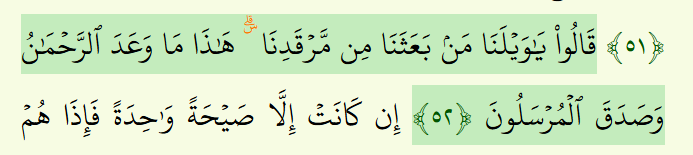
The small “س” above مَرْقَدِنَا signals this Saktah. The reciter pauses for approximately one count — no breath taken, vocal cords still.
Most students either take a breath (making it a regular Waqf) or ignore the symbol entirely and connect the words. Both approaches violate the intended reading in the narration of Hafs ‘an ‘Asim.
Perfect Your Quran Recitation Today
Join expert-led Tajweed classes, and recite the Quran with confidence and clarity.
Start Your Free Trial5. Apply the Madd Rules Correctly Transforms Your Recitation of Surah Yaseen
The Madd rules are where the beauty and discipline of Surah Yaseen truly emerge. Applying them accurately transforms recitation from mechanical reading into Tarteel. For a complete reference, see the Tajweed Madd rules guide with chart.
Madd Muttasil in Surah Yaseen
Madd Muttasil occurs when a Madd letter is followed by a Hamzah within the same word. In Surah Yaseen:
جَآءَ and ٱلسَّمَآءِ
Both require four to five counts of elongation (the accepted range in Hafs). Students frequently reduce these to two counts, flattening the recitation and technically violating a Wajib (obligatory) Madd.
Madd Munfasil in Surah Yaseen
Madd Munfasil occurs when the Madd letter ends one word and the Hamzah begins the next:
قَالُوٓا۟ إِنَّا
This requires four to five counts under the Hafs narration when reading with Wasl (connection). See the full Madd Munfasil guide for the precise scholarly positions.
| Madd Type | Example in Surah Yaseen | Count (Hafs) |
| Madd Lazim Harfi Mukhaffaf | يس — the Seen | 6 counts |
| Madd Muttasil | جَآءَ — جَآءَنَا | 4–5 counts |
| Madd Munfasil | قَالُوٓا۟ إِنَّا | 4–5 counts |
| Madd Tabi’i (Natural) | يس — the Ya | 2 counts |
| Madd ‘Arid lil-Sukoon | Pause at end of most ayahs | 2, 4, or 6 counts |
The Madd ‘Arid lil-Sukoon deserves specific attention: every time you pause at the end of an ayah in Surah Yaseen, this rule applies — and the permissible range of two, four, or six counts gives you flexibility, provided you are consistent within a single recitation sitting.
Our Students Reviews
Perfect Your Quran Recitation Today
Join expert-led Tajweed classes, and recite the Quran with confidence and clarity.
Start Your Free Trial6. Apply The Self-Recording Method That Accelerates Tajweed Correction
After sufficient listening, imitation practice begins — and the single most effective tool available to you outside of a live teacher is your own voice recorded back to you.
Record yourself reciting a three-to-five ayah segment. Then play your recording alongside the Sheikh’s recitation, pausing at each rule application.
You will hear the discrepancies that your brain masked during live recitation — a shortened Madd, a missing Ghunnah, a Saktah converted into a breath.
Students at Learn Quran Tajweed Academy who adopt this method before their weekly sessions consistently arrive with self-identified errors, which allows instructors to address deeper issues rather than surface corrections. This compounds learning speed significantly.
Our Practical (Amali) Tajweed Course is built around exactly this applied methodology — combining self-review with live instructor correction in a structured weekly cycle.
Join our Practical Tajweed Course and get a free trial

Read also: How to Practice Tajweed Daily?
Begin Your Surah Yaseen Tajweed Practice at Learn Quran Tajweed Academy
Accurate Tajweed in Surah Yaseen requires more than rules memorized from a page — it requires structured practice, real-time correction, and a qualified instructor who has guided students through exactly these challenges.
Learn Quran Tajweed Academy offers:
- Ijazah-certified instructors specializing in Hafs ‘an ‘Asim
- Personalized 1-on-1 sessions tailored to your current recitation level
- Flexible scheduling available 24/7 for students worldwide
- Structured progression from foundational rules to complete Surah mastery
- A specialized focus on Tajweed — not a generalist approach
Book your free trial lesson today and receive a recitation assessment with personalized correction from a certified instructor.
Perfect Your Quran Recitation Today
Join expert-led Tajweed classes, and recite the Quran with confidence and clarity.
Start Your Free TrialCheck out the best tajweed course for your needs:
- Practical Tajweed Course
- Beginner Tajweed Course
- Intermediate Tajweed Course
- Advanced Tajweed Course
- Quran Tarteel Course
- Tajweed Ijazah Program
- Tajweed Course for Sisters
- Tajweed course for Kids
Book your free trial Tajweed lesson today

Conclusion
Mastering Surah Yaseen with Tajweed is a structured, achievable goal — not a distant ideal. The Surah’s Tajweed density makes it a genuine test of rule application, and passing that test requires moving through deliberate stages: informed listening, rule identification, imitation, self-correction, and live instructor verification.
Every rule you apply correctly in Surah Yaseen — from the six-count Madd on the Seen to the silent Saktah in Ayah 52 — is an act of reverence toward the words of Allah. Precision here is not pedantry; it is a form of worship.
The path is clear. The tools exist. What remains is consistent, patient practice — supported, Insha’Allah, by qualified guidance.
Frequently Asked Questions About Learning Surah Yaseen with Tajweed
How Long Does It Take to Learn Surah Yaseen with Tajweed Correctly?
Most non-Arabic speaking adults who study consistently — three to four sessions per week with a certified instructor — achieve accurate Tajweed application throughout Surah Yaseen within 2 to 5 months. This estimate assumes prior foundational knowledge of core Tajweed rules. Students beginning with no Tajweed background will need longer with a structured beginner program first.
Is It Permissible to Learn Surah Yaseen Tajweed Only from Recordings?
Recordings are an essential listening tool but are insufficient alone for certified Tajweed learning. Classical scholars established that Tajweed must be taken through Mushafahah — direct transmission from teacher to student. Recordings cannot observe or correct your articulation points, Ghunnah duration, or breath management. They supplement live instruction; they do not replace it.
Do I Need to Memorize Surah Yaseen Before Applying Tajweed?
No — and attempting to memorize before Tajweed is accurate often embeds errors that become very difficult to correct later. The recommended sequence is: learn the Tajweed rules applicable to each segment, practice that segment with correct rules applied, verify with an instructor, then commit to memory. Memorization built on correct Tajweed is far more stable.