 Tajweed Resources

| Key Takeaways |
| Tajweed Made Easy by Ruquiyah Islam covers 12 core Tajweed topics including makharij, sifat, ghunnah, qalqalah, and complete madd rules in one structured volume. |
| The book uses colorful articulation diagrams showing exact letter origin points in the mouth and tongue, making makharij visual and accessible for non-Arabic speakers. |
| Each chapter ends with review questions targeting critical learning areas, making it suitable for both self-study and structured classroom use. |
| The book addresses all four rules of noon sakinah and tanween — izhaar, idghaam, ikhfa, and iqlaab — with Quranic verse examples throughout every lesson. |
| While the book is a strong theoretical foundation, mastering Tajweed application requires live correction from an Ijazah-certified instructor alongside any written resource. |
Students searching for a structured Tajweed resource in English frequently ask one question: does Tajweed Made Easy actually deliver what it promises? The short answer is yes — with one important condition.
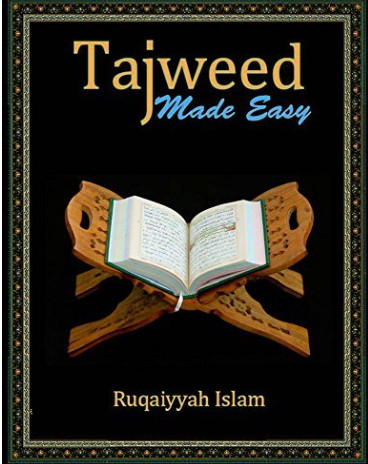
Authored by Ruquiyah Islam and illustrated by Reza Al-Amin, this book builds Tajweed knowledge systematically, covering everything from basic articulation points to complex madd rules in a format non-Arabic speakers can realistically follow.
The book’s real strength is its visual approach to makharij combined with ample Quranic examples at every stage. It functions best as a structured companion to live instruction, not a standalone replacement.
What Topics Does the Tajweed Made Easy Book Actually Cover?
Tajweed Made Easy covers twelve core Tajweed topic areas in one volume: makharij al-huruf (articulation points), sifat al-huruf (letter characteristics), ghunnah, qalqalah, letters of elevation (tafkhim) and lowness (tarqiq), letters of audibility (jahr) and whisper (hams), the four rules of noon sakinah and tanween, meem sakinah rules, lam sakinah rules, and the complete mudood (madd) system. This scope makes it one of the more thorough English-language Tajweed texts available.
How Tajweed Made EasyBook Sequences Its Topics
The sequencing reflects sound pedagogical logic — makharij come first because correct articulation is the foundation of every rule that follows. A student who cannot distinguish the makhraj of ح from ه will misapply every rule involving those letters, regardless of how well they memorize the rule definitions.
The progression from makharij → sifat → ghunnah → qalqalah → tafkhim and tarqiq → noon sakinah rules → meem sakinah rules → madd mirrors the sequencing used in traditional Tajweed academies and is academically sound.
Is the Makharij Section Useful for Non-Arabic Speakers?
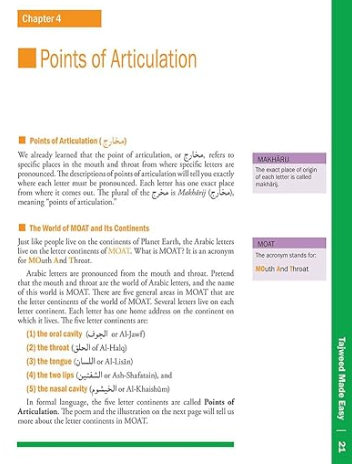
The makharij section is where this book genuinely distinguishes itself. Colorful, realistic diagrams show the exact origin point of each letter inside the mouth and tongue — not as abstract descriptions, but as visual cross-sections students can actually reference while practicing.
At Learn Quran Tajweed Academy, students in our Beginner Tajweed Course consistently struggle most with the throat letters — ع, ح, غ, خ, ه, ء — and with distinguishing ض from ظ.
Before students have a visual reference for where these sounds originate, they approximate without even realizing it. A well-drawn diagram showing the mid-throat origin of ع compared to the upper-throat position of غ gives students a physical target to aim for.
Begin your Tajweed journey with a free lesson

What Does the Tajweed Made Easy Book Get Right About Sifat?
The sifat (letter characteristics) section covers both Sifat Lazimah (permanent attributes) and Sifat ‘Aridah (contingent attributes) — the distinction that separates surface-level Tajweed knowledge from genuine mastery.
Many English Tajweed resources collapse these categories or omit Sifat ‘Aridah entirely.
| Sifat Category | Examples Covered | Practical Impact |
| Sifat Lazimah (Permanent) | Jahr, Hams, Shiddah, Rakhawah, Tawassut | Always present with the letter |
| Sifat ‘Aridah (Contingent) | Tafkhim, Tarqiq, Idghaam, Madd | Dependent on context and surrounding letters |
Understanding this distinction matters enormously for applying Tajweed rules correctly at the intermediate and advanced levels.
How Does the Book Handle Noon Sakinah and Tanween Rules?
The four rules of noon sakinah and tanween — Izhaar, Idghaam, Ikhfa, and Iqlaab — receive dedicated treatment with Quranic verse examples illustrating each rule in context. This is the rule set that most non-Arabic speaking students encounter first as a genuine system, and the book handles it clearly.
For the full rule breakdown with applied examples, our detailed guide on noon sakinah rules covers every case with the precision live students need.
Izhaar Halqi: Where Students Commonly Err
Izhaar Halqi requires clear, unmerged pronunciation of noon sakinah or tanween when followed by one of the six throat letters (ء، هـ، ع، ح، غ، خ). The book correctly identifies all six letters and provides examples.
One consistent pattern I observe in students who have studied from this book independently: they understand the rule intellectually but still produce a slight nasal bleed into the following letter — particularly before ع and ح.
This is not a book failure; it is the inherent limitation of text-based Tajweed learning. The ear needs a live reference point.
Shots Videos from Our Courses
Perfect Your Quran Recitation Today
Join expert-led Tajweed classes, and recite the Quran with confidence and clarity.
Start Your Free TrialIdghaam, Ikhfa, and Iqlaab Coverage
The book’s treatment of Idghaam in Tajweed correctly distinguishes between Idghaam with Ghunnah and Idghaam without Ghunnah — a distinction that carries real recitation consequences. Ikhfa is presented with its 15 letters and the characteristic concealment with nasal resonance held for two counts of ghunnah. Iqlaab rules receive accurate treatment with the conversion of noon sakinah to an م sound before ب.
A Quranic example of Ikhfa in context:
مِنْ شَرِّ مَا خَلَقَ
Min sharri maa khalaq
“From the evil of what He created.” (Al-Falaq 113:2)
(Demonstrates Ikhfa: نْ + شَ — noon sakinah before shin requires concealment with two counts of nasal resonance)
Does Tajweed Made Easy Book Cover Ghunnah and Qalqalah Accurately?
Ghunnah — the nasal resonance produced through the nose — is treated as a foundational characteristic of ن and م when carrying shaddah, and as an essential component of Ikhfa and Idghaam with Ghunnah. The book’s ghunnah rules coverage is accurate and includes the standard two-count duration.
For Qalqalah — the echoing bounce produced when one of the five letters ق، ط، ب، ج، د carries sukoon — the book addresses both the mechanism and the distinction between minor qalqalah (mid-word) and major qalqalah (end of word or waqf). Our detailed guide on what is qalqalah in Tajweed expands on the three levels with applied examples that complement the book’s coverage.
How Does Tajweed Made Easy Book Address Madd Rules?
The mudood (madd) system receives thorough treatment covering the major madd categories. Madd is where many self-studying students hit a wall — the rules involve both letter identification and count-based timing that is genuinely difficult to internalize without hearing correct application.
| Madd Type | Trigger Condition | Duration |
| Madd Asli (Natural) | Madd letter with no hamzah or sukoon following | 2 counts |
| Madd Munfasil | Madd letter ends word; hamzah begins next word | 2–4–5 counts |
| Madd Muttasil | Madd letter and hamzah in same word | 4–5 counts (obligatory) |
| Madd ‘Arid lil-Sukoon | Madd letter followed by sukoon at waqf | 2, 4, or 6 counts |
| Madd Lazim | Madd letter followed by permanent sukoon or shaddah | 6 counts |
For the complete system with additional madd types and chart, our Tajweed madd rules guide serves as an excellent companion reference.
Perfect Your Quran Recitation Today
Join expert-led Tajweed classes, and recite the Quran with confidence and clarity.
Start Your Free TrialWhat Are the Real Limitations of the Tajweed Made Easy Book?
Tajweed Made Easy is a strong written resource, but three genuine limitations deserve honest mention before purchase.
First, pronunciation cannot be transmitted through text. No written description of where to place the tongue for ض fully substitutes for hearing a certified Qari produce it correctly while you observe. This is true of every Tajweed book — not a specific criticism of this one.
Second, the review questions at chapter ends test recognition of rules, not application. A student can answer every question correctly and still mispronounce the letters those rules govern. Testing comprehension and testing recitation accuracy are different tasks.
Third, tafkhim and tarqiq (letter elevation and lowness) require nuanced training that text struggles to convey. The book covers the topic — but the graduated weight levels of the ر letter in different vowel environments, for example, require sustained ear training alongside reading.
Students pursuing Ijazah certification through our Tajweed Ijazah Program use structured texts like this as preparation material — but the actual certification path requires chain-verified oral transmission, not written assessment.
Join our Tajweed Ijazah Program and get a free trial

Who Is the Tajweed Made Easy Book Best Suited For?
The book serves three student profiles well and one profile less well.
It works excellently for:
- Beginners transitioning from basic Arabic reading to structured Tajweed study
- Students who want a clear theoretical map before or alongside live instruction
- Teachers preparing structured lesson plans for Tajweed classes
- Students enrolled in a live course who want a reliable written reference
It works less well for:
- Advanced students needing edge-case rule interactions and scholarly nuance
- Students who need oral modeling alongside written explanation
- Those pursuing Ijazah who need chain-verified transmission methodology
For students at the intermediate level ready to move beyond foundational rules, Learn Quran Tajweed Academy’s Intermediate Tajweed Course provides the structured live progression that advances recitation quality beyond what any book can achieve alone. Similarly, our Amali (Practical) Tajweed Course focuses specifically on applied recitation — the dimension books cannot replicate.
Our Students Reviews
Perfect Your Quran Recitation Today
Join expert-led Tajweed classes, and recite the Quran with confidence and clarity.
Start Your Free TrialJoin our Practical Tajweed Course and get a free trial

Begin Your Tajweed Mastery with Certified Instruction at Learn Quran Tajweed Academy
Tajweed Made Easy provides solid theoretical grounding — but real recitation transformation happens through live, personalized correction.
Learn Quran Tajweed Academy offers:
- Ijazah-certified instructors specializing in Hafs ‘an ‘Asim
- Personalized 1-on-1 sessions tailored to your exact recitation level
- Flexible scheduling available 24/7 for students worldwide
- Structured progression from beginner rules through full Ijazah certification
- Specialized focus: Tajweed only — not a generalist Quran platform
Book your FREE trial lesson today and hear the difference certified live instruction makes.
Check out the best tajweed course for your needs:
- Practical Tajweed Course
- Beginner Tajweed Course
- Intermediate Tajweed Course
- Advanced Tajweed Course
- Quran Tarteel Course
- Tajweed Ijazah Program
- Tajweed Course for Sisters
- Tajweed course for Kids
Book your free trial Tajweed lesson today

Conclusion
Tajweed Made Easy earns its high ratings for legitimate reasons — it covers the full scope of Tajweed topics in a format non-Arabic speakers can actually follow, with visual makharij diagrams that address the real learning gap most English-language students face. Used correctly, it maps the theoretical terrain that live instruction then brings into accurate, embodied practice.
The most effective Tajweed learning path has always combined structured written study with certified oral correction. A book develops understanding; a teacher develops the ear, the tongue, and the recitation. Insha’Allah, students who approach this resource as a companion to live instruction — rather than a substitute for it — will find it genuinely valuable.
Read Also: The Jazariyyah Tajweed Poem
Frequently Asked Questions About the Tajweed Made Easy Book
Is the Tajweed Made Easy Book Suitable for Complete Beginners?
Tajweed Made Easy works for students who can already read basic Arabic script. It is not designed to teach the Arabic alphabet from scratch. Students with foundational Arabic reading ability will find the sequencing logical and accessible, beginning with makharij and building systematically through all major Tajweed rule categories with Quranic examples.
Does the Tajweed Made Easy Book Follow the Hafs ‘an ‘Asim Recitation Method?
The book follows standard Tajweed rules as applied in the Hafs ‘an ‘Asim narration — the most widely used recitation method globally and the standard in nearly all English-language Tajweed instruction. Rules covering noon sakinah, meem sakinah, madd, and qalqalah are all presented according to this narration.
Can the Tajweed Made Easy Book Replace a Live Tajweed Teacher?
No written Tajweed resource can fully replace a certified instructor. Books transmit rules; teachers transmit pronunciation. Tajweed is an oral science — the Prophet ﷺ received Quran orally and transmitted it the same way. The book is most effective as structured preparation for, or a companion to, live sessions with an Ijazah-certified instructor.
Does the Tajweed Made Easy Book Include Enough Quranic Examples to Reinforce Rules?
Yes — Quranic verse examples are included throughout each lesson, not gathered at the end. This approach reinforces rules in context as they are learned, which is the pedagogically sound method. Review questions at the end of each chapter further target the critical distinctions students most commonly confuse.