 Tajweed Basics

Among the letters that demand the most careful attention in Quranic recitation, the letter Raa stands in a class of its own. Its pronunciation shifts between heavy and light based on precise grammatical and phonetic conditions—conditions that even experienced reciters sometimes misapply.
The rules of Raa in Tajweed divide into three core categories: mandatory tafkheem (heaviness), mandatory tarqeeq (lightness), and cases permitting both. Mastering these rules transforms your recitation from technically acceptable to genuinely beautiful and accurate.
Tafkheem and Tarqeeq of Raa
Tafkheem of Raa means pronouncing the Raa with a full, rounded heaviness, where the back of the tongue rises toward the soft palate. Tarqeeq of Raa means pronouncing it with lightness, keeping the tongue flat and the sound thin.
The Raa is a mutaraddid (oscillating) letter—its weight changes depending entirely on the vowel environment surrounding it.
This is why the rules of Raa in Tajweed require a structured, rule-by-rule approach rather than a feel-based guess.
At Learn Quran Tajweed Academy, our Intermediate Tajweed Course dedicates entire structured sessions to Raa rules precisely because students at this level often apply tafkheem and tarqeeq inconsistently.
Working with Ijazah-certified Qaris ensures that each case is corrected in real time through personalized 1-on-1 instruction.
Join our Intermediate Tajweed Course and get a free trial

How Do We Pronounce the Letter Raa in Quran?
The letter Raa is articulated from the tip of the tongue touching just above the upper front teeth, near the gum line.
This makharij point is shared with Noon and Lam, but Raa carries a unique rolling quality that distinguishes it.
When applying tafkheem, the sound produced should feel full in the mouth, resonant and thick. When applying tarqeeq, the tongue stays relaxed and the sound remains thin, similar to how the letter Raa sounds in the French word “rivière” but without the French roll.
Understanding this articulation point is the foundation for all examples of tafkheem and tarqeeq of Raa discussed throughout this guide.
Explore Al-Menhaj Book (Learn to Read Quran)
Tafkheem of Raa in the Quran with Examples
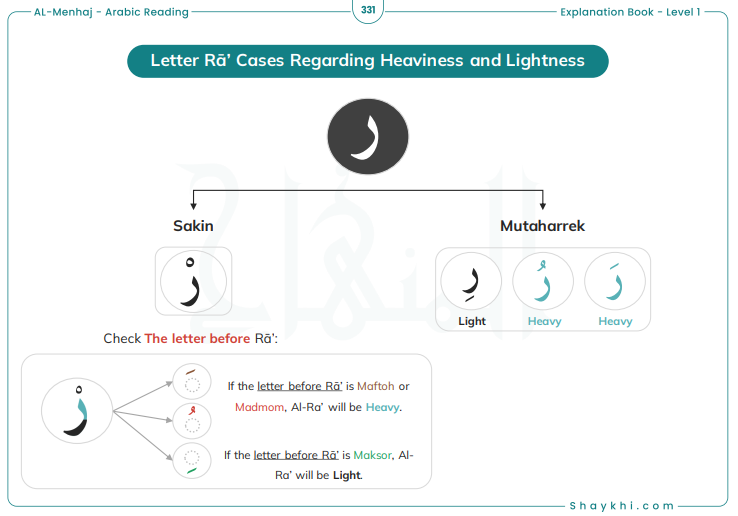
The rules tafkheem and tarqeeq of Raa begin with the tafkheem side, which has more conditions than most students expect. There are seven distinct situations that mandate heaviness in the Raa.
1. Raa carrying a dammah or fathah is always heavy
When the Raa itself carries a dammah or a fathah, tafkheem is obligatory without exception. This is the most straightforward of all Raa rules.
رُوحِ الْقُدُسِ
Rūḥil-Qudus
“The Holy Spirit” (Al-Baqarah 2:87)
Raa with dammah — mandatory tafkheem
وَتَرَى الْجِبَالَ
Wa taral-jibāl
“And you will see the mountains” (An-Naml 27:88)
Raa with fathah — mandatory tafkheem
2. Raa saakin after a dammah or fathah carries tafkheem
When the Raa is saakin (carries sukoon) and the letter immediately before it carries a dammah or fathah, the Raa must be read with heaviness. The preceding vowel “colors” the Raa with its heaviness.
A clear example is the word “القرآن” — the Raa is saakin and preceded by a letter with fathah, making tafkheem obligatory. Similarly:
زُرْتُمُ الْمَقَابِرَ
Zurtumul-maqābir
“You visited the graves” (At-Takathur 102:2)
Raa saakin after dammah — mandatory tafkheem
3. Raa saakin after a non-Yaa saakin letter preceded by fathah or dammah
When the Raa is saakin and preceded by another saakin letter (that is not Yaa), and the letter before that saakin carries a fathah or dammah, tafkheem applies. The heaviness “jumps over” the intervening saakin.
لَيْلَةُ الْقَدْرِ
Laylatul-Qadr
“The Night of Decree” (Al-Qadr 97:1)
Raa saakin, preceded by saakin Daal, preceded by fathah — tafkheem
4. Raa saakin after an incidental kasrah takes tafkheem
An incidental (aarid) kasrah is one that appears only for grammatical connection purposes, not as an original vowel of the word. In such cases, the Raa is still read with tafkheem.
لِمَنِ ارْتَضَى
Liman irtaḍā
“For whom He is pleased with” (Al-Anbiya 21:28)
Kasrah on Noon is incidental — Raa takes tafkheem
5. Raa saakin after original kasrah followed by a non-kasrah harf isti’laa in the same word
This is one of the more nuanced Raa rules. When Raa saakin follows a genuine kasrah, it would normally take tarqeeq.
However, if a harf isti’laa (letter of elevation: خ، ص، ض، ط، ظ، غ، ق) follows the Raa in the same word and that letter is NOT itself kasrah, tafkheem takes over.
| Word | Condition | Ruling |
| قِرْطَاس (Qirtas) | Raa saakin after kasrah, Taa (isti’laa) follows in same word | Tafkheem |
| مِرْصَاد (Mirsaad) | Raa saakin after kasrah, Saad (isti’laa) follows in same word | Tafkheem |
Perfect Your Quran Recitation Today
Join expert-led Tajweed classes, and recite the Quran with confidence and clarity.
Start Your Free TrialRead also: Tanween in Tajweed: A Complete Guide to Types, Rules, and Recitation Application
Tarqeeq of Raa in the Quran with Examples
The tarqeeq side of the rules of Raa in Tajweed contains five conditions, each requiring the reciter to maintain a light, thin pronunciation.
1. Raa carrying a kasrah is always light
When the Raa itself carries a kasrah, tarqeeq is mandatory. This is the mirror condition of the tafkheem fathah/dammah rule.
رِزْقًا لِلْعِبَادِ
Rizqan lil-‘ibād
“Provision for the servants” (Qaf 50:11)
Raa with kasrah — mandatory tarqeeq
2. Raa saakin after an original kasrah in the same word with no following harf isti’laa
When Raa saakin follows a genuine kasrah and no harf isti’laa comes after it in the same word, the kasrah’s lightness dominates and tarqeeq applies.
The word “فِرْعَوْن” (Fir’awn) demonstrates this clearly — the Raa is saakin, the preceding kasrah is original, and no harf isti’laa follows it in the same word.
Similarly, “الفِرْدَوْس” (Al-Firdaws) follows the same ruling.
3. Raa saakin at the end of a word after a saakin non-Yaa letter preceded by kasrah
This rule applies only when stopping (waqf). When pausing on a word ending in Raa, and the letter before the Raa is saakin (and not Yaa), and the letter before that saakin carries a kasrah — tarqeeq applies at waqf.
The words “الذِّكْر” (Ath-Thikr), “السِّحْر” (As-Sihr), and “الشِّعْر” (Ash-Shi’r) all take tarqeeq when stopped upon. The condition requires that the intervening saakin is not a harf isti’laa.
4. Raa saakin at the end of a word after a saakin Yaa takes tarqeeq
When pausing on a word where Raa is preceded by a saakin Yaa, tarqeeq is obligatory at waqf. The Yaa is itself a letter of lightness (istifal), and its influence guarantees tarqeeq.
Words like “قَدِير” (Qadeer) and “نَذِير” (Nadheer) demonstrate this clearly. The saakin Yaa before the Raa ensures tarqeeq when stopping.
5. Raa saakin after original kasrah when the following harf isti’laa is in a separate word
Even when a harf isti’laa appears near a Raa saakin, if that letter belongs to a different word, it cannot impose tafkheem. The Raa remains light in this case.
أَنْ أَنْذِرْ قَوْمَكَ
An andhir qawmak
“That you warn your people” (Nuh 71:1)
Raa saakin after kasrah, Qaaf follows but in a separate word — tarqeeq
وَلَا تُصَعِّرْ خَدَّكَ
Wa lā tusa”ir khaddak
“And do not turn your cheek away from people” (Luqman 31:18)
Raa saakin after kasrah, Khaa follows but in a separate word — tarqeeq
Read also: Sukoon in Tajweed
Where are both Tafkheem and Tarqeeq of Raa permitted?
Two situations in the rules of Raa in Tajweed allow the reciter a choice between both pronunciations.
1. The word Firq in Surah Ash-Shu’ara permits both options
فِرْقٍ
Firq “A mass”
(Ash-Shu’ara 26:63)
Here the Raa is saakin after an original kasrah, and the harf isti’laa (Qaaf) follows it in the same word — but that Qaaf carries a kasrah.
Because the isti’laa letter is itself kasrah, its elevation force is weakened.
Scholars who weighted the kasrah on the Qaaf permitted tarqeeq; those who weighted the Qaaf’s elevation status maintained tafkheem. Both readings are authentic.
2. Stopping on Misr and Qitr allows a choice based on scholarly reasoning
The words “مِصْر” (Misr — Egypt) and “الْقِطْر” (Al-Qitr — molten copper) present a special case at waqf. A saakin Saad or Taa (both isti’laa letters) separates the kasrah from the Raa.
Scholars who considered the isti’laa letter a “strong barrier” chose tafkheem. Scholars who focused on the original kasrah and the waqf context chose tarqeeq.
The preferred position among most scholars is tafkheem for “مِصْر” and tarqeeq for “الْقِطْر” based on the principle of preferring waqf to mirror wasl conditions.
| Word | Preferred Ruling at Waqf | Reasoning |
| مِصْر (Misr) | Tafkheem (preferred) | Saad (isti’laa) acts as a strong barrier |
| الْقِطْر (Al-Qitr) | Tarqeeq (preferred) | Preference for original kasrah influence at waqf |
Raa Mushaddad Examples and Their Ruling
A Raa mushaddad carries a shaddah, making it one of the most distinctive Raa forms in Quranic recitation. Scholars of Tajweed are explicit on this: the mushaddad Raa follows exactly the same tafkheem and tarqeeq rules as the non-mushaddad Raa — the vowel on the shaddah-bearing Raa determines its weight.
The shaddah itself represents an idgham — a saakin Raa absorbed into a following voweled Raa.
The reciter pronounces only the second, doubling its weight. Tafkheem applies when that Raa carries fathah or dammah; tarqeeq applies when it carries kasrah.
The mushaddad Raa does not appear at the start of a word except in specific conditions
One important structural feature of Raa mushaddad examples is that a mushaddad Raa at the beginning of a word only arises when the final letter of the preceding word is a Noon, a tanwin, or a Lam that undergoes idgham into the Raa.
This is a phonetic condition, not an exception — it reflects how these sounds merge in connected recitation.
مِنْ رَّبِّهِمْ
Min Rabbihim
“From their Lord” (Al-Baqarah 2:5)
Noon of “min” merges into Raa — mushaddad Raa with fathah — tafkheem
غَفُورٌ رَّحِيمٌ
Ghafūrun Rahīm
“Forgiving, Most Merciful” (Al-Baqarah 2:173)
Tanwin of “Ghafoorun” merges into Raa — mushaddad Raa with fathah — tafkheem
وَإِلَى الرَّسُولِ
Wa ilal-Rasūl “And to the Messenger”
(An-Nisa 4:59)
Lam of “ila” merges into Raa — mushaddad Raa with fathah — tafkheem
The mushaddad Raa is one of the more nuanced topics in Tajweed because its rules interact with idgham, word boundaries, and the five exceptional Quranic positions. Mastering these raa mushaddad examples thoroughly is a hallmark of precision that Ijazah-certified reciters demonstrate in every recitation.
A Complete Summary Table of Raa Rules in Tajweed
| Condition | Ruling |
| Raa with fathah | Tafkheem |
| Raa with dammah | Tafkheem |
| Raa saakin after fathah | Tafkheem |
| Raa saakin after dammah | Tafkheem |
| Raa saakin after incidental kasrah | Tafkheem |
| Raa saakin after original kasrah + non-kasrah isti’laa in same word | Tafkheem |
| Raa with kasrah | Tarqeeq |
| Raa saakin after original kasrah, no isti’laa in same word | Tarqeeq |
| Raa saakin after saakin Yaa (at waqf) | Tarqeeq |
| Raa saakin after saakin non-Yaa, preceded by kasrah (at waqf) | Tarqeeq |
| Raa saakin after original kasrah + isti’laa in separate word | Tarqeeq |
| Word فِرْقٍ (Ash-Shu’ara 26:63) | Both permitted |
| مِصْر at waqf | Tafkheem preferred |
| الْقِطْر at waqf | Tarqeeq preferred |
Working through this table systematically with an Ijazah-certified instructor ensures you internalize not just the rules but the reasoning behind each case.
Learn Quran Tajweed Academy’s Advanced Tajweed Course walks students through every Raa condition using live Quran recitation correction, so the rules become second nature rather than memorized lists.
Reserve your free trial lesson for Advanced Tajweed Course

Common Mistakes Non-Arabic Speakers Make with Raa Saakin Examples
Raa saakin examples are where most non-native reciters struggle. Three consistent errors appear repeatedly in student recitations.
1. Applying tarqeeq to all saakin Raa
Many students assume that a sukoon always signals lightness. This is incorrect; the governing factor is always the preceding vowel or the presence of isti’laa letters.
2. Failing to adjust at waqf
Words like “الذِّكْر” and “قَدِير” require tarqeeq only when stopping. If the reciter continues, the Raa becomes voweled and its own vowel governs. Many students apply waqf rules even in wasl, creating consistent mispronunciation.
Perfect Your Quran Recitation Today
Join expert-led Tajweed classes, and recite the Quran with confidence and clarity.
Start Your Free TrialStart Perfecting Your Raa Recitation with Expert Guidance Today
The rules of Raa in Tajweed are precise, structured, and fully learnable with the right instruction. Applying them accurately elevates every single ayah you recite.
Learn Quran Tajweed Academy provides:
- Ijazah-certified Qaris with authentic sanad and deep Tajweed specialization
- Personalized 1-on-1 sessions targeting your specific recitation errors
- Structured progression from foundational to advanced Raa rule mastery
- Interactive recitation correction with real-time feedback every session
- Flexible 24/7 scheduling for students worldwide
- Free trial lesson to assess your current level and customize your path
Book your free trial lesson today at Learn Quran Tajweed Academy and experience the difference that specialized, certified Tajweed instruction makes.
Check out the best tajweed course for your needs:
- Practical Tajweed Course
- Beginner Tajweed Course
- Intermediate Tajweed Course
- Advanced Tajweed Course
- Quran Tarteel Course
- Tajweed Ijazah Program
- Tajweed Course for Sisters
- Tajweed course for Kids
Book your free trial Tajweed lesson today to assess your current application of Tajweed rules and receive a customized learning path toward recitation mastery.

Conclusion
The three-way division of Raa rules — tafkheem, tarqeeq, and dual permissibility — gives every reciter a precise framework for correct pronunciation. Applying these rules consistently removes one of the most common sources of Tajweed error in Quranic recitation.
The distinction between original and incidental kasrah, the role of harf isti’laa, and the unique waqf conditions all interact to make Raa one of the most instructive letters in Tajweed study. Mastering it sharpens your analytical approach to all other letter rules as well.
Alhamdulillah, the scholars of Tajweed have preserved these rules with remarkable precision across generations. With consistent practice, qualified instruction, and genuine attention to each condition, your recitation of Raa will Insha’Allah meet the standard of tarteel that Allah’s Book deserves.
Related Articles
Tajweed Basics



Leave a Reply