 Tajweed Rules

Every reciter who has sat with a qualified sheikh knows that the elongations of the Quran are not decorative — they are obligatory. Miss a Madd, and you may change meaning. Add one incorrectly, and your recitation breaks Tajweed entirely. Huruful Madd form the structural backbone of every prolongation rule you will ever study.
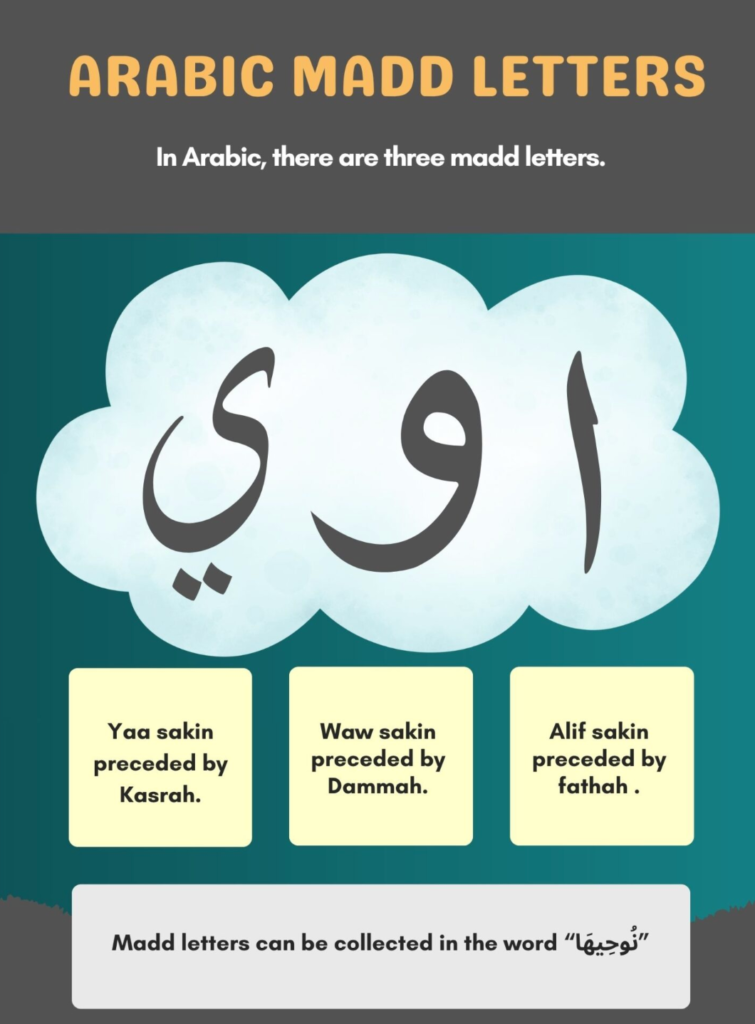
The three Madd letters in Tajweed — Alif (ا), Waw (و), and Ya (ي) — each carry precise phonetic conditions that govern when elongation is valid. Mastering their identities, conditions, and interactions with surrounding letters is the foundation upon which every Madd category stands.
What Are Madd Letters in Tajweed?
Huruful Madd are specifically three letters — Alif (ا), Waw Sakinah (وْ), and Ya Sakinah (يْ) — each paired with a required vowel on the preceding letter. Without fulfilling that vowel condition, no Madd letter exists, and therefore no elongation applies.
The conditions are:
- Alif (ا): Always Sakinah (no vowel on itself); must be preceded by a letter with a Fathah (◌َ)
- Waw Sakinah (وْ): Must be preceded by a letter carrying a Dhammah (◌ُ)
- Ya Sakinah (يْ): Must be preceded by a letter carrying a Kasrah (◌ِ)
These three conditions are non-negotiable. Scholars of Tajweed from Ibn al-Jazari’s tradition emphasize this pairing as the very definition of a valid Madd letter.
At Learn Quran Tajweed Academy, our Beginner Tajweed Course with Ijazah-certified Qaris introduces students to Huruful Madd identification through structured verse-by-verse application, ensuring correct recognition before advancing to Madd categories.
Begin your Tajweed journey with a free lesson

1. The Madd Alif Is the Most Frequently Occurring Madd Letter in the Quran
Alif Madd appears more than any other Madd letter across Quranic text. It is always written as a bare Alif — no Hamzah, no Madda sign above it — and always falls after a Fathah.
A clear example occurs in:
قَالَ
Qāla
He said.
The Alif in “Qāla” follows the Fathah on Qaf — a textbook Madd Alif
What many non-Arabic speakers struggle with is confusing this Alif with a Hamzatul Wasl (ا) at the beginning of words. The distinction is positional — Madd Alif never appears at the start of a word and never carries a Hamzah sign.
A common error among English-speaking students is shortening the Alif Madd under time pressure during Salah. This shortening, when it distorts meaning, is considered a Lahn Jali (clear error) — a serious recitation mistake that must be corrected.
Perfect Your Quran Recitation Today
Join expert-led Tajweed classes, and recite the Quran with confidence and clarity.
Start Your Free Trial2. Waw Sakinah as a Madd Letter Requires the Dhammah Condition to Be Valid
Waw appears frequently in Arabic, but only qualifies as Huruful Madd when it is Sakinah (carrying no vowel) AND preceded by a Dhammah on the letter before it.
Any other configuration — such as Waw with a vowel of its own — disqualifies it from being a Madd letter.
Consider:
نُوحِيهَا
Nūḥīhā
“We reveal it.” (Yusuf 12:3)
The Waw in “Nū” is Sakinah, preceded by Dhammah on the Nun — valid Madd Waw
The failure to observe the Dhammah condition is one of the most common technical errors among intermediate reciters.
Students who rush identification sometimes apply elongation to a Waw that carries its own vowel, producing an incorrect Madd where none should exist.
Read also: Tajweed Madd Rules: Types of Madd with Chart
3. Ya Sakinah as a Madd Letter Is Activated Only When Preceded by a Kasrah
Ya Sakinah (يْ) functions as a Madd letter exclusively when the letter before it carries a Kasrah (◌ِ). This is the mirror condition of the Waw rule. The Ya must be completely vowel-free itself — any Fathah, Dhammah, or Kasrah on the Ya immediately disqualifies it.
Observe this in:
فِي
Fī
In / Among.
Ya is Sakinah, preceded by Kasrah on the Fa — perfect Madd Ya condition
The phonetic placement of Ya Madd is from the middle of the tongue with the sides raised — this makharij precision ensures the elongation sounds pure and not muffled, which is a persistent challenge for speakers of European languages where this articulation point is unused.
The Madd Letter Conditions
Committing these three conditions to memory is essential before tackling any Madd category. This table serves as a permanent reference:
| Madd Letter | Written Form | Condition on Itself | Condition on Preceding Letter |
| Alif Madd | ا | Always Sakinah | Must carry Fathah (◌َ) |
| Waw Madd | وْ | Must be Sakinah | Must carry Dhammah (◌ُ) |
| Ya Madd | يْ | Must be Sakinah | Must carry Kasrah (◌ِ) |
Every Madd rule in Tajweed — from Madd Tabee’i to Madd Lazim — traces back to these three letters and their conditions. No Madd category can be properly applied without first identifying whether a valid Huruful Madd is present.
Madd Lin Letters in Tajweed
An important nuance that intermediate students must understand is that Madd Lin letters (حروف المد اللين) — Waw Sakinah and Ya Sakinah preceded by Fathah (not Dhammah or Kasrah) — are NOT Madd letters. They are Lin (softness) letters.
| Feature | Huruful Madd | Huruful Lin |
| Waw condition | Preceded by Dhammah | Preceded by Fathah |
| Ya condition | Preceded by Kasrah | Preceded by Fathah |
| Alif included? | Yes | No |
| Default duration | 2 counts (Tabee’i) | No elongation unless at Waqf |
Confusing Lin letters with Madd letters is a persistent error in intermediate study. The word خَوْف (Khawf — “fear”) contains a Waw Sakinah preceded by Fathah — this is a Lin letter, not a Madd letter, and it carries no elongation unless a pause (Waqf) falls after it.
Our Practical Tajweed Course at Learn Quran Tajweed Academy focuses precisely on real-time Mushaf application — not just rule memorization.
Join our Practical Tajweed Course and get a free trial

Madd Tabee’i Is the Natural Default Elongation Built Around Huruful Madd
Madd Tabee’i (المد الطبيعي), also called Madd Asli, is the baseline Madd — the elongation applied to a Madd letter when no Hamzah or Sukun follows it to trigger a longer category. Its duration is 2 counts (Harakatayn), and it represents the natural, uninterrupted flow of the Madd letter.
The significance for non-Arabic speakers is this: Madd Tabee’i is the minimum. Every Madd letter that does not meet the conditions for a longer Madd must still receive its 2-count elongation. Dropping it to 1 count constitutes a Lahn Jali error.
Read also: Madd Leen
Understanding Madd Far’i Requires Recognizing How Huruful Madd Interact with Hamzah and Sukun
Madd Far’i (المد الفرعي) — the extended or secondary Madd — emerges when a Madd letter is followed by either a Hamzah or a Sukun. These two triggers produce distinct Madd categories, each with its own duration rules.
The interaction table below clarifies the major categories:
| Trigger After Madd Letter | Category Name | Duration (Hafs) |
| Hamzah in the same word | Madd Muttasil | 4–5 counts (obligatory) |
| Hamzah in next word | Madd Munfasil | 4–5 counts (preferred in Hafs) |
| Sukun due to Waqf (pause) | Madd ‘Arid lil-Sukun | 2, 4, or 6 counts |
| Original Sukun (Mushaddad) | Madd Lazim | 6 counts (obligatory) |
| Sukun due to Idgham/Ikhfa context | Madd Lin | 2 counts minimum at Waqf |
Knowing which Madd letter is present — and what follows it — is how a reciter correctly identifies and applies the right Madd Far’i category. This is why Huruful Madd mastery is not optional; it is the prerequisite for all advanced Madd application.
Learn Quran Tajweed Academy’s Intermediate Tajweed Course offers systematic progression for students who have mastered letter identification and now need precise count calibration, ensuring Madd Far’i duration is consistent across every verse.
Join our Intermediate Tajweed Course and get a free trial

Perfect Your Quran Recitation Today
Join expert-led Tajweed classes, and recite the Quran with confidence and clarity.
Start Your Free TrialStart Perfecting Your Madd Letter Application with Learn Quran Tajweed Academy
Huruful Madd are not just a chapter in Tajweed — they are the gateway to every elongation rule in the Quran. Every Madd category you will ever recite traces back to correctly identifying these three letters and their conditions.
Learn Quran Tajweed Academy offers specialized online Tajweed instruction built for non-Arabic speakers who are serious about recitation accuracy:
- Ijazah-certified instructors with Hafs ‘an ‘Asim specialization
- Personalized 1-on-1 live sessions focused on your specific recitation errors
- Structured progression from Huruful Madd identification to full Madd Far’i mastery
- Flexible scheduling available 24/7 to suit Western time zones
- Beginner, Intermediate, Practical, and Advanced Tajweed Courses available
- Tajweed Ijazah Program for students pursuing formal certification
Book your free trial Tajweed lesson today and begin reciting with the precision and confidence that every Quranic word deserves.
Check out the best tajweed course for your needs:
- Practical Tajweed Course
- Beginner Tajweed Course
- Intermediate Tajweed Course
- Advanced Tajweed Course
- Quran Tarteel Course
- Tajweed Ijazah Program
- Tajweed Course for Sisters
- Tajweed course for Kids

Conclusion
Mastering Huruful Madd means understanding that Alif, Waw Sakinah, and Ya Sakinah each carry binding vowel conditions on the preceding letter. Without confirming those conditions, no elongation is valid. This precision is what separates correct Tajweed from habitual recitation.
Every Madd category — Tabee’i, Muttasil, Munfasil, Lazim, and ‘Arid lil-Sukun — is built on accurate Madd letter identification. A reciter who masters Huruful Madd eliminates the root source of most Madd errors before they begin. Alhamdulillah, the science is systematic and learnable.
The distinction between Madd letters and Lin letters is equally critical and frequently misunderstood. Keeping Waw and Ya with Fathah clearly separate from their Dhammah and Kasrah counterparts gives the reciter clean, confident identification every time they open the Mushaf.

Leave a Reply