 Tajweed Rules

| Key Takeaways |
| Madd Farq occurs when Hamzat al-Qat’ (interrogative Hamza) enters upon a definite article (ال), converting Hamzat al-Wasl into a long Alif. |
| Madd Farq appears in only three Quranic words: ءَآللَّهُ, ءَآلذَّكَرَيْنِ, and ءَآلْـَٰٔنَ, making it one of the rarest Madd types. |
| The standard recitation length for Madd Farq is six counts (harakaat), classifying it as Madd Lazim (Obligatory Madd) in the Hafs ‘an ‘Asim narration. |
| Tasheel (facilitation) is a permitted alternative recitation mode, reducing the Madd to two counts without full elongation. |
| Madd Farq is named “distinguishing” because the elongation audibly differentiates an interrogative statement from a declarative one in Quranic recitation. |
Few Tajweed rules demand as much precision as Madd Farq — and yet, it is one of the most misunderstood rules even among advanced students. Madd Farq (مَدّ الفَرْق), the Distinguishing Madd, is a specialized type of Madd Lazim that transforms the grammatical nature of a sentence through elongation alone.
It operates in exactly three words across the entire Quran, each functioning as a rhetorical question directed at the listener.
The elongated Alif — born from Hamzat al-Qat’ entering upon Hamzat al-Wasl — distinguishes divine interrogation from a plain declarative statement, a distinction that carries deep meaning in correct Quranic recitation.
What Is Madd Farq in Tajweed?
Madd Farq is defined as the elongation that arises when Hamzat al-Qat’ (همزة القطع) used for interrogation enters upon a word beginning with Hamzat al-Wasl (همزة الوصل) — specifically the definite article ال. Hamzat al-Wasl drops in connected speech, so to prevent the loss of the interrogative Hamza, it is replaced by a long Alif (مد) held for six counts.
The name itself explains everything: Farq (فَرْق) means “to separate” or “to distinguish.” Without this elongation, the interrogative sentence would sound identical to its declarative counterpart, erasing a critical communicative difference.
Consider this simple parallel from Arabic:
- اللهُ خَلَقَ السَّمَاوَات — A declarative statement: “Allah created the heavens.”
- ءَآللَّهُ خَلَقَ السَّمَاوَات؟ — A rhetorical question: “Is it Allah who created the heavens?”
The Madd is what makes that question audible to the listener’s ear. Without it, the meaning collapses.
At Learn Quran Tajweed Academy, our Intermediate Tajweed Course specifically addresses Madd types at this level of nuance — with Ijazah-certified instructors helping students move beyond surface-level memorization into applied recitation precision.
Join our Intermediate Tajweed Course and get a free trial

Quranic Examples of Madd Farq
The following are the verified occurrences of Madd Farq in the Quran, presented for recitation reference.
ءَآللَّهُ أَذِنَ لَكُمْ
‘A-aaallaahu ‘adhina lakum
“Has Allah permitted you?” (Yunus 10:59)
Madd Farq on ءَآللَّهُ — six counts, Muthaqqal
ءَآلذَّكَرَيْنِ حَرَّمَ
‘A-aaladh-dhakarayni harrama
“Has He forbidden the two males?” (Al-An’am 6:143)
Madd Farq on ءَآلذَّكَرَيْنِ — six counts, Muthaqqal
ءَآلْـَٰٔنَ وَقَدْ كُنتُم
‘A-aaaal’aana wa qad kuntum
“Is it now, when you had previously…?” (Yunus 10:51)
Madd Farq on ءَآلْـَٰٔنَ — six counts, Mukhaffaf
| Quranic Word | Surah & Verse(s) | Type |
| ءَآللَّهُ | Yunus 10:59 / An-Naml 27:59 | Madd Lazim Muthaqqal (Heavy) |
| ءَآلذَّكَرَيْنِ | Al-An’am 6:143 / Al-An’am 6:144 | Madd Lazim Muthaqqal (Heavy) |
| ءَآلْـَٰٔنَ | Yunus 10:51 / Yunus 10:91 | Madd Lazim Mukhaffaf (Light) |
Two of these words — ءَآللَّهُ and ءَآلذَّكَرَيْنِ — are classified as Madd Lazim Muthaqqal Kalimi (Heavy Obligatory Word Madd), because the letter immediately following the Madd carries a shaddah (شدة), indicating a merged and doubled consonant.
ءَآلْـَٰٔنَ, by contrast, is classified as Madd Lazim Mukhaffaf Kalimi (Light Obligatory Word Madd), because the letter following the Madd carries a sukoon without shaddah and the Hamza after it is pronounced clearly without idgham.
This distinction — Muthaqqal vs. Mukhaffaf — follows the same framework used across all Madd Lazim types.
Shots Videos from Our Courses
Perfect Your Quran Recitation Today
Join expert-led Tajweed classes, and recite the Quran with confidence and clarity.
Start Your Free TrialWhat Is the Correct Madd Farq Length and Recitation Rules?
Madd Farq is recited at six counts (harakaat) as its primary and preferred mode — consistent with all types of Madd Lazim in the narration of Hafs ‘an ‘Asim.
This elongation is obligatory (lazim), not optional, because the sukoon following the Madd letter is original (asli) — not a pausal sukoon or incidental stopping point. This is precisely what separates it from Madd ‘Arid Lissukoon, where sukoon only appears upon stopping.
Is Tasheel Permitted in Madd Farq Recitation?
Tasheel (تسهيل) — facilitation of Hamzat al-Wasl to a sound between a Hamza and an Alif, without elongation — is a valid second mode for all three Madd Farq words. In this mode, Hamzat al-Wasl is not fully converted to a long Alif; instead, it is softened and held for only two counts.
Both modes — full Madd (six counts) and Tasheel (two counts) — are authentically transmitted in the recitation of Hafs ‘an ‘Asim. However, the six-count Madd is the more widely taught and preferred mode in practical recitation instruction.
How to Identify Madd Farq Words Correctly in the Mushaf?
Madd Farq words carry a specific visual signature in the Uthmani Mushaf that students can learn to recognize instantly.
ءَآللَّهُ — You will see two Hamzas (ءَآ) at the opening, followed by the doubled Lam of لله with shaddah. The elongated Alif is written between the two Hamza symbols.

ءَآلذَّكَرَيْنِ — Similarly opens with ءَآ, followed by الذكرين with shaddah on the Dhaal, confirming the Muthaqqal classification.
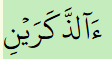
ءَآلْـَٰٔنَ — Opens with ءَآ, followed by الـآن with a sukoon over the Lam and a Hamza above the Alif after it, confirming the Mukhaffaf classification.

Training your eye to spot these patterns before recitation begins eliminates hesitation mid-verse — a skill developed through consistent practice with a certified instructor.
Perfect Your Quran Recitation Today
Join expert-led Tajweed classes, and recite the Quran with confidence and clarity.
Start Your Free TrialHow Does Madd Farq Differ from Madd Badal?
Students consistently confuse Madd Farq with Madd Badal — and the confusion is understandable, since both involve an Alif that originates from a Hamza. Understanding the difference is essential for accurate Tajweed application.
| Feature | Madd Badal | Madd Farq |
| Origin of Madd | Hamzat al-Qat’ precedes Madd letter | Hamzat al-Wasl is replaced by Madd letter |
| Position of Hamz | Hamza comes BEFORE the Madd | Hamza (interrogative) comes BEFORE the converted Madd |
| Sukoon after Madd | No original sukoon follows | Original (asli) sukoon follows — causes Lazim |
| Length | Two counts (harakaat) | Six counts (harakaat) |
| Type | Independent Madd category | Subtype of Madd Lazim |
| Examples | آدم (أأدم), آزر (أأزر) | ءَآللَّهُ, ءَآلذَّكَرَيْنِ, ءَآلْـَٰٔنَ |
The single most decisive distinction: Madd Badal carries no sukoon after the Madd letter, so it is not Lazim and remains at two counts. Madd Farq has an original sukoon immediately after the Madd, making elongation obligatory at six counts.
In my experience teaching at Learn Quran Tajweed Academy, students who drill Madd Badal words (like آدم and آزر) before approaching Madd Farq internalize this contrast far more quickly. The contrast becomes tactile — they feel the difference in the throat and the timing before they can fully articulate the grammatical rule.
Read also: Madd Lazim Kalimi Muthaqqal
Our Students Reviews
Perfect Your Quran Recitation Today
Join expert-led Tajweed classes, and recite the Quran with confidence and clarity.
Start Your Free TrialCommon Student Errors When Applying Madd Farq
Students at every level make predictable, correctable errors with Madd Farq. Recognizing them early accelerates mastery.
| Error | Root Cause | Correction |
| Shortening the Madd to two counts | Confusing Madd Farq with Madd Badal | Internalize: original sukoon after Madd = Lazim = six counts |
| Pronouncing initial Hamza as a hard stop | Treating ءَآ as two separate Hamzas | The first Hamza flows into the extended Alif — no hard stop |
| Missing the shaddah on the letter after Madd | Rushing through Muthaqqal words | Slow down: shaddah in ءَآللَّهُ and ءَآلذَّكَرَيْنِ must be fully articulated |
| Applying Madd Farq to non-Lazim Madd positions | Over-generalizing the rule | Madd Farq applies only to these three words — no others |
The shaddah error is the most consequential. Because the shaddah in ءَآللَّهُ falls on the divine name itself, dropping or softening it changes the quality of the recitation significantly. Most students who struggle with this have not yet fully mastered Idgham at the foundational level — the two rules are connected.
Our Advanced Tajweed Course at Learn Quran Tajweed Academy targets precisely these advanced-level rule interactions through personalized 1-on-1 sessions with Ijazah-certified instructors, available 24/7 to suit your schedule globally.
Reserve your free trial lesson for Advanced Tajweed Course

How Madd Farq Relates to Madd Lazim in Tajweed Classification
Madd Farq is a subtype of Madd Lazim — the obligatory elongation category in Tajweed. Madd Lazim is defined by two conditions: a Madd letter followed by an original (permanent) sukoon in the same word. Both conditions are present in all three Madd Farq words.
Within Madd Lazim, the classification branches as follows:
- Madd Lazim Kalimi (Word-based Lazim) → further divided into:
- Muthaqqal (Heavy) — sukoon from shaddah: ءَآللَّهُ, ءَآلذَّكَرَيْنِ
- Mukhaffaf (Light) — sukoon without shaddah: ءَآلْـَٰٔنَ
Madd Farq is therefore not a separate Madd category floating outside the classification system — it is fully embedded within Madd Lazim, sharing its six-count length and its core defining condition of original sukoon.
Understanding this positioning helps students building toward Ijazah certification develop the systematic, structured knowledge of Madd types that examiners expect.
Our Tajweed Ijazah Program at Learn Quran Tajweed Academy builds this classification fluency progressively, ensuring students can explain every Madd occurrence they encounter — not only recite it correctly.
Join our Tajweed Ijazah Program and get a free trial

For a full map of all Madd categories and their relationships, the Tajweed Madd rules guide with chart provides a structured visual reference.
Begin Mastering Madd Farq with Certified Instruction at Learn Quran Tajweed Academy
Madd Farq is rare in count but significant in meaning — and applying it correctly requires ears trained by consistent, expert feedback.
Learn Quran Tajweed Academy offers:
- Ijazah-certified instructors specializing in Hafs ‘an ‘Asim
- Personalized 1-on-1 sessions tailored to your current recitation level
- Flexible scheduling available 24/7 for global students
- Structured progression from foundational Madd rules to full Ijazah certification
- Specialized Tajweed-only instruction — not a generalist academy
Check out the best tajweed course for your needs:
- Practical Tajweed Course
- Beginner Tajweed Course
- Intermediate Tajweed Course
- Advanced Tajweed Course
- Quran Tarteel Course
- Tajweed Ijazah Program
- Tajweed Course for Sisters
- Tajweed course for Kids
Book your free trial Tajweed lesson today

Read also: Madd Silah Sughra and Kubra
Conclusion
Madd Farq stands apart from every other Madd type by serving a grammatical and communicative function — not just a phonetic one. The elongation is doing real semantic work: it turns a statement into a question, and that question carries the weight of divine address.
Mastering it means mastering not just the count of six, but the understanding of why. That understanding is what separates a reciter who has memorized rules from one who recites with true comprehension and tarteel.
With only three words to apply it, Madd Farq is learnable quickly — but only correctly with guided, certified instruction. Insha’Allah, may every recitation of ءَآللَّهُ, ءَآلذَّكَرَيْنِ, and ءَآلْـَٰٔنَ reflect both precision and reverence.
Frequently Asked Questions About Madd Farq
Is Madd Farq the same as Madd Lazim?
Madd Farq is a specific subtype within Madd Lazim, not a separate category. It shares the six-count length and the defining condition — original sukoon following the Madd letter — that characterize all Madd Lazim types. Its distinction lies in its grammatical origin: Hamzat al-Qat’ entering upon Hamzat al-Wasl.
Why is Madd Farq called the Distinguishing Madd?
The name Farq (فَرْق) means “to distinguish” or “to separate.” The elongation audibly differentiates an interrogative sentence from a declarative one. Without it, ءَآللَّهُ and اللَّهُ would sound identical in connected recitation, erasing the rhetorical question entirely.
Can Madd Farq be shortened during recitation?
The primary and preferred mode is six counts (Madd Lazim). Tasheel — softening the converted Alif to a sound between Hamza and Alif, recited at two counts — is a valid secondary mode transmitted within the Hafs ‘an ‘Asim narration. Both modes are correct; six counts is the widely taught standard.
Related Articles
Tajweed Rules