 Tajweed Rules

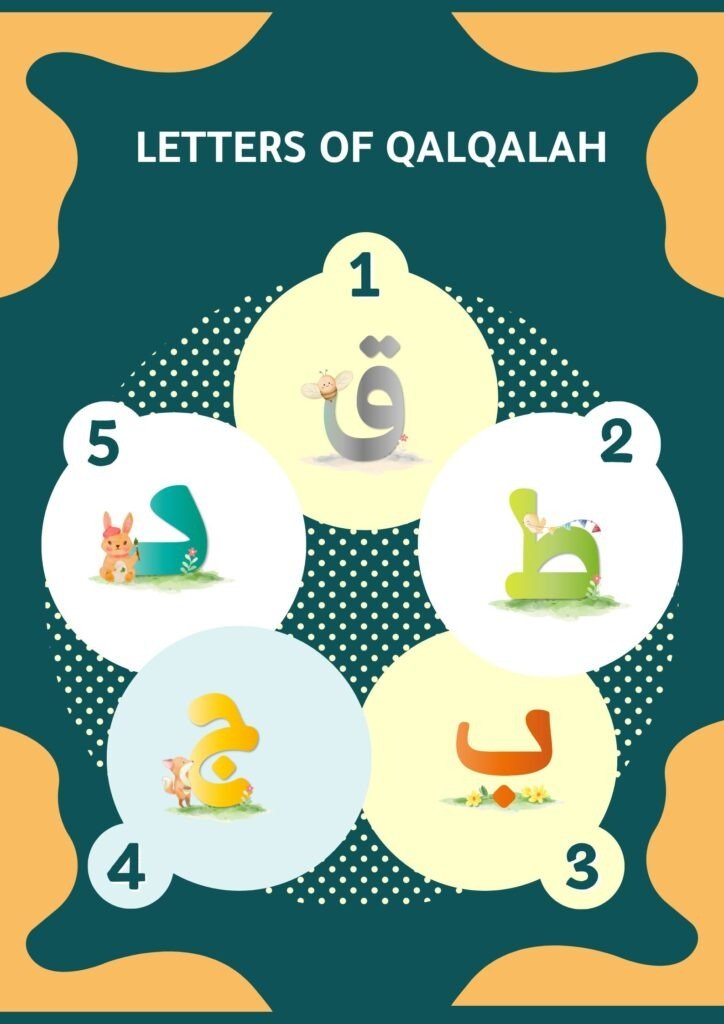
The Qalqalah letters in the Quran—ق, ط, ب, ج, and د—produce a distinct echo when pronounced with a sukoon (no vowel). These letters, grouped as “قطب جد” for easy memorization, are known for their attributes of Jahr and Shiddah, which block airflow and sound, creating a vibrating effect.
Qalqalah only occurs when these letters are followed by a sukoon, adding rhythm and clarity to Quranic recitation.
What Are Qalqalah letters?
The letters of Qalqalah in the Holy Quran are 5 letters and they are
(ق – ط – ب – ج – د) They can be combined in the word قطب جد to facilitate their memorization.
And these letters have the attribute of Jahr – preventing the airflow when pronouncing them – and Shiddah – preventing the flow of sound when pronouncing them.
Qalqalah is applied to these letters only in the case of sukoon, but in the case of vowels it is not pronounced with Qalqalah or echo.
for example:
The Almighty’s saying
(وَلَنَبْلُوَنَّكُمْ بِشَيْءٍ مِنَ الْخَوْفِ وَالْجُوعِ وَنَقْصٍ مِنَ الْأَمْوَالِ وَالْأَنْفُسِ)
(And We will certainly test you with something of fear and hunger and a loss of wealth and lives)
The place of qalqalah came in His Almighty’s saying: (ولنبلونكم), it came in the middle of the word in the letter Ba(ب) .
At Learn Quran Tajweed Academy, students in the Beginner Tajweed Course begin mastering the letters of Qalqalah in dedicated sessions with Ijazah-certified Qaris who correct articulation from the very first lesson, building muscle memory through structured 1-on-1 practice.
Begin your Tajweed journey with a free lesson
1. The Letter ق (Qaf)
The letter ق (Qaf) is one of the primary letters of Qalqalah. It is articulated from the back of the throat, and when pronounced with a sukoon (no vowel), it creates a distinct echoing sound.
This letter falls under the category of “Qalqalah Sughra” or “Qalqalah Kubra,” depending on its position and whether it has a Shaddah. When Qaf appears at the end of a verse or word with a Shaddah, the pronunciation becomes more intense, producing a strong, resonant sound.
In contrast, when Qaf is found in the middle of a word or without a Shaddah, it produces a lighter, more subtle sound.
Read also: Types of Qalqalah in Tajweed
2. The Letter ط (Taa)
The letter ط (Taa) is considered the strongest of the Qalqalah letters. It is articulated with the tip of the tongue touching the upper front of the teeth and creates a forceful, vibrating sound.
When Taa appears at the end of a word with a Shaddah, it produces a powerful, clear Qalqalah, known as Qalqalah Kubra.
Its intense sound makes it easily recognizable in recitations, particularly when it is found at the end of verses in the Quran. Taa‘s articulation requires a firm stop, which enhances the echoing effect.
Read also: Qalqalah in Tajweed: Letters, Types, Examples, and Levels Explained
3. The Letter ب (Baa)
The letter ب (Baa) is articulated by bringing both lips together. When this letter appears with a sukoon or at the end of a word, it generates a noticeable but less intense Qalqalah compared to Taa and Jeem. Baa falls under Qalqalah Sughra, meaning the echoing effect is lighter and softer.
Despite being less forceful, its pronunciation still adds clarity and rhythm to the recitation. The Qalqalah produced by Baa is important in maintaining the smooth flow of the recitation, especially in middle or end positions.
Perfect Your Quran Recitation Today
Join expert-led Tajweed classes, and recite the Quran with confidence and clarity.
Start Your Free Trial4. The Letter ج (Jeem)
The letter ج (Jeem) is articulated from the middle of the mouth with a soft but resonant sound. When it appears with a sukoon, it produces a middle-range Qalqalah sound, referred to as Qalqalah Wusta.
While it is less intense than Taa, it still has a pronounced echo when articulated properly. Jeem is often found in the middle of words or at the beginning with a sukoon, making it a key letter in achieving balanced and clear recitation in Quranic verses.
The Qalqalah sound of Jeem ensures the continuity of the recitation while maintaining the beauty of the verse.
5. The Letter د (Daal)
The letter د (Daal) is articulated by placing the tip of the tongue against the upper front teeth. Similar to Baa, Daal produces a light echo when it is saakin or at the end of a word, which is classified as Qalqalah Sughra.
Its sound is less intense than that of Taa and Jeem, but it still creates a subtle resonance that aids in maintaining the rhythmic flow of the recitation. Daal‘s gentle Qalqalah effect ensures a smooth transition between words in the recitation.
Learn Quran Tajweed Academy’s Quran Tarteel Course specializes in developing this pacing discipline, helping students experience how proper breath control, measured stops, and Qalqalah together create the melodious recitation that reflects the Quran’s divine beauty.
Join our Quran Tarteel Course and get a free trial

Read also: Ghunnah Rules in Tajweed
Examples for Each Letter of Qalqalah Letters
Each of the five letters of Qalqalah has a distinct makhraj, which gives its echo a unique acoustic character. Studying one verified Quranic example per letter — rooted in the actual text of the Quran — trains both the ear and the makhraj simultaneously, which is far more effective than isolated phonetic drills.
1. An Example of Qalqalah for the Letter ق
The ق (Qaf) is articulated at the deepest point of the tongue meeting the soft palate. Its echo is the most resonant among the five letters — deep, full, and throat-adjacent. A widely cited example for Qalqalah Sughra on ق comes from Surah An-Naba:
وَخَلَقْنَٰكُمْ أَزْوَٰجًا
Wa khalaqnākum azwājā
“And We created you in pairs.” (An-Naba’ 78:8)
The ق in خَلَقْنَٰكُمْ carries an original sukoon mid-word — Qalqalah Sughra. The reciter continues without stopping, producing a light, controlled deep echo from the aqsal lisan.
A common student error here is flattening the echo entirely, as the deep makhraj makes the bounce less obvious than labial or mid-palatal letters.
2. An Example of Qalqalah for the Letter ط
The ط (Ta) is articulated at the tip and blade of the tongue pressing against the upper gum roots, with the back of the tongue raised toward the soft palate.
This elevation — its sifah of isti’la — gives its Qalqalah echo a full, emphatic, forward-resonant quality that clearly distinguishes it from the thinner د and ت, which share the same makhraj zone.
A clear and well-known Quranic example demonstrating ط Qalqalah Kubra at waqf comes from Surah Al-Buruj:
وَٱللَّهُ مِن وَرَآئِهِم مُّحِيطٌۢ
Wallāhu miw warā’ihim muḥīṭ
“But Allah encompasses them from all sides.” (Al-Buruj 85:20)
Stopping on مُّحِيطٌۢ at waqf: the ط carries tanwin damm in continuous recitation but takes sukoon at waqf — Qalqalah Kubra. The tongue tip and blade press firmly against the upper gum roots with full back-tongue elevation maintained throughout.
The echo releases with the characteristic “full” rounded quality of ط — students must not drop the tafkheem during the bounce, as the isti’la sifah must be preserved right through the Qalqalah release itself.
Learn Quran Tajweed Academy’s Practical Tajweed Course directly addresses these common recitation errors through focused audio feedback and correction, giving students immediate guidance on Qalqalah intensity calibration.
Join our Practical Tajweed Course and get a free trial

3. An Example of Qalqalah for the Letter ب
The ب (Ba) is the only Qalqalah letter articulated at the lips (shafatain). Both lips press firmly together, building pressure under the sukoon, then spring open to release the echo.
No breath should leak before the release — that would violate the Jahr sifah of ب and collapse the Qalqalah entirely.
A clear Quranic example appears in Surah Al-Masad:
مَآ أَغْنَىٰ عَنْهُ مَالُهُۥ وَمَا كَسَبَ
Mā aghnā ‘anhu māluhu wa mā kasab
“His wealth will not avail him or that which he gained.” (Al-Masad 111:2)
Stopping on كَسَبَ at waqf: the ب carries a fathah in continuous recitation but takes sukoon at waqf — Qalqalah Kubra. Both lips close fully, then release a clean, resonant labial echo.
This is one of the most practiced Kubra examples in Tajweed teaching because the ب falls cleanly at verse end.
4. An Example of Qalqalah for the Letter ج
The ج (Jim) is articulated where the middle of the tongue meets the hard palate. Its echo is mid-mouth in depth — neither as deep as ق nor as frontal as ط. Many students under-press the middle of the tongue, producing a weak or incomplete bounce.
A widely referenced Quranic example for ج Qalqalah Kubra with shaddah appears in Surah Al-Baqarah:
قُلْ هِىَ مَوَٰقِيتُ لِلنَّاسِ وَٱلْحَجِّ
Qul hiya mawāqītu lin-nāsi wal-ḥajj
“Say, they are measurements of time for the people and for Hajj.” (Al-Baqarah 2:189)
Stopping on وَٱلْحَجِّ at waqf: the ج is mushaddad. This is the strongest Qalqalah — Akbar — where the full double-press of the middle tongue against the hard palate is held, then released in a powerful mid-palatal echo.
The shaddah must not be dropped; the reciter holds both the first and second letter positions before releasing.
5. An Example of Qalqalah for the Letter د
The د (Dal) shares its makhraj with ط and ت — the tip of the tongue against the upper gum roots — but it carries the sifah of istifal (lowering) and infitah (openness), unlike the elevated and emphatic ط. Its Qalqalah is therefore lighter and thinner in tone, without the “full” rounded quality of ط.
The most practiced Quranic example for د Qalqalah Kubra is from Surah Al-Ikhlas:
وَلَمْ يَكُن لَّهُۥ كُفُوًا أَحَدٌ
Wa lam yakul-lahū kufuwan aḥad
“Nor is there to Him any equivalent.” (Al-Ikhlas 112:4)
Stopping on أَحَدٌ at waqf: the د carries tanwin in continuous recitation but takes sukoon at waqf — Qalqalah Kubra. The tongue tip releases cleanly from the gum roots with a light, forward echo.
Perfect Your Quran Recitation Today
Join expert-led Tajweed classes, and recite the Quran with confidence and clarity.
Start Your Free TrialBegin Your Qalqalah Mastery With Expert Guidance at Learn Quran Tajweed Academy
The letters of Qalqalah, when recited correctly, give the Quran a rhythmic life that reflects the precision Allah’s Book deserves. Mastering this rule transforms recitation from basic reading into genuine Tajweed application.
Learn Quran Tajweed Academy — your dedicated partner in Quranic recitation excellence:
- Ijazah-certified instructors specializing in Hafs ‘an ‘Asim for non-Arabic speakers
- 1-on-1 personalized sessions with real-time audio correction and feedback
- Structured progression from Beginner through Practical and Advanced Tajweed Courses
- Tajweed Ijazah Program and Quran Tarteel Course available for advanced learners
- Flexible scheduling available 24/7 to fit your time zone
Check out the best tajweed course for your needs:
- Practical Tajweed Course
- Beginner Tajweed Course
- Intermediate Tajweed Course
- Advanced Tajweed Course
- Quran Tarteel Course
- Tajweed Ijazah Program
- Tajweed Course for Sisters
- Tajweed course for Kids
Book your free trial Tajweed lesson today to assess your current application of Tajweed rules and receive a customized learning path toward recitation mastery.

Conclusion
The five letters ق، ط، ب، ج، د — captured in قُطْبُ جَدّ — each carry a distinct echo character shaped by their makhraj and the combined power of Jahr and Shiddah. Applying them correctly across Sughra, Kubra, and Akbar positions elevates recitation accuracy significantly.
Qalqalah is not simply a bounce — it is the acoustic release of a makhraj under pressure, a feature built into the Arabic letter’s structure. Connecting this rule to sifat theory and waqf practice produces a reciter who applies Tajweed with understanding, not just habit.

Leave a Reply