 Tajweed Rules
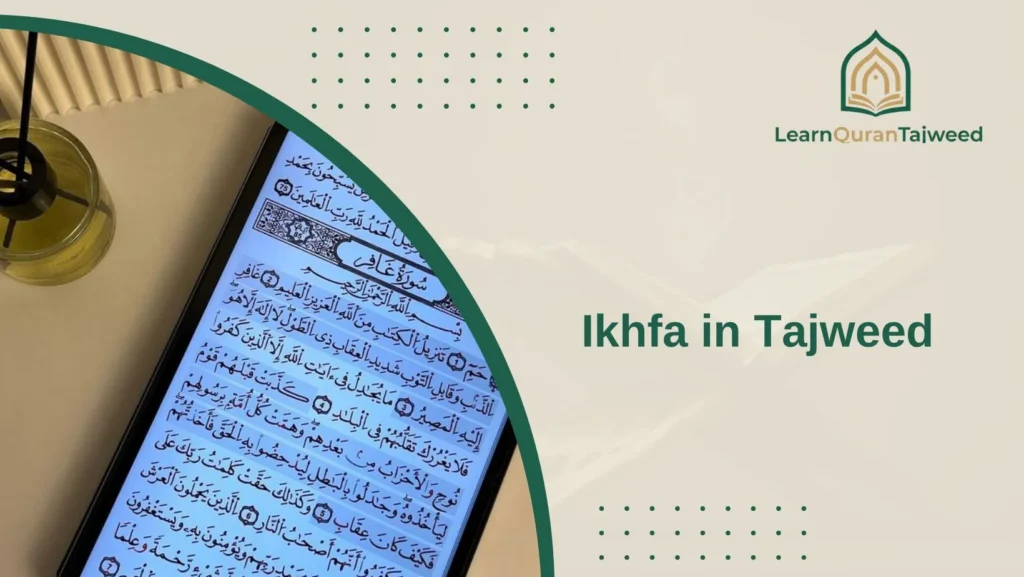
When you recite Surah Al-Baqarah and encounter نْ followed by ف or ت for example, something subtle but precise must happen in your mouth. That nuanced sound—neither a full noon nor silence—is ikhfa, and mastering it separates accurate Tajweed recitation from approximate reading.
Ikhfa is one of the four rules governing noon saakin and tanween, and it applies in more situations than any other rule in this category. Understanding its letters, levels, and application across the Quran is essential for any student pursuing authentic, beautified recitation.
What Is the Meaning of Ikhfa in Arabic?
Ikhfa (إخفاء) linguistically means “concealment” or “hiding.” In Tajweed terminology, it means pronouncing a noon saakin (نْ) or tanween in a state between complete clarity (izhaar) and complete merging (idgham)—with a nasal sound (ghunnah) held for two counts.
This middle-ground pronunciation is what defines ikhfa. The noon is neither fully articulated nor completely merged into the following letter. Instead, it is concealed while the articulation point moves toward the following letter’s makhraj, and ghunnah fills the space.
What Are the Rules of Ikhfaa in Tajweed?
The ikhfa rule applies when a noon saakin or tanween is followed by any of its fifteen designated letters. Three conditions must be met simultaneously for ikhfa to apply.
Condition 1: A noon saakin (نْ) or tanween (ً ٍ ٌ) must be present.
Condition 2: One of the fifteen ikhfa letters must immediately follow.
Condition 3: Both letters must appear within the same word (for noon saakin) or across two words (for tanween and noon saakin both).
When these conditions are met, the reciter conceals the noon sound, holds ghunnah for two counts (two harakaat), and transitions the articulation point subtly toward the following letter without completing its full sound.
At Learn Quran Tajweed Academy, our Beginner Tajweed Course teaches ikhfa application systematically through 1-on-1 sessions with Ijazah-certified Qaris, ensuring students internalize this rule with precision from the very beginning rather than developing incorrect habits that become difficult to correct later.
Begin your Tajweed journey with a free lesson

What Are the 15 Letters of Ikhfa?
The fifteen ikhfa letters are well-established in classical Tajweed scholarship. Imam Ibn Al-Jazari (rahimahullah) listed them clearly in his foundational text Al-Muqaddimah Al-Jazariyyah.
A helpful mnemonic groups them using the opening letters of fifteen Arabic phrases.
| Letter | Arabic | Example Word | |
| 1 | Ta | ت | مِنْ تَحْتِهَا |
| 2 | Tha | ث | مَنْثُورًا |
| 3 | Jim | ج | أَنْجَيْنَاكُم |
| 4 | Dal | د | مِنْ دُونِهِ |
| 5 | Dhal | ذ | إِنْ ذَهَبَ |
| 6 | Zay | ز | أَنْزَلْنَا |
| 7 | Sin | س | إِنْسَان |
| 8 | Shin | ش | مَنْشُورًا |
| 9 | Sad | ص | أَنْصَارًا |
| 10 | Dad | ض | مَنْضُودٍ |
| 11 | Ta (heavy) | ط | أَنْطَقَنَا |
| 12 | Dha | ظ | مَنْظُورًا |
| 13 | Fa | ف | أَنْفُسَكُم |
| 14 | Qaf | ق | مِنْ قَبْل |
| 15 | Kaf | ك | مَلَكٌ كَرِيم |
These fifteen letters exclude the letters of izhaar (throat letters), idgham (ي ن م و ل ر), and iqlab (ب), leaving precisely these fifteen as ikhfa letters.
What Are Ikhfaa Letters (Haqiqi)
When scholars and students refer to “ikhfa letters” without qualification, they always mean the 15 letters of Ikhfa Haqiqi listed above.
The term “Ikhfa Haqiqi” (إخفاء حقيقي) refers specifically to the ikhfa of noon saakin and tanween—the “true” or “real” ikhfa. Scholars use this term to distinguish it from “Ikhfa Shafawi,” which applies to meem saakin before ب.
Perfect Your Quran Recitation Today
Join expert-led Tajweed classes, and recite the Quran with confidence and clarity.
Start Your Free TrialIkhfa Examples in Quran
Authentic ikhfa examples in the Quran are abundant, appearing across hundreds of verses. Examining actual Quranic instances is the most reliable way to internalize the rule’s application and develop accurate muscle memory.
1. Noon Saakin before Sad (ص):
يَنصُرُكُمْ
Yansurakum
“He will help you”
Ikhfa of نْ before ص — strong level due to shared makhraj region
2. Noon Saakin before Dhal (ذ):
لِيُنذِرَ
Liyundhira
“To warn”
Ikhfa of نْ before ذ — middle level; ghunnah held two counts, articulation shifts toward ذ)
3. Noon Saakin before Ta (ت):
أَنتُمْ
Antum
“You (plural)”
Ikhfa of نْ before ت — strongest level; both share the tongue-tip makhraj region
4. Noon Saakin before Kaf (ك):
يَنكِثُونَ
Yankithoona
“They break (their oaths)”
Ikhfa of نْ before ك — weakest level; furthest makhraj from noon
5. Noon Saakin before Jim (ج):
نُنجِي
Nunji
“We save”
Ikhfa of نْ before ج — middle level; concealment clear within a single word
6. Noon Saakin before Shin (ش):
فَأَنشَرْنَا
Fa-ansharná
“And We revived”
Ikhfa of نْ before ش — middle level; ghunnah resonates smoothly through the nasal passage
7. Noon Saakin before Qaf (ق):
انقَلَبُوا
Inqalaboo
“They returned”
Ikhfa of نْ before ق — weak level; the back-of-throat makhraj of ق creates lightest concealment
8. Noon Saakin before Sin (س):
الْإِنسَانُ
Al-Insaan
“The human being”
Ikhfa of نْ before س — middle level; one of the most frequently occurring ikhfa instances in the Quran
9. Noon Saakin before Sad (ص) across two words:
مَن صَبَرَ
Man sabara
“Whoever is patient”
Ikhfa across a word boundary — the rule applies identically whether noon saakin and its letter are within one word or across two
10. Noon Saakin before Dhal (ذ) across two words:
مِن ذَا
Min dhaa
“From what / Who is it that”
Cross-word ikhfa before ذ — middle level; a compact, commonly occurring phrase in the Quran
Join our Quran Tarteel Course and get a free trial

Read Also: Ikhfa Shafawi
Levels of Ikhfa in Tajweed
A distinguishing mark of expert Tajweed knowledge is understanding that ikhfa is not a single uniform sound. Classical scholars divided ikhfa into three levels based on the proximity of the following letter’s makhraj to the makhraj of the noon (tip of the tongue, near the upper gum).
| Level | Arabic Term | Letters | Why This Level |
| Strong (Aqwa) | أقوى | ط، د، ت | These letters share the same makhraj region as noon (tip of tongue); proximity creates stronger concealment |
| Middle (Ausath) | أوسط | ث، ج، ذ، ز، س، ش، ص، ض، ظ، ف | Moderate distance from noon’s makhraj |
| Weak (Adaf) | أضعف | ق، ك | Furthest makhraj from noon; weakest concealment |
How To Recognize the Ikhfaa Rule in the Mushaf?
In some printed Masahif (copies of the Quran), ikhfa is often indicated through the absence of sukoon on the noon and the absence of a shaddah on the following letter.

How to Learn Ikhfaa Letters?
Many students memorize the fifteen ikhfa letters once and then forget them under recitation pressure. The key is active recall training embedded into real Quranic text, not isolated drills.
1. Letter Recognition
Memorize the fifteen letters grouped by their makhraj proximity levels (strong, middle, weak). This grouping naturally connects the letters to their ikhfa intensity.
2. Isolated Practice
Practice ikhfa with each letter individually using short phrases before moving to full verses.
3. Quranic Application
Apply the rule in actual Quranic recitation while listening to a qualified reciter (like Sheikh Mahmoud Khalil Al-Husary’s tarteel recordings) to calibrate your sound.
4. Live Correction
Recite to a teacher for real-time feedback. Self-correction has limits—a qualified ear catches errors your own ear normalizes.
Learn Quran Tajweed Academy’s Intermediate Tajweed Course systematically builds exactly this progression for students who have basic Tajweed familiarity but need to solidify their ikhfa application, ensuring no letter is missed or mispronounced before advancing to more complex rules.
Join our Intermediate Tajweed Course and get a free trial

Types of Ikhfaa in Tajweed
Tajweed scholarship recognizes two primary types of ikhfa, each with distinct triggering conditions.
1. Ikhfa Haqiqi
This is the ikhfa of noon saakin and tanween before the fifteen letters discussed throughout this article. It is called “haqiqi” (real/true) because the concealment is complete—the noon’s sound is genuinely hidden, not merely softened.
2. Ikhfa Shafawi
This type applies exclusively to meem saakin (مْ) when followed by ب (ba). The meem is concealed with ghunnah, and the lips are brought close but not fully closed as they would be for a complete meem.
| Type | Trigger | Letter | Ghunnah |
| Ikhfa Haqiqi | Noon saakin / Tanween | 15 letters (ت ث ج د ذ ز س ش ص ض ط ظ ف ق ك) | Yes (2 counts) |
| Ikhfa Shafawi | Meem Saakin | ب only | Yes (2 counts) |
Understanding both types prevents a common confusion where students misapply the meem rule to noon situations or vice versa.
Read Also: The Difference Between Ikhfa, Idgham, Izhar, and Iqlab
Common Mistakes Relating to Al-Ikhfaa Rule
Even students who understand ikhfa theoretically make consistent errors when reciting. Awareness of these mistakes is the first step toward correction.
Mistake 1 — Converting Ikhfa into Izhaar
Some reciters, especially those learning from non-Tajweed-trained teachers, pronounce the noon fully before ikhfa letters. This clearly violates the rule and is a recognized recitation error.
Mistake 2 — Converting Ikhfa into Idgham
Others completely merge the noon into the following letter without ghunnah, producing a sound resembling idgham bila ghunnah. This destroys the distinct identity of ikhfa.
Mistake 3 — Inconsistent Ghunnah Duration
The ghunnah must be held for two full harakaat (counts). Rushing it to one count or extending it beyond two counts both constitute errors. A metronome or hand-tapping practice during early learning stages helps calibrate this.
Mistake 4 — Applying Uniform Ikhfa Across All Levels
Treating all fifteen letters with identical ikhfa intensity is a subtle but real error. A student reciting نْ before ق (weak level) with the same intensity as نْ before ط (strong level) is not applying authentic Tajweed as transmitted.
Mistake 5 — Mispronouncing the Ghunnah Nasalization
Ghunnah must resonate from the nasal passage (al-khayshoom). Some students produce it too far forward in the mouth, creating an unnatural nasal sound rather than a smooth, resonant one.
Working with Ijazah-certified instructors at Learn Quran Tajweed Academy through our Advanced Tajweed Course provides the individualized attention needed to identify and eliminate these subtle ikhfa errors, with flexible scheduling available 24/7.
Reserve your free trial lesson for Advanced Tajweed Course

Perfect Your Quran Recitation Today
Join expert-led Tajweed classes, and recite the Quran with confidence and clarity.
Start Your Free TrialLearn Quran Tajweed Academy Helps You Apply Ikhfa with Confidence
Mastering ikhfa is achievable with the right structured guidance and consistent practice under qualified supervision.
Learn Quran Tajweed Academy offers:
- Ijazah-certified native Arab instructors specializing in non-Arabic speaker instruction
- Structured courses from Beginner through Advanced Tajweed and Tajweed Ijazah Program
- Personalized 1-on-1 sessions with real-time pronunciation correction
- Flexible 24/7 scheduling to fit any time zone
- Proven progression system from rule recognition to full Quranic application
Check out the best tajweed course for your needs:
- Practical Tajweed Course
- Beginner Tajweed Course
- Intermediate Tajweed Course
- Advanced Tajweed Course
- Quran Tarteel Course
- Tajweed Ijazah Program
- Tajweed Course for Sisters
- Tajweed course for Kids
Book your free trial Tajweed lesson today to assess your current application of Tajweed rules and receive a customized learning path toward recitation mastery.

Conclusion
Ikhfa stands as one of the most frequently occurring Tajweed rules in the Quran, applied before fifteen specific letters with a carefully calibrated nasal sound held for exactly two counts. Its three levels—strong, middle (ausath), and weak—require deliberate, trained attention to apply authentically.
Understanding the difference between Ikhfa Haqiqi and Ikhfa Shafawi eliminates a category of common errors students make when these two rules intersect in recitation. Each type has its own trigger, letter set, and precise articulation requirement.
Consistent recitation under qualified supervision remains the most reliable path to internalized ikhfa mastery. Alhamdulillah, with clear knowledge of the fifteen letters, their levels, and authentic Quranic examples to practice from, any dedicated student can recite with the accuracy this noble science demands.


Leave a Reply