 Tajweed Basics
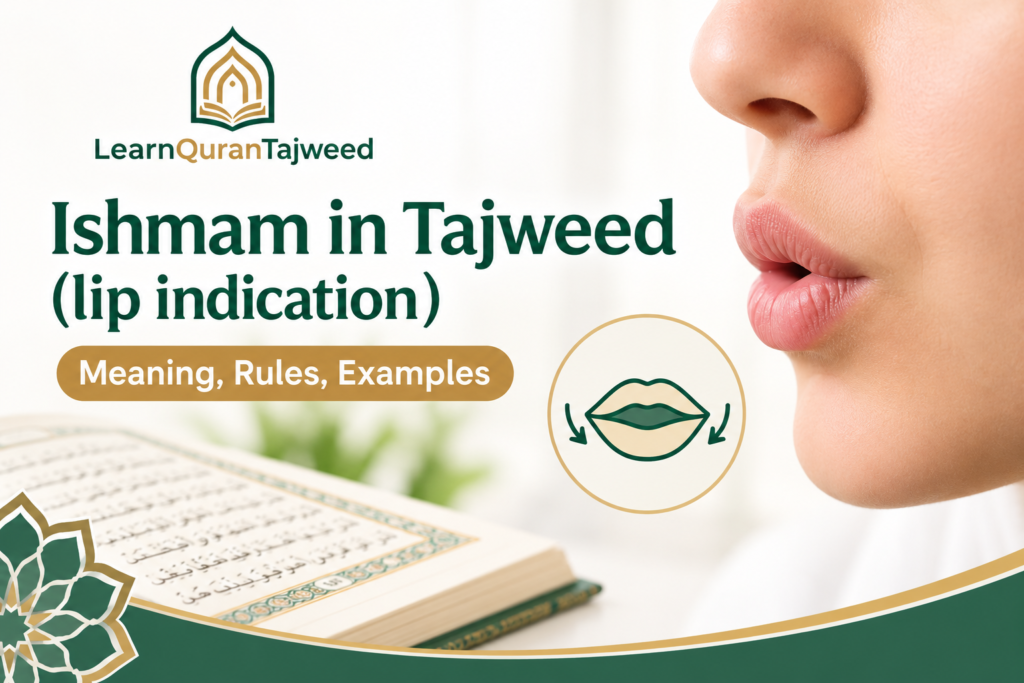
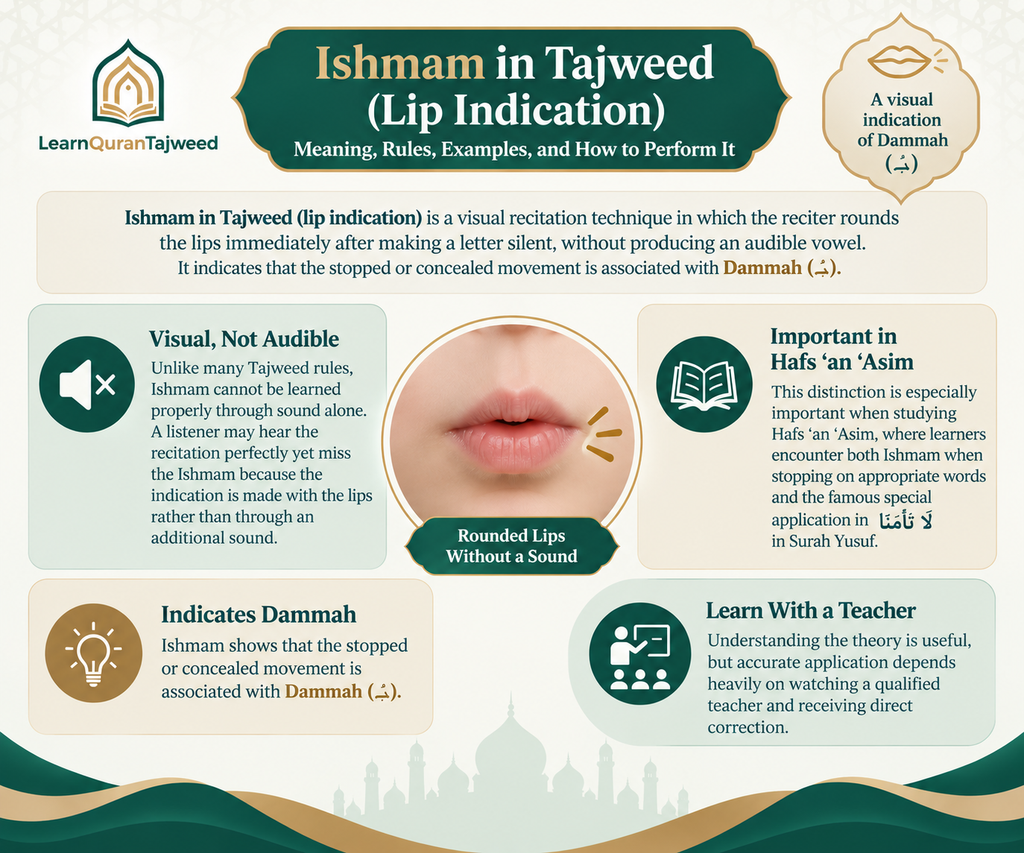
Ishmam in Tajweed (lip indication) is a visual recitation technique in which the reciter rounds the lips immediately after making a letter silent, without producing an audible vowel. It indicates that the stopped or concealed movement is associated with Dammah (ـُ).
Unlike many Tajweed rules, Ishmam cannot be learned properly through sound alone. A listener may hear the recitation perfectly yet miss the Ishmam because the indication is made with the lips rather than through an additional sound.
This distinction is especially important when studying Hafs ‘an ‘Asim, where learners encounter both Ishmam when stopping on appropriate words and the famous special application in لَا تَأْمَنَّا in Surah Yusuf.
Understanding the theory is useful, but accurate application depends heavily on watching a qualified teacher and receiving direct correction.
What Is Ishmam in Tajweed (Lip Indication)?
Ishmam in Tajweed is the rounding of the lips immediately after making the final letter silent when stopping, without producing an audible Dammah, as a visual indication of the letter’s original Dammah.
The Arabic term الإشمام is used in Tajweed and Qira’at literature for more than one performance phenomenon, but learners studying Hafs most commonly encounter it in connection with stopping and with the special word لَا تَأْمَنَّا.
Why Is Ishmam Called a Lip Indication and What Does It Indicate?
Ishmam is called a lip indication because its recitational information is communicated visually through the shape of the mouth rather than through an audible vowel. The reciter rounds the lips in the position associated with Dammah (ـُ) while leaving a small opening between them, without producing a complete “u” sound.
This means that Ishmam can be seen but not heard: someone watching the reciter can observe the brief lip movement, while a listener relying only on sound cannot detect it as an additional vowel.
When Ishmam is used at a stop, this lip movement indicates that the final letter, now made silent according to the rules of Waqf, was originally associated with a Dammah during continuation.
Ishmam therefore visually preserves information about the original vowel after that vowel has disappeared from the audible stopped form, making the lip movement a meaningful part of recitational transmission rather than a decorative gesture.
How Do You Perform Ishmam in Tajweed?
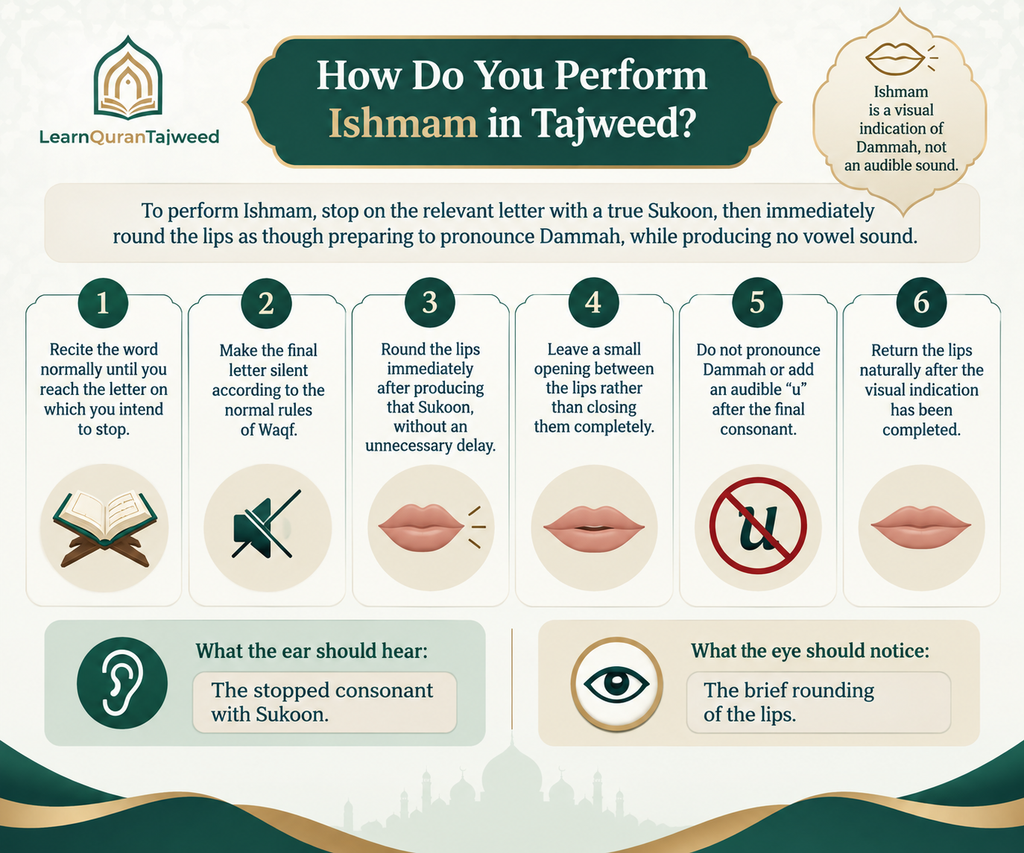
To perform Ishmam, stop on the relevant letter with a true Sukoon, then immediately round the lips as though preparing to pronounce Dammah, while producing no vowel sound.
The sequence matters because rounding the lips too early or adding a faint Dammah changes the intended performance.
- Recite the word normally until you reach the letter on which you intend to stop.
- Make the final letter silent according to the normal rules of Waqf.
- Round the lips immediately after producing that Sukoon, without an unnecessary delay.
- Leave a small opening between the lips rather than closing them completely.
- Do not pronounce Dammah or add an audible “u” after the final consonant.
- Return the lips naturally after the visual indication has been completed.
A useful self-check is to separate what the ear and eye should perceive. The ear should hear the stopped consonant, while the eye should notice the brief rounding of the lips.
Why Must Ishmam Follow the Sukoon Immediately?
The lip movement should follow the Sukoon without a noticeable delay because Ishmam belongs to the performance of that particular stop.
If the reciter stops, waits, and only then rounds the lips, the gesture becomes disconnected from the letter it is meant to indicate. The correct sequence is therefore stop first, lip indication immediately afterward.
Practitioner note: one of the easiest mistakes to make is concentrating so much on the lips that the reciter changes the sound of the final consonant. Master the stop itself first, then add the visual indication.
If coordinating the Sukoon and lip movement feels unnatural, guided practice with Learn Quran Tajweed can help you develop the correct technique through direct teacher feedback.
Through the Online Tajweed Course for Adults, you can practice subtle visual rules like Ishmam with guided demonstration and personalized correction rather than trying to understand them from audio alone.

Where Does Ishmam Occur in Hafs ‘an ‘Asim?
In the recitation of Hafs ‘an ‘Asim, learners should distinguish between Ishmam associated with stopping on a suitable final Dammah and the special Ishmam encountered in لَا تَأْمَنَّا during continuous recitation.
Treating these as if they were identical leads to unnecessary confusion because the timing and recitational context are different.
Ishmam When Stopping on a Word Ending in Dammah
When stopping on a suitable word whose final letter carries Dammah, the audible Dammah disappears and the final letter is made silent. Ishmam may then indicate the original Dammah through the lips.For example, consider:نَسْتَعِينُ
When continuing, the final ن carries its vowel. When stopping, the reciter stops on the Noon with Sukoon and may then round the lips silently to indicate the original Dammah. Another type of example is a word ending in a grammatical nominative form, such as:عَلِيمٌ
When stopping on عَلِيمٌ, the Tanween is dropped and the final Meem is pronounced with Sukoon: عَلِيمْ. The reciter may then round the lips silently after the Meem to indicate the original Dammah. In other words, Ishmam indicates the Dammah of the final letter, not the Noon sound represented by Tanween.
Practitioner note: Do not try to preserve or partially pronounce the Tanween while performing Ishmam. The correct sequence is remove the Tanween → stop with Sukoon → round the lips silently for Ishmam.
When Is Ishmam Not Used at a Stop?
Ishmam is associated with Dammah, so it is not applied indiscriminately to every Quranic stop.It is not the method used to indicate an original Fathah or Kasrah. The lip rounding specifically corresponds to Dammah, which is why the grammatical and vocalic condition of the final letter matters.
A common beginner error is therefore to think, “Ishmam is something I can do whenever I stop.” A better decision rule is: first identify the original final vowel, then determine whether Ishmam is applicable.
Inside Learn Quran Tajweed Academy
Curious about how online learning works? Peek inside our actual Quran classes and hear the beautiful recitation of our students and teachers.
Perfect Your Quran Recitation Today
Join expert-led Tajweed classes, and recite the Quran with confidence and clarity.
Start Your Free TrialWhat Is the Special Ishmam in لَا تَأْمَنَّا?
One of the most important applications learners encounter in Hafs ‘an ‘Asim occurs in Surah Yusuf, verse 11:
لَا تَأْمَنَّا
This example is particularly important because Ishmam appears within the word during connected recitation, rather than simply being added after an ordinary word-final stop.
How Is Ishmam Performed in لَا تَأْمَنَّا?
The word involves two Noons historically brought together through Idgham. In the Ishmam performance, the lips indicate the Dammah connected with the first Noon while the reciter maintains the required merged pronunciation and Ghunnah.
The important point is that the lip rounding must not become a separate audible Dammah. The indication belongs to the mouth shape while the established recitation of the word remains controlled.
This is precisely why لَا تَأْمَنَّا is difficult to master from a written description. The learner must coordinate Idgham, Ghunnah, timing, and lip movement without inserting an extra vowel.
Practitioner note: do not exaggerate the lip rounding in an attempt to make the Ishmam “clearer.” The objective is a precise indication, not a dramatic facial movement.
Because لَا تَأْمَنَّا combines an audible recitational structure with a visual indication, this is one of the places where learning through Talaqqi and Mushafahah—direct reception and oral demonstration from a teacher—is particularly valuable.
What Is the Difference Between Ishmam and Rawm?
The main difference is that Rawm preserves a faint audible portion of the original vowel, while Ishmam indicates Dammah through silent lip movement.
This distinction is essential because both rules appear in discussions of stopping, yet they communicate the original vowel differently.
| Feature | Ishmam | Rawm |
| Main method | Lip movement | Faint vocalization |
| Audible? | No | Yes, faintly |
| Visible? | Yes | Not dependent on lip indication |
| Relationship to Dammah | Indicated by rounding the lips | A small portion of the vowel is pronounced |
| Basic perception | By sight | By hearing |
| Timing | After making the letter silent | During the reduced pronunciation of the vowel |
The easiest memory rule is:Rawm gives the ear part of the vowel; Ishmam gives the eye an indication of the Dammah. Do not therefore perform Ishmam by whispering a weak “u.” Once an audible portion of the vowel is intentionally produced, the performance no longer represents the defining feature of silent Ishmam.
If distinguishing between Rawm and Ishmam becomes difficult during actual Quran recitation, Learn Quran Tajweed offers guided instruction where you can develop these subtle stopping rules through teacher demonstration and personalized correction in the Tajweed ul Quran course.

Why Is Ishmam Difficult to Learn From Audio Alone?
Ishmam cannot be reliably identified from audio alone because its defining lip indication produces no independent sound. This makes Ishmam different from rules such as Madd, Qalqalah, or Ghunnah, where the learner can hear important aspects of the rule and imitate them through repeated listening.
With Ishmam, audio may teach you the surrounding recitation, but it cannot show you the lip position itself. A video demonstration is more useful than audio, but direct instruction remains stronger because a teacher can identify whether your lip movement is too early, too late, too exaggerated, or accidentally producing a vowel.
This gives learners a useful decision framework: use text to understand Ishmam, visual demonstration to observe it, and teacher feedback to verify your own performance.
Common Mistakes When Performing Ishmam
Most errors in Ishmam come from confusing the visual indication with the vowel it represents. The following mistakes deserve particular attention:
- Producing an audible Dammah: Ishmam indicates Dammah without actually pronouncing it.
- Rounding the lips before completing the Sukoon: in stopping Ishmam, the consonant must first be made silent before the indication follows.
- Waiting too long before moving the lips: the indication should remain connected to the stop.
- Applying Ishmam to every final vowel: its lip rounding is associated specifically with Dammah, not Fathah or Kasrah.
- Exaggerating the mouth shape: a controlled, recognizable movement is sufficient.
- Learning لَا تَأْمَنَّا from spelling alone: its correct performance depends on understanding the recitational transmission, not simply interpreting the written letters.
An especially useful practice method is to work in layers. First perfect the stopped consonant or the recitation of لَا تَأْمَنَّا, then practice the lip movement separately in front of a mirror, and finally combine both under teacher supervision.
See Our Classrooms in Action
Watch these short clips from our live, interactive Quran courses to see how our students learn and interact with our expert tutors.
Perfect Your Quran Recitation Today
Join expert-led Tajweed classes, and recite the Quran with confidence and clarity.
Start Your Free TrialMaster Ishmam With Learn Quran Tajweed
Understanding Ishmam in Tajweed on paper is only the first stage. Build accurate Quran recitation with Learn Quran Tajweed, where guided Tajweed instruction helps you practice subtle rules such as Ishmam through demonstration, listening, repetition, and personalized correction.
[Start Learning Tajweed Online]
Courses we offer:
- Online Tajweed Classes
- Beginner Tajweed Course
- Intermediate Tajweed Course
- Advanced Tajweed Course
- Amali (Practical) Tajweed Course
- Tajweed Course for Kids
- Tajweed Course for Ladies
- Tajweed ul Quran Course

Conclusion
Ishmam in Tajweed (lip indication) is a silent visual technique that uses lip rounding to indicate Dammah without pronouncing an additional vowel. In stopping, the lips are rounded immediately after the relevant final letter has been made silent.
Learners of Hafs ‘an ‘Asim should also recognize the special application associated with لَا تَأْمَنَّا in Surah Yusuf. Because correct Ishmam depends on visible movement and precise timing, it is one of the clearest examples of a Tajweed detail best learned through observation and direct teacher correction.
FAQs About Ishmam in Tajweed
What is Ishmam in Tajweed?
Ishmam is a silent rounding of the lips used to indicate Dammah without pronouncing it. In stopping Ishmam, the lip movement follows the Sukoon and is perceived visually rather than through an additional sound.
Can you hear Ishmam?
No, Ishmam itself is not heard because no vowel sound is produced. The reciter rounds the lips to indicate Dammah, so the defining indication is recognized by watching the mouth.
Where is the special Ishmam in Hafs found?
The well-known special application during connected recitation in Hafs occurs in the word لَا تَأْمَنَّا in Surah Yusuf 12:11. It requires careful coordination of the merged Noons, Ghunnah, and lip indication.
What is the difference between Ishmam and Rawm?
Ishmam is a silent visual indication, whereas Rawm involves pronouncing a faint portion of the original vowel. In simple terms, Ishmam is perceived by sight while Rawm can be perceived by hearing.
Does Ishmam produce a Dammah sound?
No, the lip position resembles the preparation for Dammah, but an audible Dammah must not be added. Producing a clear “u” sound is a common application mistake.
Can Ishmam be learned by listening to Quran recitation?
Audio alone cannot demonstrate Ishmam completely because its defining feature is visual. Watching an accurate demonstration and practicing with a qualified Tajweed teacher are more reliable ways to learn its timing and lip position.
Related Articles
Tajweed Basics