 Quran
Have you ever reached verse 27 of Surah Al-Qiyamah, seen that tiny letter س printed above the line, and had no idea what to do with it? You are not alone. That one small mark is the most misread symbol in the whole surah, and most reciters glide straight past it.
Surah Al-Qiyamah is a favourite among students moving beyond the very short chapters. It is only 40 verses long, yet it packs in almost every core rule a learner needs: ikhfa, idgham, iqlab, qalqalah, three types of madd, ghunnah, and one of only four saktah pauses in the entire recitation of Hafs. That density is exactly why mastering Surah Qiyamah tajweed builds so much confidence.
This guide walks through Surah Qiyamah tajweed the way a tutor would in a live session. You will see the specific words each rule appears in, how to pronounce them, and which errors to watch for.
What You Will Learn
- Where the famous saktah in verse 27 falls, and how to perform it without breaking the meaning.
- Every noon sakinah and tanween rule in the surah, matched to the exact word it appears in.
- The three madd types that shape the surah’s rhythm, and how long to hold each one
- The qalqalah, ghunnah, and raa points that separate a smooth recitation from a rushed one.
- The five mistakes learners repeat most in this surah, with a simple fix for each.
Surah Qiyamah Tajweed: What Makes This Surah a Turning Point for Reciters
Surah Al-Qiyamah is the 75th chapter of the Quran, revealed in Makkah, containing 40 verses, and located in Juz’ 29. Its theme is the Day of Resurrection, and its short, rhyming verse endings make it easy to memorise and satisfying to recite aloud.
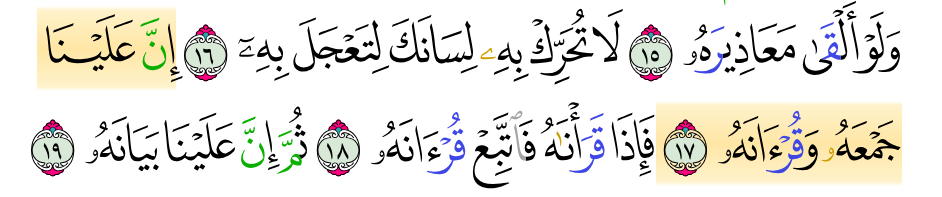
But there is a deeper reason this surah matters to reciters. Verses 16 to 19 speak directly about how the Quran is to be received and repeated: إِنَّ عَلَيْنَا جَمْعَهُ وَقُرْآنَهُ — “Indeed, upon Us is its collection and its recitation.” Few chapters comment on recitation itself while demanding such precision from the reciter, which is why Surah Qiyamah tajweed deserves more attention than its length suggests.
The Saktah in Verse 27: The Signature Rule of Surah Al-Qiyamah
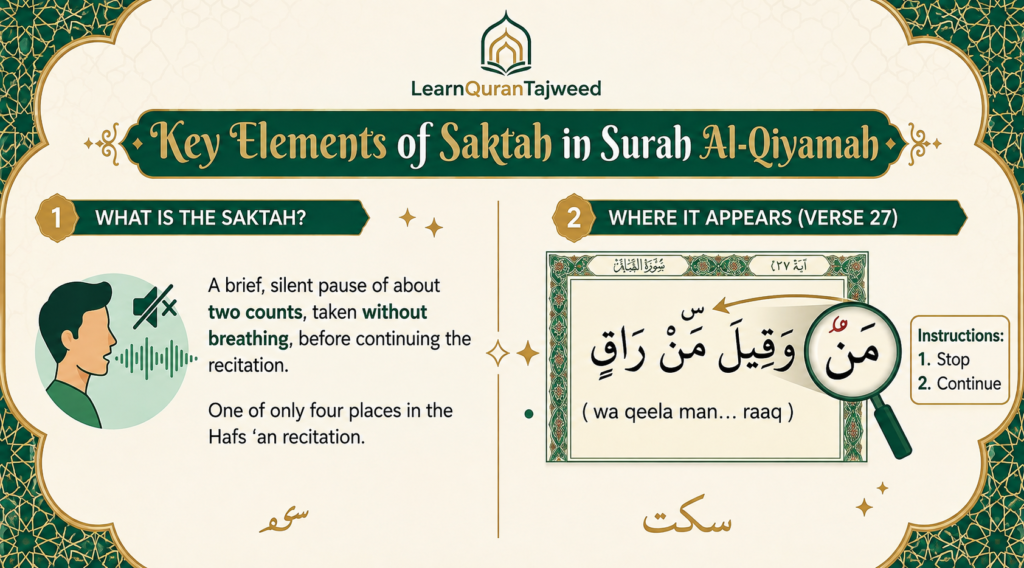
The saktah is a brief, silent pause of about two counts, taken without breathing, before continuing the recitation. Surah Al-Qiyamah contains one of only four places in the recitation of Hafs ‘an ‘Asim where it occurs.
Where It Appears
Verse 27 reads: وَقِيلَ مَنْ ۜ رَاقٍ ( wa qeela man… raaq ). The small س (or the word سكته) printed above the line between مَنْ and رَاقٍ is your instruction to stop the sound briefly, hold your breath, then say رَاقٍ.
Why The Pause Protects The Meaning
Without the saktah, noon sakinah followed by raa would normally merge (idgham), producing marraaq — a single word that sounds like a Persian-borrowed term and loses the intended sense entirely. The pause keeps the noon audible and the phrase clear: “and it is said, ‘Who can heal him?'”
Two practical notes. First, the saktah cancels the idgham that the letters would otherwise require. Second, you may not take a breath during it, or the pause becomes an ordinary stop.
See Our Classrooms in Action
Watch these short clips from our live, interactive Quran courses to see how our students learn and interact with our expert tutors.
Perfect Your Quran Recitation Today
Join expert-led Tajweed classes, and recite the Quran with confidence and clarity.
Start Your Free TrialNoon Sakinah and Tanween Rules in Surah Qiyamah Tajweed
This is where the surah earns its reputation as a teaching chapter. Four of the noon sakinah rules appear here, and each one has a clear, memorable example you can drill in minutes.
1. Ikhfa — Hidden Nasalisation
The word الْإِنسَانُ appears in verses 3, 5, 10, 13, 14, and 36. In each case the noon sakinah meets س, so the noon is neither fully pronounced nor merged. Hide it in the nose for roughly two counts while your tongue prepares the seen.
Verse 39 gives a second example: وَالْأُنثَىٰ, where noon sakinah meets ث. Verse 38 shows ikhfa with tanween in عَلَقَةً فَخَلَقَ.
2. Idgham with Ghunnah — Merging the Noon
Verse 3 has أَلَّن نَّجْمَعَ and verse 4 has أَن نُّسَوِّيَ: the noon disappears into the following noon with a full nasal hold. Verse 37 stacks two in a row — نُطْفَةً مِّن مَّنِيٍّ يُمْنَىٰ — merging tanween into meem, then noon into meem, then tanween into yaa.
Verses 36 and 40 add أَن يُتْرَكَ and أَن يُحْيِيَ, where noon merges into yaa. Verse 22 gives وُجُوهٌ يَوْمَئِذٍ نَّاضِرَةٌ, containing two merges in six syllables.
3. Iqlab — Turning Noon into Meem
Tanween followed by ب converts to a nasalised meem. Verse 13 has يَوْمَئِذٍ بِمَا (yawma’idhim-bimaa) and verse 24 has يَوْمَئِذٍ بَاسِرَةٌ (yawma’idhim-baasirah). Say a soft meem with ghunnah, keeping the lips barely touching.
4. Izhar — Clear Pronunciation
Verse 39 opens with فَجَعَلَ مِنْهُ, where noon sakinah meets ه, a throat letter. Here the noon is pronounced plainly with no nasal hold and no merging at all.
Madd Rules That Shape the Surah’s Rhythm
Three families of elongation control the pace of this chapter. Getting their counts right is what makes a recitation sound measured rather than hurried or sung.
a. Madd Munfasil — The Very First Words
The surah opens with لَا أُقْسِمُ in verses 1 and 2: a madd letter at the end of one word meeting a hamzah at the start of the next. In Hafs, this is held for four or five counts. The same pattern returns in كَلَّا إِذَا (verse 26), إِلَىٰ أَهْلِهِ (verse 33), and عَلَىٰ أَن يُحْيِيَ (verse 40).
b. Madd Badal — Two Counts Only
قُرْآنَهُ in verses 17 and 18, and الْآخِرَةَ in verse 21, both contain a hamzah followed by a madd letter. These take only two counts, and learners routinely stretch them to four.
c. Madd ‘Aarid and Madd ‘Iwad at the Stops
When you stop on الْفِرَاقُ (28), بِالسَّاقِ (29), or الْمَسَاقُ (30), the final letter becomes silent, and the preceding alif becomes madd ‘aarid lis-sukoon: two, four, or six counts, but consistently the same length throughout your recitation.
Stopping on سُدًى in verse 36 gives madd ‘iwad — the tanween drops, and you hold a plain two counts. And the rhyming endings such as فَسَوَّىٰ and الْمَوْتَىٰ are natural madd: two counts, never more.
Surah Al-Qiyamah: Qalqalah, Ghunnah, and the Letter Raa
These three details are small in print but very audible in practice. They are usually what a tutor corrects first when a student recites this surah aloud.
a. Qalqalah — The Echoing Bounce
Minor qalqalah appears mid-word in أُقْسِمُ (verses 1 and 2), أَلْقَىٰ (verse 15), and نُطْفَةً (verse 37). Give the qaf and taa a light, contained bounce without adding a vowel after them.
Major qalqalah appears when you stop on the qaf endings of verses 27 to 30: رَاقٍ، الْفِرَاقُ، بِالسَّاقِ، الْمَسَاقُ. Here the bounce is stronger and clearly heard.
b. Ghunnah Mushaddadah — Two Counts of Nasal Sound
Any doubled noon or meem carries a full nasal hold. Find it in إِنَّ عَلَيْنَا (verses 17 and 19), يُنَبَّأُ (verse 13), تَظُنُّ (verse 25), وَظَنَّ أَنَّهُ (verse 28), and بِالنَّفْسِ (verse 2).
c. Tafkheem and Tarqeeq of Raa
The surah alternates between heavy and light raa constantly. الْبَصَرُ (7) and الْمَفَرُّ (10) take a full, heavy sound, while قَادِرِينَ (4) and الْفِرَاقُ (28) are light and thin.
If this distinction still feels unstable, the detailed rules of tafkheem and tarqeeq of raa are worth reviewing before you recite the surah in full.
Inside Learn Quran Tajweed Academy
Curious about how online learning works? Peek inside our actual Quran classes and hear the beautiful recitation of our students and teachers.
Perfect Your Quran Recitation Today
Join expert-led Tajweed classes, and recite the Quran with confidence and clarity.
Start Your Free TrialA Worked Example: Verse 13 from Start to Finish
Verse 13 — يُنَبَّأُ الْإِنسَانُ يَوْمَئِذٍ بِمَا قَدَّمَ وَأَخَّرَ — contains four rules in eight words, which makes it an ideal daily drill. Begin with the ghunnah on the doubled noon of يُنَبَّأُ. Move into the ikhfa of الْإِنسَانُ. Apply iqlab across يَوْمَئِذٍ بِمَا. Close with the shaddah on قَدَّمَ and a light, thin raa at the end of وَأَخَّرَ.
Reciting one verse this deliberately, five or six times, teaches more than reading the whole surah quickly. This is precisely the method used in one-to-one Quran recitation classes, where a tutor listens and corrects in real time rather than leaving errors to settle into habit.
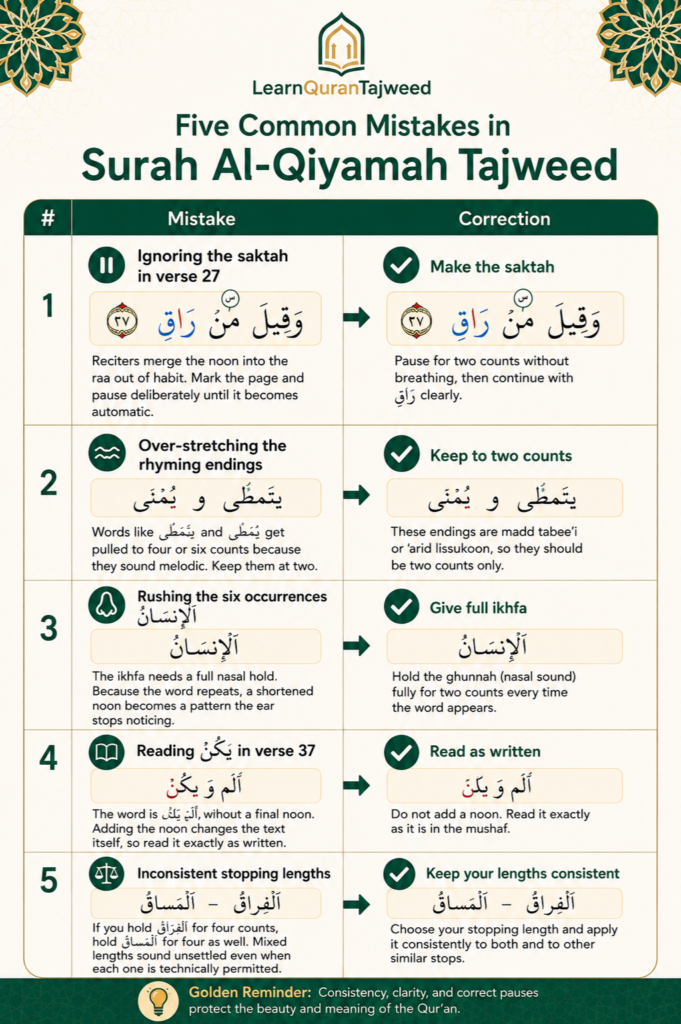
Five Common Mistakes in Surah Qiyamah Tajweed
Surah Al-Qiyamah contains several Tajweed points that can be easy to miss, especially when reciting at a faster pace. The following mistakes are among the most important to watch for when practicing the Surah.
1. Ignoring The Saktah In Verse 27
Many reciters read وَقِيلَ مَنْ رَاقٍ in one breath and let the noon merge into the raa, as idgham would normally require. The habit is strong because noon sakinah before raa merges everywhere else in the Quran, so the ear expects it here too.
The fix starts with what you see on the page. Highlight the small س above مَنْ in your mushaf, then pause for two counts without breathing each time you reach it. After a few weeks of deliberate practice, the pause becomes automatic.
2. Over-Stretching The Rhyming Endings
Words such as يَتَمَطَّىٰ (verse 33) and يُمْنَىٰ (verse 37) end on a soft alif that invites a long, melodic pull. Many learners hold them for four or six counts because the rhyme sounds beautiful, but these endings are natural madd, not madd ‘aarid.
Keep every one of them at two counts, whether you continue or stop. A simple check is to tap two fingers as you finish the word. If the sound lasts past the second tap, you are stretching beyond what the rule allows.
3. Rushing The Six Occurrences Of الْإِنسَانُ
الْإِنسَانُ appears six times in the surah, and each time it carries an ikhfa where the noon sakinah meets س. Because the word is so familiar, reciters often clip the nasal sound and move straight to the seen.
The repetition makes this mistake hard to notice, since a shortened noon soon sounds normal to the ear. Slow down on each occurrence, hold the hidden noon in the nose for a full two counts, and record yourself to check.
4. Reading يَكُنْ in Verse 37
Verse 37 reads أَلَمْ يَكُ نُطْفَةً, with no noon at the end of يَكُ. Learners who know the more common form يَكُنْ often add the noon without thinking, especially when reciting from memory at speed.
This is not a pronunciation slip but a change to the written text itself, which makes it more serious than most tajweed errors. Look closely at the word in your mushaf, read it exactly as printed, and repeat the full verse until يَكُ feels natural.
5. Inconsistent Stopping Lengths
When you stop on الْفِرَاقُ, بِالسَّاقِ, and الْمَسَاقُ, you may hold the madd ‘aarid for two, four, or six counts. The problem comes when a reciter holds one ending for four counts and the next for two, switching lengths without realising it.
Each length is valid on its own, but mixing them makes the recitation sound uneven and unsettled. Choose one length before you begin, use it for every verse ending of this type, and keep it the same through the whole surah.
Teaching Surah Qiyamah Tajweed to Kids and Adults
Reading about Surah Qiyamah tajweed and producing it correctly are two different skills, only a trained ear can tell you which one you have.
Shaykhi Academy’s tajweed and Quran recitation classes pair you with Al-Azhar-qualified, Ijazah-certified tutors who listen to every verse you recite and correct you on the spot.
Whether you’re just starting or aiming for mastery, our comprehensive online programs are designed to help you recite the Quran with confidence, accuracy, and beauty.
Courses we offer:
- Online Tajweed Classes
- Learn Quran with Tajweed Online
- Beginner Tajweed Course
- Intermediate Tajweed Course
- Advanced Tajweed Course
- Amali (Practical) Tajweed Course
- Tajweed Course for Kids
- Tajweed Course for Adults
- Tajweed Course for Ladies
- Tajweed ul Quran Course
- Quran Recitation with Tajweed Course
Lessons are one-to-one, scheduled around you, and available for children and adults at every level — from your first Noorani Qaida letter to full-surah mastery with a certified sanad. Start with a free trial session and hear the difference in your first lesson.
Perfect Your Quran Recitation Today
Join expert-led Tajweed classes, and recite the Quran with confidence and clarity.
Start Your Free TrialConclusion
Surah Al-Qiyamah is a compact tajweed workshop. Its 40 verses hold six repetitions of ikhfa in one word, layered idgham in verse 37, iqlab across two verses, three madd families, both grades of qalqalah, and the rare saktah of verse 27 that most reciters miss entirely.
Work through it slowly rather than quickly. Fix one rule at a time, keep your elongation counts consistent, and read verse 37 exactly as written. Studying Surah Qiyamah tajweed in this deliberate way improves not just this chapter but every chapter you recite afterwards.
The surah also offers a lesson that goes beyond technique. In verses 16 to 19, the Prophet ﷺ is told not to hurry his tongue with the revelation, but to listen first and then follow its recitation. That same patience is the right attitude for any learner: listen carefully, repeat calmly, and let accuracy come before speed.
As a next step, record yourself reciting the full surah once a week and compare it with a qualified reciter, verse by verse. Note where your counts, nasal sounds, or pauses drift, and focus the following week on those points. With steady review and feedback from a trained teacher, your recitation of Al-Qiyamah will soon sound confident, clear, and correct.
FAQs
How many tajweed rules are in Surah Al-Qiyamah?
Around eleven rules. The surah contains examples of more than a dozen distinct rules, including ikhfa, idgham with ghunnah, iqlab, izhar, ghunnah mushaddadah, minor and major qalqalah, madd munfasil, madd badal, madd ‘aarid lis-sukoon, madd ‘iwad, and the saktah. That range is why it is widely used as a teaching surah.
What is the saktah in Surah Al-Qiyamah?
It is a two-count silent pause taken without breathing, found in verse 27 between مَنْ and رَاقٍ. It prevents the noon from merging into the raa, which would blur the meaning of the phrase.
Is Surah Al-Qiyamah Makki or Madani?
It is a Makki surah, revealed in Makkah before the migration. It is chapter 75 of the Quran, has 40 verses, and appears in Juz’ 29.
How long does it take to learn Surah Al-Qiyamah with correct tajweed?
Most learners who already know the basic rules need two to four weeks of short daily sessions to recite it accurately from memory.
Can children learn Surah Qiyamah tajweed?
Yes. Children often master the sounds faster than adults because they imitate rather than analyse. Teach the pronunciation first through repetition, introduce rule names afterwards, and keep sessions to two or three verses.
What is the best way to practice the madd rules in Surah Al-Qiyamah?
Choose one madd type per session and recite only the words containing it. Count the beats out loud or tap them with your finger, then check yourself against a recording by a qualified reciter such as those on Quran audio libraries.