 Quran
Quran
Surah Al-Kafirun is one of the first chapters most Muslims memorise, and one of the most frequently recited in prayer. The Prophet ﷺ recited it in the two rak’ahs before Fajr and after Maghrib, which means many of us say these six verses several times a week.
And yet, when a teacher listens closely, the same handful of errors appear again and again: a shortened madd, a missing ghunnah, a dal (د) pronounced instead of merged. Learning surah Kafiroon tajweed properly fixes all of them in a single short lesson.
This guide walks you through the surah word by word. You will see exactly which rule applies where, how long each stretch should be, what changes when you stop at the end of a verse, and which mistakes to listen for in your own recitation.
Because the chapter is only six verses long, it is the ideal place to consolidate the rules of noon sakinah, meem sakinah, madd, and idgham all at once.
What You Will Learn
- The complete tajweed map of Surah Al-Kafirun, verse by verse, with counts and timings.
- Where the seven cases of madd munfasil fall and how many harakat each takes.
- The two hidden rules most students miss: the idgham mutajanisayn in عَبَدتُّمْ and the qalqalah that only appears when you stop.
- The four most common recitation mistakes in this surah and how to correct them.
Surah Kafiroon Tajweed: What This Short Chapter Demands From Your Recitation
Surah Al-Kafirun (chapter 109) is a Makkan surah of six verses. Its vocabulary is unusually repetitive: the roots ع-ب-د, and the particles لَا and مَا return over and over.
That repetition is a gift for a student of tajweed. Instead of meeting fifteen different rules once each, you meet four or five rules many times, which is exactly how muscle memory is built.
The rules you will actually apply in Surah Kafiroon tajweed are these: madd munfasil, madd tabee’i, madd ‘arid lissukoon, ikhfa haqiqi, izhar shafawi, idgham with ghunnah, and idgham mutajanisayn. There is also lam qamariyyah in verse one and tafkheem of the raa.
See Our Classrooms in Action
Watch these short clips from our live, interactive Quran courses to see how our students learn and interact with our expert tutors.
Perfect Your Quran Recitation Today
Join expert-led Tajweed classes, and recite the Quran with confidence and clarity.
Start Your Free TrialSurah Kafiroon Tajweed Breakdown Verse-by-Verse
Here is the detail. For each verse, the rule is named, the reason is given, and the timing is specified in harakat (a harakah is roughly the time it takes to say one short vowel — think of a steady finger tap).
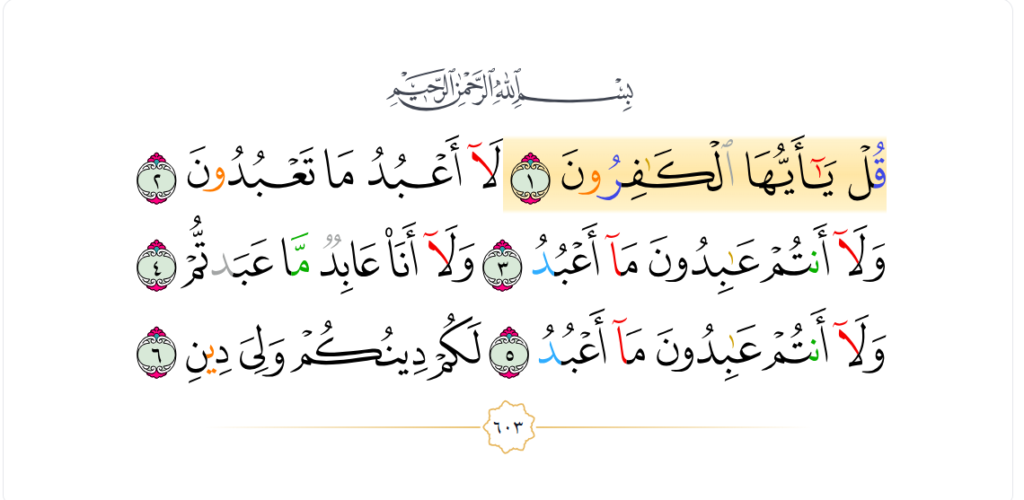
a. Verse 1 — قُلْ يَـٰٓأَيُّهَا ٱلْكَـٰفِرُونَ
Verse 1 opens the surah with a clear command, and already demands careful attention to elongation length and letter weight before you move further:
- قُلْ — the qaaf is a letter of isti’la (elevation), produced from the deepest part of the tongue against the soft palate. Keep it full and heavy; do not soften it into a kaaf.
- The laam here is saakinah and followed by yaa, so it is pronounced clearly (izhar). A laam sakinah only merges into laam or raa.
- يَـٰٓأَيُّهَا — the elongation mark over the alif signals madd. Scholars treat this as madd munfasil in ruling, because يَا is an independent particle of address joined in the script. Stretch it 4 or 5 harakat in the way of Hafs.
- The yaa in أَيُّهَا carries a shaddah. Press on it, but add no ghunnah — nasalisation belongs to noon and meem only.
- ٱلْكَـٰفِرُونَ — kaaf is a moon letter, so this is lam qamariyah: the laam is pronounced audibly. The raa carries a dammah, which makes it heavy (mufakhkham), not thin.
If you stop at the end of the verse, the final noon takes sukoon, and you get madd ‘arid lissukoon on رُو: 2, 4, or 6 harakat, consistently applied.
b. Verse 2 — لَآ أَعْبُدُ مَا تَعْبُدُونَ
Verse 2 brings back the madd munfasil pattern and introduces one of the surah’s trickiest sounds — the throat-based ‘ayn in أَعْبُدُ:
- لَآ أَعْبُدُ — madd munfasil, 4–5 harakat. The madd letter ends the word لَا and a hamzah opens the next.
- أَعْبُدُ — the ‘ayn is saakin and comes from the middle of the throat. This is the single most-missed makhraj in the surah; many reciters replace it with a light hamzah or swallow it entirely.
- مَا — plain madd tabee’i, exactly 2 harakat. No more, no less.
- تَعْبُدُونَ — madd tabee’i on دُو while continuing; madd ‘arid lissukoon if you stop at the verse end.
c. Verse 3 — وَلَآ أَنتُمْ عَـٰبِدُونَ مَآ أَعْبُدُ
This verse alone contains four separate rules:
- وَلَآ أَنتُمْ — madd munfasil, 4–5 harakat.
- أَنتُمْ — noon sakinah followed by taa gives ikhfa haqiqi. The tongue does not touch the gum ridge; the sound is nasalised for 2 harakat while the mouth already shapes the taa.
- تُمْ عَـٰبِدُونَ — meem sakinah followed by ‘ayn gives izhar shafawi. Close the lips cleanly and release. Do not hum the meem.
- مَآ أَعْبُدُ — madd munfasil again, 4–5 harakat.
Stopping here matters: If you pause at أَعْبُدُ, the daal becomes saakin, and you must produce qalqalah — a crisp, unvoiced bounce. While joining to verse 4, there is no qalqalah at all.
This is the detail that separates a recitation that sounds trained from one that sounds approximate, and it is the kind of correction a live teacher catches in seconds.
d. Verse 4 — وَلَآ أَنَا۠ عَابِدٌۭ مَّا عَبَدتُّمْ
Verse 4 repeats the structure of verse 2 but swaps in a different speaker, hiding one of Tajweed’s most commonly missed rules inside عَبَدتُّمْ:
- وَلَآ أَنَا۠ — madd munfasil on لَآ أَ. Then look at the small superscript alif over أَنَا۠: it tells you the alif is not pronounced while continuing. Read “anā” short — roughly “ana” — and lengthen it only if you stop there.
- عَابِدٌۭ مَّا — a tanween meeting a meem produces idgham with ghunnah, complete (kamil). The tanween disappears entirely into a meem mushaddadah held with nasalisation for 2 harakat: “‘ābidum-mā”.
- عَبَدتُّمْ — the jewel of the surah. A daal saakin meets a taa, two letters sharing the same makhraj with different attributes, so we apply idgham mutajanisayn, complete. The daal vanishes; you pronounce a doubled taa and preserve its whisper (hams): “‘abad-tum” with no audible d and no qalqalah.
Give the shaddah its due weight here — this is also a natural place for nabr (stress) in recitation.
e. Verse 5 — وَلَآ أَنتُمْ عَـٰبِدُونَ مَآ أَعْبُدُ
Identical to verse 3: madd munfasil, ikhfa haqiqi in أَنتُمْ, izhar shafawi at تُمْ عَـٰبِدُونَ, a second madd munfasil, and qalqalah on the daal only if you stop.
f. Verse 6 — لَكُمْ دِينُكُمْ وَلِيَ دِينِ
The final verse closes the surah with its most-repeated line — and a reminder that your stopping length should stay consistent with the choices you made earlier:
- لَكُمْ دِينُكُمْ — meem sakinah before daal: izhar shafawi, clear and unhummed.
- دِينُكُمْ وَلِيَ — meem sakinah before waaw: izhar shafawi again. Students often produce ikhfa shafawi here by mistake. Remember the boundary: ikhfa shafawi happens only before baa.
- وَلِيَ — in the recitation of Hafs, the yaa carries a fathah: “wa liya”, not “wa lī”.
- دِينِ — stopping at the end of the surah drops the kasrah, the noon takes sukoon, and you get madd ‘arid lissukoon on دِي: 2, 4, or 6 harakat. Whichever length you choose, match it to the length you used at the end of verses 1 and 2.
The 4 Most Common Mistakes in Reciting Surah Al-Kafirun
These are the four errors teachers hear most often when they check a student’s Surah Kafiroon tajweed:
1. Shortening The Madd Munfasil
Because لَآ أَ feels like one quick syllable in everyday speech, most reciters give it only 2 harakat instead of the required 4–5. This madd appears seven times in just six verses, so this one habit changes the rhythm of the whole surah. Count each one with a steady finger tap until the full length becomes natural.
Whichever length you choose, 4 or 5, use it for all seven cases. To practise, recite verse 3 slowly and check that وَلَآ أَنتُمْ and مَآ أَعْبُدُ take exactly the same time. If one sounds longer than the other, your rhythm is still drifting.
2. Pronouncing The Daal In عَبَدتُّمْ
Saying “‘abad-tum” with an audible d breaks the idgham mutajanisayn and adds a sound that should not be there. The daal must disappear completely into the taa, leaving a doubled taa with its soft whisper: “‘abattum”. Don’t bounce on the daal either, because this is a merge, not a stop.
This mistake usually comes from reading the word as it looks on the page, since the daal is still written. Don’t overcorrect into a single light taa (“‘abatum”) either. Hold the shaddah briefly so the doubled taa is clearly heard.
3. Humming The Meem In لَكُمْ دِينُكُمْ
Both meems here follow the rule of izhar shafawi, not ikhfa, so they must be pronounced clearly with no nasal hum. Any ghunnah on these meems is an added sound that does not belong in the recitation. Remember the boundary: ikhfa shafawi happens only when a meem sakinah is followed by a baa.
Take extra care at دِينُكُمْ وَلِيَ. Meem and waaw are both pronounced with the lips, so the meem can easily slide into a nasal sound before the waaw. Close your lips lightly on the meem, then open straight into the waaw without lingering.
4. Inconsistent Stopping Length
Choosing 4 harakat at ٱلْكَـٰفِرُونَ and then only 2 at تَعْبُدُونَ is an error of consistency, even though each length is allowed on its own. Pick one length for madd ‘arid lissukoon (2, 4 or 6 harakat) before you begin. Then hold that same length at every verse ending through to دِينِ.
This mistake usually shows up in prayer, when reciters rush the later verses to reach rukoo’. Choose your stopping length before you start reciting, and count it on your fingers at first. With practice, the length becomes automatic and stays the same from the first verse to the last.
Self-diagnosis only goes so far. Recording yourself helps you hear obvious slips, but you cannot correct a makhraj you have never heard produced correctly — which is why every classical route to accurate recitation runs through a teacher who listens and corrects in real time.
Inside Learn Quran Tajweed Academy
Curious about how online learning works? Peek inside our actual Quran classes and hear the beautiful recitation of our students and teachers.
Perfect Your Recitation With a Certified Tajweed Teacher
Reading about idgham mutajanisayn is not the same as producing it. You can memorise every rule in this guide and still swallow the ‘ayn in أَعْبُدُ or hum a meem that should be clear, simply because no one has listened to you recite and pointed it out.
At Learn Quran Tajweed, you recite Surah Al-Kafirun to a qualified teacher who holds an Ijazah. Your teacher listens to every madd, ghunnah and stop, then corrects your Surah Kafiroon tajweed on the spot, before small slips harden into habits you repeat in every prayer.
Once this surah is secure, you apply the same rules across the rest of Juz’ Amma. The madd munfasil, ikhfa haqiqi and izhar shafawi you practise here come back in almost every short surah, so each lesson builds on the last instead of starting from scratch.
Courses we offer:
- Tajweed Course for Kids
- Tajweed Course for Adults
- Tajweed Course for Ladies
- Tajweed ul Quran Course
- Quran Recitation with Tajweed Course
- Tajweed Ijazah Program
- Online Tajweed Classes
- Learn Quran with Tajweed Online
- Beginner Tajweed Course
- Intermediate Tajweed Course
- Advanced Tajweed Course
- Amali (Practical) Tajweed Course
Whether you are a complete beginner or polishing a recitation you learned years ago, the fastest progress comes from live correction. Book your free trial class today, recite to a teacher who hears you, and pray your next Fajr sunnah with confidence.
Perfect Your Quran Recitation Today
Join expert-led Tajweed classes, and recite the Quran with confidence and clarity.
Start Your Free TrialConclusion
Surah Al-Kafirun packs a remarkable amount of tajweed into six short verses: seven cases of madd munfasil, two of ikhfa haqiqi in أَنتُمْ, four of izhar shafawi, one idgham with ghunnah in عَابِدٌۭ مَّا, and the idgham mutajanisayn in عَبَدتُّمْ that most reciters never notice.
Add the qalqalah that appears only when you stop at أَعْبُدْ, the lam qamariyyah and heavy raa of ٱلْكَـٰفِرُونَ, and the madd ‘arid lissukoon that closes the surah, and you have a complete introductory tajweed syllabus in one chapter.
Take-away message: mastering Surah Kafiroon tajweed is not about memorising rule names — it is about producing the right sound for the right duration, every time. Learn these ten rules here, and you will carry them into every short surah you recite in prayer.
The fastest path from knowing the rules to applying them is a teacher who hears you. Everything else is preparation.
FAQs
How many tajweed rules are in Surah Al-Kafirun?
Ten distinct rules appear across its six verses, including madd munfasil, madd tabee’i, madd ‘arid lissukoon, ikhfa haqiqi, izhar shafawi, idgham with ghunnah, idgham mutajanisayn, qalqalah on stopping, lam qamariyyah, and tafkheem of the raa.
Is there any ghunnah in Surah Al-Kafirun?
Yes, in two situations. The ikhfa haqiqi in أَنتُمْ (verses 3 and 5) carries a 2-harakat nasalisation, and the idgham in عَابِدٌۭ مَّا (verse 4) produces a meem mushaddadah held with ghunnah for 2 harakat.
What is the rule in عَبَدتُّمْ?
It is idgham mutajanisayn kamil. The daal saakin merges completely into the taa because both letters share the same makhraj with different attributes. Pronounce a doubled taa with its whisper, with no trace of the daal.
Is there qalqalah in Surah Al-Kafirun?
Only when you stop. If you pause at the end of verses 3 and 5 on أَعْبُدْ, the daal takes sukoon and requires qalqalah. If you continue into the next verse, no qalqalah occurs.
Why is Surah Al-Kafirun recommended for tajweed beginners?
It is short, highly repetitive, and free of the harder rules such as iqlab and madd lazim. The same few rules recur many times, which builds accurate habits quickly — and it is recited often in prayer, so the practice is immediately useful.