 Tajweed Basics

Ha Al-Kinayah/Damir (هاء الكناية / هاء الضمير) is the pronoun هاء added to a word to refer to a singular absent masculine person, meaning “him” or “his.” In Quran recitation, its pronunciation depends on its vowel and on whether the letters immediately before and after it are vowelled or sakin.
It is also called Ha Al-Damir (هاء الضمير), and its elongation is commonly discussed under Madd Silah (مد الصلة). The rule may look small on the Mushaf page, but applying it correctly requires the reciter to distinguish between Silah Sughra, Silah Kubra, no Silah, and several special cases in Hafs ‘an ‘Asim.
The most useful way to understand Ha Al-Kinayah is not to memorize isolated examples. Instead, examine three things in order: the Ha itself, the letter before it, and the letter after it.
This guide explains that decision process, the four possible positions of Ha Al-Kinayah, the difference between the two types of Silah, and the important Hafs exceptions.
What Is Ha Al-Kinayah/Damir in Tajweed?
Ha Al-Kinayah/Damir is the additional pronoun Ha (ه) attached to a noun, verb, or particle to refer to a singular absent masculine person.
In grammatical meaning, it functions like “him” or “his.” It is not part of the original root structure of the word.
For example
:مِنْهُ minhu — “from him”
بِهِ
bihi — “with/by him”
عَلَيْهِ
‘alayhi — “upon him”
Ha Al-Kinayah may therefore be attached to:
- Nouns
- Verbs
- Particles
It is also known as Ha Al-Damir because it represents a pronoun, while the expression Ha Al-Silah is associated with the connecting vowel sound that may follow it under the appropriate recitation conditions.
Is Ha Al-Kinayah Pronounced With Dammah or Kasrah?
Yes. The basic vowel of Ha Al-Kinayah (هاء الكناية) is Dammah, as in مِنْهُ. It is pronounced with Kasrah when preceded by a Kasrah or a sakin Ya, as in بِهِ and عَلَيْهِ. In the narration of Hafs, there are also transmitted exceptions that must be learned separately.
Read also: Qirat of Quran — The 7 Famous Qira’at, and How They Differ
When Does Ha Al-Kinayah/Damir Receive Silah?
Ha Al-Kinayah normally receives Silah when it is vowelled with Dammah or Kasrah and occurs between two vowelled letters during continuous recitation.
Silah means connecting the vowelled Ha to a corresponding Madd sound.If the Ha carries Dammah, it is connected with a small Waw-like sound (ـهُۥ ). If the Ha carries Kasrah, it is connected with a small Ya-like sound:(ـهِۦ)
This connection applies during Wasl — continuous recitation — rather than when stopping on the word.
The uploaded Madd reference likewise classifies Madd Silah according to whether the pronoun occurs between vowelled letters and whether a Hamzah follows it.
The Two Conditions for Silah
Use this simple checklist before extending Ha Al-Kinayah:
- The Ha must be vowelled with Dammah or Kasrah.
- The Ha must normally occur between two vowelled letters.
Then look one step further: does a Hamzah follow the Ha?
That determines whether the resulting elongation is Silah Sughra or Silah Kubra.
Practitioner note: many students look only at the small Waw or Ya printed after the Ha. A stronger recitation habit is to recognize the grammatical Ha first and then check the surrounding letters. This makes the rule easier to apply even when studying different Mushaf notation systems.
If recognizing these conditions while reading continuously is difficult, Learn Quran Tajweed offers the expert guidance you need to turn Tajweed knowledge into confident, accurate recitation.
With personalized correction and focused practice in the Online Tajweed Course for Adults, you can master the correct lengths, reduce hesitation, correct recurring recitation mistakes, and apply Tajweed rules naturally and confidently as you recite the Quran.
Read also: Tuhfat Al-Atfal – The Beginner’s Poem That Opens The Door To Tajweed

What Is Madd Silah Sughra?
Madd Silah Sughra is the two-count connection of a vowelled Ha Al-Kinayah occurring between two vowelled letters when the following letter is not Hamzah.
It belongs with the natural two-count elongations in practical recitation.
Examples include:رَبَّهُۥ كَانَ
The Ha carries Dammah, so the connection is produced through a Waw sound.
Another example is:بِهِۦ بَصِيرًا
Here the Ha carries Kasrah, so the connection is produced through a Ya sound.
How Long Is Silah Sughra?
Silah Sughra is prolonged for two Harakah.Do not turn the connection into a separate full syllable. The objective is a controlled Madd linked naturally to the vowel of the Ha.
The supporting Madd material similarly identifies Madd Silah Sughra as occurring when the pronoun lies between vowelled letters without a following Hamzah, with an elongation of two Harakah.
Read also: What Is Qaida Noorania?
See Our Classrooms in Action
Watch these short clips from our live, interactive Quran courses to see how our students learn and interact with our expert tutors.
Perfect Your Quran Recitation Today
Join expert-led Tajweed classes, and recite the Quran with confidence and clarity.
Start Your Free TrialWhat Is Madd Silah Kubra?
Madd Silah Kubra occurs when a vowelled Ha Al-Kinayah is eligible for Silah and is immediately followed by a Hamzat Al-Qat‘ (ء).Examples include:يَرَهُۥٓ أَحَدٌ and:مَالَهُۥٓ أَخْلَدَهُ.
The Hamzah changes the classification from Silah Sughra to Silah Kubra.
How Long Is Silah Kubra in Hafs?
In the supplied material, Silah Kubra in Hafs is extended four or five Harakah according to the applicable transmission path.
Conceptually, it is related to Madd Munfasil, because the connecting Madd created after the pronoun is followed by a Hamzah in the next word. The attached Madd guide also describes Silah Kubra as a form associated with Madd Munfasil and gives the four-to-five-count treatment.
| Type | Position of Ha | What Follows Ha? | Length |
| Silah Sughra | Between two vowelled letters | No Hamzah | 2 counts |
| Silah Kubra | Between two vowelled letters | Hamzah | 4–5 counts in the supplied Hafs framework |
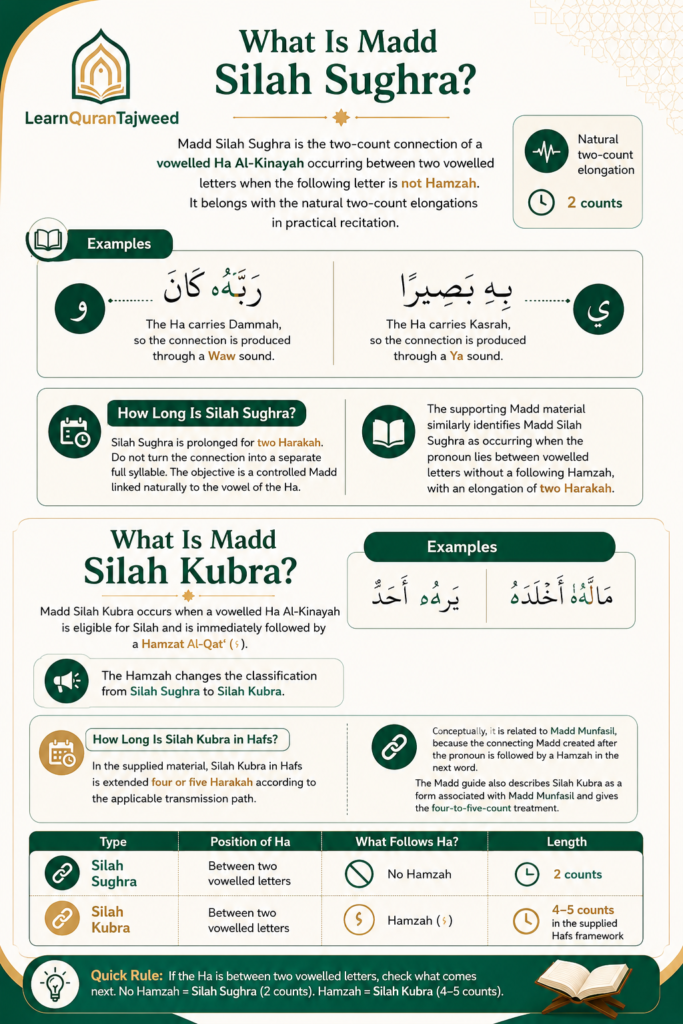
A common mistake is deciding the Madd length before checking the next letter. First establish whether Silah exists; then check for Hamzah to determine its type.
What Are the Four Conditions of Ha Al-Kinayah in Hafs?
The easiest way to apply Ha Al-Kinayah/Damir is to classify what appears immediately before and after the Ha.There are four basic combinations.
| Before Ha | After Ha | General Hafs Rule | Example |
| Vowelled | Vowelled | Silah | رَبَّهُۥ كَانَ |
| Sakin | Vowelled | No Silah | فِيهِ هُدًى |
| Vowelled | Sakin | No Silah | لَهُ ٱلْمُلْكُ |
| Sakin | Sakin | No Silah | وَءَاتَيْنَاهُ ٱلْإِنجِيلَ |
This table provides the most useful decision framework for everyday recitation.
1. Ha Between Two Vowelled Letters Normally Receives Silah
When both surrounding letters are vowelled, Ha Al-Kinayah normally receives Silah in Hafs. For example:رَبَّهُۥ كَانَ.
- With a Dammah on the Ha, a corresponding Waw connection is heard.
- With Kasrah:بِهِۦ بَصِيرًا a Ya connection is heard.
This is the core environment students should learn first before studying the exceptions.
2. Ha After a Sakin Letter and Before a Vowelled Letter Normally Has No Silah
When the preceding letter is sakin but the following letter is vowelled, Hafs generally does not apply Silah.
For example:فِيهِ هُدًى
Do not automatically extend the Ha simply because it carries Kasrah. This example reveals an important principle: the vowel on Ha alone does not determine Silah. The surrounding sounds matter.
3. Ha After a Vowelled Letter and Before a Sakin Letter Has No Silah
When a vowelled letter precedes Ha but a sakin letter follows it, there is normally no Silah.
For example:لَهُ ٱلْمُلْكُ
Extending the Ha would introduce an additional Madd letter before a sakin sound and create an unsuitable meeting of sakin sounds.Therefore, the Ha is read without Silah.
4. Ha Between Two Sakin Letters Has No Silah
There is also no Silah when the Ha occurs in an environment where the relevant surrounding sounds are sakin.An example is:وَءَاتَيْنَاهُ ٱلْإِنجِيلَ
Applying Silah here would create an impermissible accumulation of sakin sounds.
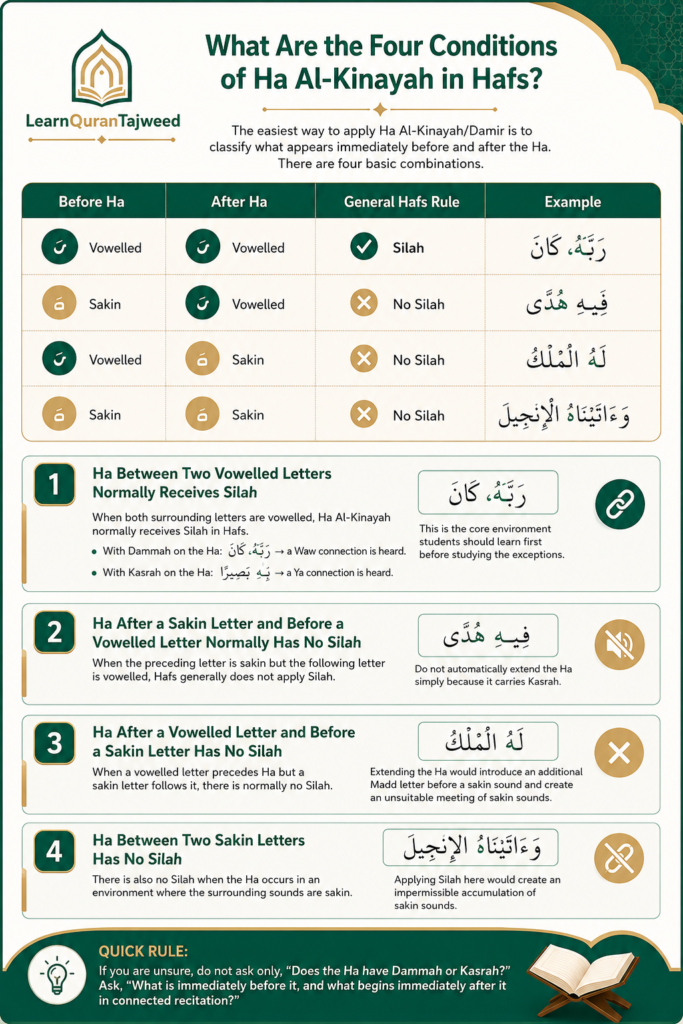
Quick rule: if you are unsure, do not ask only, “Does the Ha have Dammah or Kasrah?” Ask, “What is immediately before it, and what begins immediately after it in connected recitation?”
What Are the Important Ha Al-Kinayah Exceptions in Hafs?
Hafs has transmitted exceptions in which Ha Al-Kinayah does not follow the general Silah pattern, so these positions should be memorized individually.These exceptions are particularly important because a student who knows the general rule perfectly can still misread them.
Hafs Applies Silah in وَيَخْلُدْ فِيهِۦ مُهَانًا
In:
وَيَخْلُدْ فِيهِۦ مُهَانًا
Al-Furqan 25:69
the Ha follows a sakin Ya, so the normal pattern would suggest no Silah.
Hafs nevertheless recites this position with Silah.
This is an excellent reminder that transmitted Quran recitation takes precedence over applying a theoretical formula mechanically.
Hafs Does Not Apply Silah in يَرْضَهُ لَكُمْ
In:
يَرْضَهُ لَكُمْ
Az-Zumar 39:7
the surrounding environment would normally meet the basic condition for Silah.Hafs reads the Ha without Silah.
This is essentially the reverse of the previous exception: one position appears not to qualify but receives Silah, while the other appears to qualify but does not.
Hafs Reads the Ha Sakin in أَرْجِهْ وَأَخَاهُ
In:
أَرْجِهْ وَأَخَاهُ
which occurs in Al-A‘raf and Ash-Shu‘ara, Hafs reads the Ha with Sukoon.Because the Ha itself is sakin, the basic requirement for Silah — a vowelled Ha — is absent.
Hafs Reads the Ha Sakin in فَأَلْقِهْ إِلَيْهِمْ
Another important position is:فَأَلْقِهْ إِلَيْهِمْ An-Naml 27:28 Hafs again reads the Ha with Sukoon.
Two Other Pronunciation Details to Remember
The supplied material also identifies special vowel treatment in:
وَمَا أَنْسَانِيهُ إِلَّا الشَّيْطَانُ
Al-Kahf 18:63
where Hafs reads the Ha with Dammah, and:
عَلَيْهُ اللَّهَ
Al-Fath 48:10
where the Ha is likewise read with Dammah.
These are exactly the kinds of positions where learning only “Kasrah after Ya” can produce an incorrect recitation.
For learners who know the general rule but repeatedly hesitate at exceptional words, the Tajweed ul Quran Course at Learn Quran Tajweed provides focused practice with qualified teachers who can identify and correct mistakes directly in your recitation, helping you move beyond rule memorization and apply Tajweed accurately and naturally while reading the Quran.

Does Ha Al-Kinayah Receive Silah When You Stop?
No. Silah is a rule of Wasl, meaning connected recitation, and it is not maintained when stopping on Ha Al-Kinayah.
This distinction is essential.
A student may correctly produce Silah while connecting two words but then incorrectly preserve the extra Waw or Ya sound after deciding to stop.
Think of Silah as a bridge. It connects the Ha to what follows; when there is no following sound because you have stopped, that bridge is no longer produced.
Does هَٰذِهِ Follow the Ha Al-Kinayah Silah Rule?
The final Ha in the demonstrative هَٰذِهِ is treated like Ha Al-Kinayah for the relevant Silah ruling, even though it is not the masculine singular pronoun itself.
For example:هَٰذِهِۦ بِضَاعَتُنَا The Ha is connected according to the applicable Silah treatment during Wasl.
This is a useful edge case because students sometimes learn the grammatical definition so rigidly that they fail to recognize هَٰذِهِ as following the same recitation treatment.
What Is the Difference Between Ha Al-Kinayah and Ha of Femininity?
Ha Al-Kinayah represents a masculine singular pronoun, while the apparent Ha heard when stopping on Ta Marbutah belongs to a feminine word ending and follows different grammatical and pronunciation rules.
| Ha Al-Kinayah / Damir | Ta Marbutah / Feminine Ending |
| Refers to a singular absent masculine person | Indicates femininity in many nouns/adjectives |
| Written as ه | Usually written as ة |
| Pronounced as Ha in connection and stopping | Pronounced as T in connected speech and H when stopped upon |
| May receive Silah under its conditions | Does not follow Ha Al-Kinayah Silah rules |
The practical test is simple: do not classify every final “h” sound as Ha Al-Kinayah.
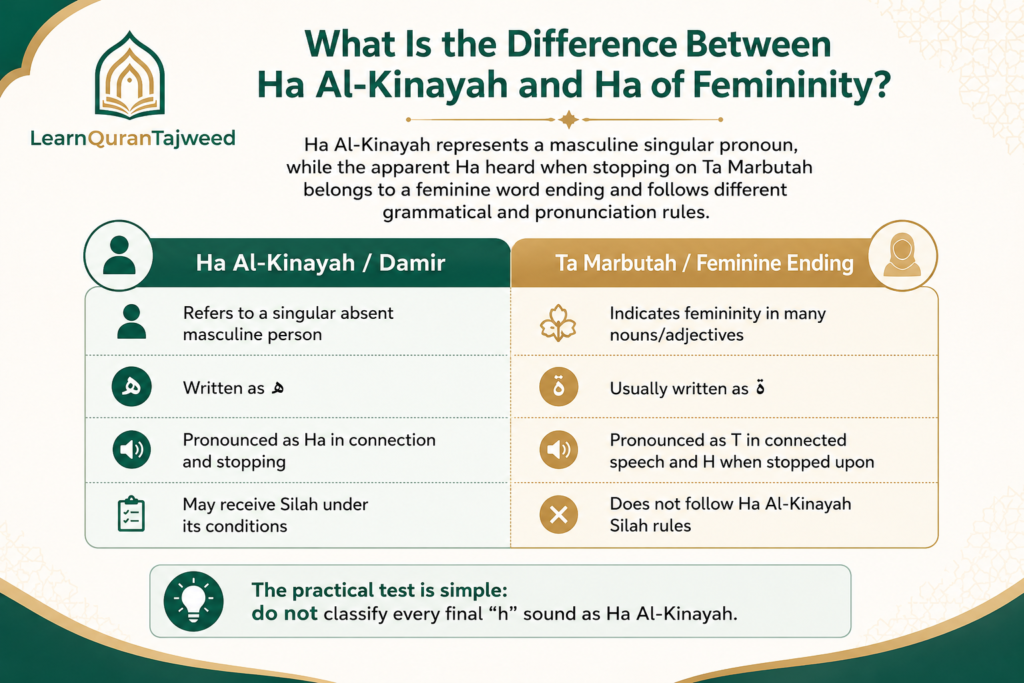
First determine what the letter is doing grammatically and how it is written in the Mushaf.
How Can You Identify Ha Al-Kinayah Quickly While Reciting?
A reliable method is to use a short decision sequence rather than trying to recall every example separately.
- Identify the Ha. Is it the masculine singular pronoun, or a form treated under the same Silah ruling?
- Check its vowel. Silah requires the relevant vowelled Ha, not a sakin Ha.
- Check the preceding sound. Is it vowelled or sakin?
- Check the following sound during Wasl. Is it vowelled or sakin?
- If Ha is between two vowelled sounds, check for Hamzah.
- No following Hamzah: apply Silah Sughra for two counts.
- Following Hamzah: apply Silah Kubra according to the transmitted Madd length.
- Finally, check whether the word is a known Hafs exception.
This sequence prevents one of the most common learning problems: seeing a small ۥ or ۦ and stretching automatically without understanding why it is there.
Original insight: treat Ha Al-Kinayah as a three-position reading problem — before / Ha / after. Once students learn to scan those three positions as one unit, Silah becomes much easier to recognize during continuous recitation.
Common Mistakes When Reciting Ha Al-Kinayah/Damir
Most mistakes with this rule come from overgeneralizing one part of the rule.
Students commonly extend every pronoun Ha with Dammah or Kasrah, even when one of the surrounding sounds is sakin.
Another mistake is reading Silah Sughra and Kubra with the same length without checking whether Hamzah follows.
Some learners also preserve the Silah while stopping, although the connecting sound belongs to Wasl, not Waqf.
The opposite problem occurs when a learner sees فِيهِۦ مُهَانًا and removes the Silah because the preceding Ya is sakin. That reasoning follows the general rule but misses the transmitted Hafs exception.
Finally, students sometimes try to derive exceptions from logic. The safer method is: understand the general system, then memorize the transmitted exceptions as fixed recitation positions.
Inside Learn Quran Tajweed Academy
Curious about how online learning works? Peek inside our actual Quran classes and hear the beautiful recitation of our students and teachers.
Perfect Your Quran Recitation Today
Join expert-led Tajweed classes, and recite the Quran with confidence and clarity.
Start Your Free TrialStart Mastering Ha Al-Kinayah With Guided Tajweed Practice
Reading the rules of Ha Al-Kinayah/Damir can teach you when Silah should occur, but mastering the correct two-count Silah, longer Silah, smooth transitions, and Hafs exceptions requires trained feedback and consistent practice.
With Learn Quran Tajweed and the Learn Quran with Tajweed Online course, you can develop these rules through guided Quran recitation, direct pronunciation correction, and practical Tajweed training with qualified teachers, helping you apply what you learn accurately instead of relying on theory alone.
Courses we offer:
- Online Tajweed Classes
- Learn Quran with Tajweed Online
- Beginner Tajweed Course
- Intermediate Tajweed Course
- Advanced Tajweed Course
- Amali (Practical) Tajweed Cours

Perfect Your Quran Recitation Today
Join expert-led Tajweed classes, and recite the Quran with confidence and clarity.
Start Your Free TrialConclusion
Ha Al-Kinayah/Damir becomes much easier once you stop treating every pronoun Ha as an automatic Madd.
The general Hafs pattern is clear: a vowelled Ha between two vowelled sounds normally receives Silah. Without a following Hamzah, it becomes Silah Sughra; with Hamzah, it becomes Silah Kubra.
The remaining challenge is knowing when the general pattern does not apply. Positions such as يَرْضَهُ لَكُمْ and وَيَخْلُدْ فِيهِۦ مُهَانًا show why accurate Tajweed depends on both understanding the rule and learning its transmitted exceptions.
Frequently Asked Questions About Ha Al-Kinayah/Damir
What Is Ha Al-Kinayah in Tajweed?
Ha Al-Kinayah is the pronoun Ha (ه) added to a word to refer to a singular absent masculine person. Depending on its surrounding sounds during Wasl, it may receive Silah through a corresponding Waw or Ya sound.
Is Ha Al-Kinayah the Same as Ha Al-Damir?
Yes, Ha Al-Kinayah is also called Ha Al-Damir because it functions as a pronoun referring to a singular absent masculine person. The terminology emphasizes different aspects of the same Ha.
What Is the Difference Between Silah Sughra and Silah Kubra?
Silah Sughra occurs when eligible Ha Al-Kinayah is not followed by Hamzah, while Silah Kubra occurs when Hamzah follows it. Sughra is two counts; Kubra receives the longer Madd treatment specified for the applicable Hafs transmission.
When Is There No Silah on Ha Al-Kinayah?
There is generally no Silah when Ha is not between two vowelled sounds or when the Ha itself is sakin. Hafs also has transmitted exceptions, so the general formula must be learned together with those specific Quranic positions.
Does Silah Apply When Stopping on Ha Al-Kinayah?
No, Silah applies during Wasl, not when stopping on the word. The additional Waw- or Ya-like connection exists to connect Ha to the following sound.
What Is the Main Exception to Ha Al-Kinayah After a Sakin Letter in Hafs?
The key exception is وَيَخْلُدْ فِيهِۦ مُهَانًا in Surah Al-Furqan 25:69. Hafs applies Silah here even though the Ha follows a sakin Ya, contrary to the normal pattern.
Related Articles
Tajweed Basics