 Quran
Quran
The Qirat of Quran are the authentically transmitted ways of reciting the Quran, preserved through qualified reciters and chains of transmission going back through the Companions to Prophet Muhammad ﷺ.
They are not different Qurans, personal interpretations, or later attempts to read an unclear Arabic text. Qira’at preserve transmitted differences in pronunciation and recitation, including features such as Madd, Hamzah, Idgham, Imalah, and certain word forms.
You may often hear about the 7 Qirat of Quran, but this can create an important question: are there seven Qira’at or ten?
The seven are the famous readings systematized by Ibn Mujahid, while the recognized canonical system was later completed with three additional Qira’at, making ten canonical Qira’at.
Understanding this distinction is essential before studying the individual readings.
1. Qira’ah of Nafi’ al-Madani
Nafi’ al-Madani (نافع المدني) was one of the seven famous Imams of Qira’at and the leading authority of Quranic recitation in Madinah in his time. He was born around 90 AH and became widely respected for his reliability, knowledge, and mastery of recitation.
He studied the Quran with a large number of the Tabi’in, and his chain of transmission ultimately reaches prominent Companions—including Ubayy ibn Ka’b, Zayd ibn Thabit, Ibn Abbas, and Abu Hurayrah رضي الله عنهم—who received Quranic recitation from the Prophet ﷺ.
The Qira’ah of Nafi’ represents the Madinan tradition among the seven canonical Qira’at. Its two best-known narrators are:
- Qalun (قالون): Isa ibn Mina, a distinguished reciter of Madinah who studied directly with Nafi’. Nafi’ is reported to have given him the nickname Qalun, meaning “good” in the Roman/Byzantine language, because of the quality of his recitation.
- Warsh (ورش): Uthman ibn Sa’id, an Egyptian reciter who traveled to Madinah specifically to study with Nafi’. After returning to Egypt, he became a leading authority in Quranic recitation there and was known for his strong command of Arabic, Tajweed, and beautiful recitation.
The transmissions of Qalun and Warsh preserve a number of distinctive recitational features involving areas such as Hamzah, Madd, Imalah, and the treatment of certain pronouns and connected sounds. These are not different Qurans, but authenticated variations within the transmitted science of Qira’at.
Today, Warsh ‘an Nafi’ is particularly well known in parts of North and West Africa, while Qalun ‘an Nafi’ also remains an established and studied transmission. Together, their narrations preserve the Madinan recitational tradition associated with Imam Nafi’.
Read also: Tuhfat Al-Atfal – The Beginner’s Poem That Opens The Door To Tajweed
2. Qira’ah of Ibn Kathir al-Makki
Imam Abdullah ibn Kathir al-Dari al-Makki was born in Makkah around 45 AH and was one of the Tabi’in. He met Companions such as Anas ibn Malik and Abdullah ibn al-Zubayr رضي الله عنهما and became a leading authority of Quranic recitation in Makkah.
He studied with scholars including Mujahid ibn Jabr and Abdullah ibn al-Sa’ib. His chains of transmission connect through prominent Companions and ultimately reach the Prophet ﷺ. Ibn Kathir died in 120 AH.
Who Are the Two Narrators of Ibn Kathir?
The two famous narrators of his Qira’ah are:
- Al-Bazzi (البزي): Ahmad ibn Muhammad al-Bazzi, a prominent Makkan reciter and muezzin of Al-Masjid Al-Haram.
- Qunbul (قنبل): Muhammad ibn Abd al-Rahman al-Makhzumi, a respected authority in Quranic recitation in the Hijaz.
Unlike Qalun and Warsh from Nafi’, Al-Bazzi and Qunbul transmitted Ibn Kathir’s Qira’ah through intermediate teachers rather than directly from him.
What Distinguishes the Qira’ah of Ibn Kathir?
The Qira’ah of Ibn Kathir has several distinctive principles. One of the best known is Silat Mim al-Jam’, where the plural Mim is connected with a Waw when followed by a vowelled letter. For example, عَلَيْهِمْ غَيْرِ in Surah Al-Fatihah is connected in recitation as عَلَيْهِمُو غَيْرِ.
Other notable features include Silat Ha’ al-Kinayah under specific conditions, shortening Madd Munfasil to two counts, a longer treatment of Madd Muttasil, and Tasheel of the second Hamzah when two Hamzahs occur together in certain words.
These features form part of a complete transmitted system of Qira’ah, rather than isolated pronunciation techniques.
Read also: What Is Qaida Noorania?
3. Qira’ah of Abu ‘Amr al-Basri
Imam Abu ‘Amr ibn al-‘Ala’ al-Basri was born around 70 AH and became one of the leading authorities in both Quranic recitation and the Arabic language. He was highly regarded for his knowledge of the Quran, Arabic grammar, and linguistic usage and became one of the most influential scholars of the Basran tradition. He died in 154 AH.
Who Are the Two Narrators of Abu ‘Amr?
The two famous narrators of his Qira’ah are:
- Al-Duri (الدوري): Hafs ibn Umar al-Duri, whose transmission preserves distinctive features involving areas such as Hamzah and Imalah.
- Al-Susi (السوسي): Salih ibn Ziyad al-Susi, whose transmission is especially associated with the extensive application of Idgham al-Kabir.
Both transmitted the Qira’ah of Abu ‘Amr through his prominent student Al-Yazidi, rather than receiving it directly from Abu ‘Amr.
What Distinguishes the Qira’ah of Abu ‘Amr?
One of its most recognizable features is Idgham al-Kabir, particularly in the transmission of Al-Susi, where certain vowelled letters are assimilated into following letters according to established conditions.
Other notable principles include shortening or moderating Madd Munfasil according to the transmission and path, moderating Madd Muttasil, easing the second of two Hamzahs in certain cases, replacing some single silent Hamzahs with a corresponding Madd letter, and specific applications of Imalah and Taqlil.
The Qira’ah also has particular rules concerning Mim al-Jam’ and attached pronouns.
These features show why advanced Qira’at study requires a strong Tajweed foundation: familiar concepts such as Idgham, Madd, and Hamzah are applied within a more detailed, fully transmitted recitational system.
Read also: What Is Qaida Noorania?
Inside Learn Quran Tajweed Academy
Curious about how online learning works? Peek inside our actual Quran classes and hear the beautiful recitation of our students and teachers.
Perfect Your Quran Recitation Today
Join expert-led Tajweed classes, and recite the Quran with confidence and clarity.
Start Your Free Trial4. Qira’ah of Ibn ‘Amir al-Shami
Imam Abdullah ibn ‘Amir al-Yahsُubi al-Shami was born around 21 AH and was one of the Tabi’in. He became the leading Imam of Quranic recitation in Damascus and was known for the strength and shortness of his chain of transmission.
He received Quranic recitation through early authorities connected to prominent Companions, including Abu al-Darda’ رضي الله عنه and the transmission associated with Uthman ibn Affan رضي الله عنه. Ibn ‘Amir remained a major authority of the Shami recitational tradition until his death in 118 AH.
Who Are the Two Narrators of Ibn ‘Amir?
The two famous narrators of his Qira’ah are:
- Hisham (هشام): Hisham ibn Ammar al-Dimashqi, a prominent Damascene scholar and reciter.
- Ibn Dhakwan (ابن ذكوان): Abdullah ibn Ahmad ibn Dhakwan, a distinguished reciter associated with the Umayyad Mosque in Damascus.
Both transmitted Ibn ‘Amir’s Qira’ah through intermediate teachers rather than directly from Ibn ‘Amir himself.
What Distinguishes the Qira’ah of Ibn ‘Amir?
The Qira’ah of Ibn ‘Amir has several distinctive principles. Madd Muttasil and Madd Munfasil are generally read with a moderate length, while the treatment of two Hamzahs occurring together varies between Hisham and Ibn Dhakwan according to their respective transmissions.
Hisham is particularly known for specific rules concerning Hamzah, including special treatments of a final Hamzah when stopping. Ibn Dhakwan has particular applications of Imalah in designated words, while the Qira’ah also includes specific forms of Idgham between certain neighboring letters.
Together, these features form a complete transmitted system. Students should therefore learn Ibn ‘Amir’s Qira’ah through direct recitation and correction with a qualified teacher, rather than memorizing individual pronunciation differences in isolation.
5. Qira’ah of ‘Asim al-Kufi
Imam ‘Asim ibn Abi al-Najud al-Asadi al-Kufi was a leading authority of Quranic recitation in Kufa and died around 127 AH. He studied with prominent reciters including Abu Abd al-Rahman al-Sulami and Zirr ibn Hubaysh.
Through these teachers, his chains of transmission connect to major Companions such as Ali ibn Abi Talib and Abdullah ibn Mas’ud رضي الله عنهما, and ultimately to the Prophet ﷺ.
Who Are the Two Narrators of ‘Asim?
The two principal narrators of his Qira’ah are:
- Hafs (حفص): Hafs ibn Sulayman al-Kufi, who studied closely with ‘Asim. His narration, Hafs ‘an ‘Asim, became the most widely used transmission of the Quran in much of the Muslim world today.
- Shu’bah (شعبة): Abu Bakr Shu’bah ibn Ayyash al-Kufi, another major transmitter of ‘Asim’s recitation whose Riwayah preserves a number of differences from Hafs.
An important terminology point is that Hafs and Shu’bah are Riwayat from the Qira’ah of ‘Asim; they are not separate Qira’at among the ten.
What Distinguishes the Qira’ah of ‘Asim?
The Qira’ah of ‘Asim includes established principles concerning Madd, Idgham, Hamzah, stops, and connections between words, with some details differing between Hafs and Shu’bah.
Hafs is especially well known for particular Sakt positions, where the reciter makes a very brief pause without taking a breath, as well as established treatments of Madd and Hamzah. Shu’bah preserves its own transmitted choices in a number of words and recitational positions.
Because many learners already recite according to Hafs ‘an ‘Asim, studying ‘Asim’s Qira’ah can provide a useful starting point for understanding the difference between a Qira’ah, a Riwayah, and a Tariq before comparing other canonical readings.
6. Qira’ah of Hamzah al-Kufi
Imam Hamzah ibn Habib al-Zayyat al-Kufi was born around 80 AH and was known for his precision in Quranic recitation, scholarship, and devotion. He was called Al-Zayyat because of his association with the oil trade.
His Quranic transmission is connected through established chains to prominent Companions, particularly Ali ibn Abi Talib and Abdullah ibn Mas’ud رضي الله عنهما, and ultimately to the Prophet ﷺ. Hamzah died around 156 AH.
Who Are the Two Narrators of Hamzah?
The two famous narrators of his Qira’ah are:
- Khalaf (خلف): Khalaf ibn Hisham al-Baghdadi, one of the principal transmitters of Hamzah’s recitation.
- Khallad (خلاد): Khallad ibn Khalid al-Kufi, the second famous narrator of this Qira’ah.
Both transmitted Hamzah’s Qira’ah through Sulaym ibn Isa, one of Hamzah’s prominent students, rather than directly from Hamzah himself.
What Distinguishes the Qira’ah of Hamzah?
The Qira’ah of Hamzah has several particularly recognizable features. Madd Muttasil and Madd Munfasil are generally read with a long extension, traditionally reaching six counts.
Hamzah is also well known for his detailed treatment of Hamzah when stopping, which may involve techniques such as easing, substitution, transfer of the vowel, or omission according to established conditions. Another major characteristic is Imalah Kubra, particularly in many words whose final Alif originates from Ya.
The Qira’ah also includes specific applications of Sakt, a brief pause without taking a breath before Hamzah in certain contexts, as well as particular forms of Idgham between selected letters.
These features demonstrate why listening and direct instruction are especially important when studying Hamzah’s Qira’ah. Written rules can describe what changes, but accurate performance requires hearing the transmitted recitation and receiving correction from a qualified teacher.
7. Qira’ah of Al-Kisa’i al-Kufi
Imam Ali ibn Hamzah al-Kisa’i al-Kufi was a leading authority in both Quranic recitation and Arabic grammar. He became one of the most influential scholars of the Kufan school of Arabic and was recognized as one of the seven canonical Quran reciters.
Al-Kisa’i studied Quranic recitation with several teachers, most notably Hamzah al-Kufi, while developing his own transmitted Qira’ah. He died in 189 AH in Al-Rayy.
Who Are the Two Narrators of Al-Kisa’i?
The two famous narrators of his Qira’ah are:
- Abu Al-Harith (أبو الحارث): Al-Layth ibn Khalid al-Baghdadi, one of the principal transmitters of Al-Kisa’i’s recitation.
- Al-Duri (الدوري): Hafs ibn Umar al-Duri, another major transmitter of Al-Kisa’i’s Qira’ah.
An important point for students is that Al-Duri transmits from both Abu ‘Amr al-Basri and Al-Kisa’i. Therefore, the narrator’s name alone does not always identify the Qira’ah; the Imam from whom the Riwayah is transmitted must also be specified.
What Distinguishes the Qira’ah of Al-Kisa’i?
One of the most recognizable characteristics of Al-Kisa’i’s Qira’ah is its extensive use of Imalah, which appears in numerous established words and positions. The reading also contains distinctive principles involving Idgham, as well as particular rules for Madd and attached pronouns.
Al-Kisa’i also has specific rules concerning stopping on certain feminine endings (Ha’ al-Ta’nith) and particular applications of assimilation between neighboring letters.
Together, these features form a complete transmitted recitational system and show why students must study each Qira’ah together with its Riwayat and transmission paths, rather than identifying a reading by the narrator’s name alone.
Why Are There Different Qira’at of the Quran?
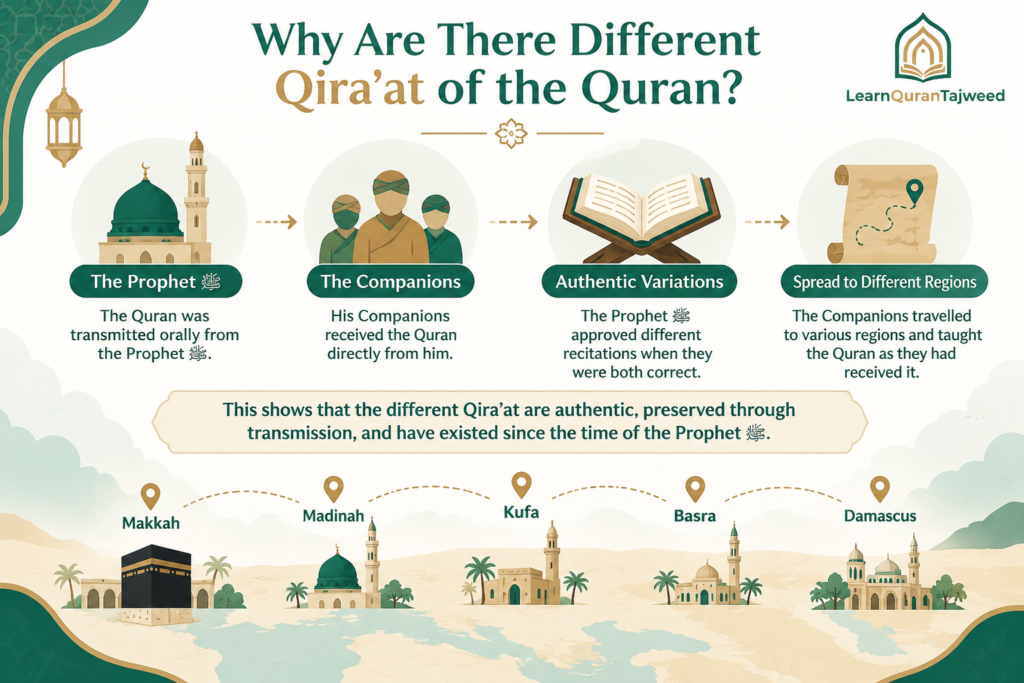
Different Qira’at exist because the Quran was transmitted orally from the Prophet ﷺ to his Companions, and authentic recitational variations were preserved through that transmission.
The supplied material highlights the well-known report in which Umar ibn Al-Khattab رضي الله عنه heard Hisham ibn Hakim رضي الله عنه reciting Surah Al-Furqan differently from the way Umar had learned it.
When both recited before the Prophet ﷺ, he approved both recitations.This establishes an essential principle: authentic variation in Quranic recitation existed during the Prophet’s lifetime rather than being invented centuries later.
The Companions later travelled to different regions and taught the Quran as they had received it. Different transmitted recitational traditions consequently became associated with major centers such as Makkah, Madinah, Kufa, Basra, and Damascus.
What Conditions Make a Qira’ah Accepted?
A Quranic reading was not accepted simply because an Arabic word could theoretically be read in a certain way.The supplied source emphasizes three major criteria used in evaluating an accepted reading:
- Authentic transmission.
- Compatibility with the Arabic language.
- Compatibility with the Uthmanic Mushaf script.
This distinction matters because the early Uthmanic script could accommodate more than one reading in certain places.
But written possibility alone does not create an authentic Qira’ah. The reading must have been received and transmitted rather than reconstructed from the consonantal script.That is one of the most important principles for understanding the Qira’at.
If you want to move beyond theoretical Tajweed rules into carefully supervised Quran recitation, qualified instruction at Learn Quran Tajweed with Our Teachers can help you refine your pronunciation, strengthen your Tajweed accuracy, and develop the careful listening and recitation skills needed before approaching advanced Qira’at and recitational differences.

How Many Qirat of Quran Are There?
There are ten canonical Qira’at of the Quran, although the first seven became especially famous after Ibn Mujahid selected and organized seven prominent readings.
This is why searches for “how many Qirat of Quran” can produce apparently conflicting answers.The clearest framework is:
| Category | Number | Meaning |
| Famous Seven Qira’at | 7 | The seven readings associated with the imams selected by Ibn Mujahid |
| Additional canonical Qira’at | 3 | Abu Ja‘far, Ya‘qub, and Khalaf |
| Canonical Qira’at | 10 | The seven plus the additional three |
Therefore, saying “there are seven Qira’at” without further explanation is incomplete when discussing the full canonical system.
What Are the Other Three Qira’at?
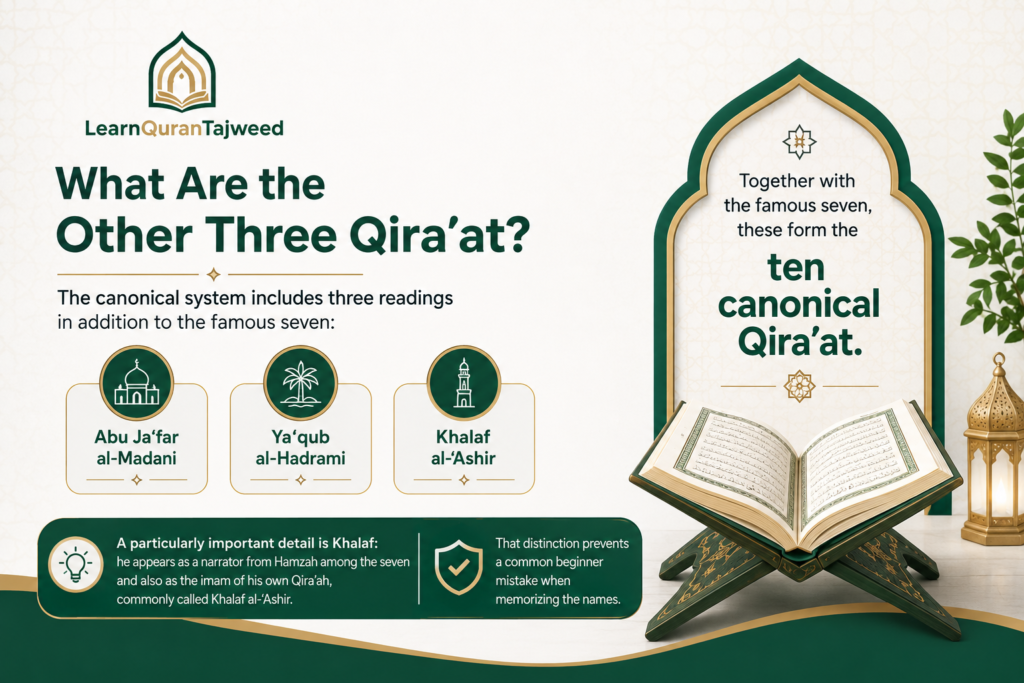
The canonical system includes three readings in addition to the famous seven:
- Abu Ja‘far al-Madani
- Ya‘qub al-Hadrami
- Khalaf al-‘Ashir
Together with the famous seven, these form the ten canonical Qira’at.
A particularly important detail is Khalaf: he appears as a narrator from Hamzah among the seven and also as the imam of his own Qira’ah, commonly called Khalaf al-‘Ashir.
That distinction prevents a common beginner mistake when memorizing the names.
How Can Different Qira’at All Be Quran?
Different authentic Qira’at can all be Quran because their variations were received through transmitted recitation rather than invented by individual readers. Some differences concern pronunciation without substantially changing the meaning, while others provide a related difference in wording or meaning — for example:
- فَتَبَيَّنُوا
- فَتَثَبَّتُوا
The key principle is that accepted Qira’at are not created by looking at an old undotted manuscript and guessing possible readings. The Quran was fundamentally preserved through oral transmission alongside written preservation.
This directly answers the claim that Qira’at arose simply because early Arabic writing lacked dots and vowel marks. The script could accommodate transmitted readings, but the script was not the source from which those readings were invented.
Do Qira’at Contradict One Another?
Authentic Qira’at should not be understood as competing editions in which Muslims must decide which version is “correct.” They belong to a single transmitted Quranic recitation tradition.
In some places, a variation affects only pronunciation; in others, the wording adds an additional dimension of meaning. A productive way to study such passages is not to ask “which one fixes the other?” but rather, “what does each authentically transmitted reading contribute to our understanding of the verse?”
That framework turns apparent variation into a subject of Quranic study rather than a source of confusion.
Understanding how the authentic Qira’at complement one another is much easier when you study Quran recitation directly with a qualified teacher.
At Learn Quran Tajweed, our experienced Quran teachers provide the personalized correction and close attention adults need to refine every detail of their recitation.
Through the Tajweed Ijazah Program, you can strengthen your Tajweed, correct recurring pronunciation mistakes, and develop greater accuracy and confidence while building a solid foundation for understanding more advanced recitational differences.

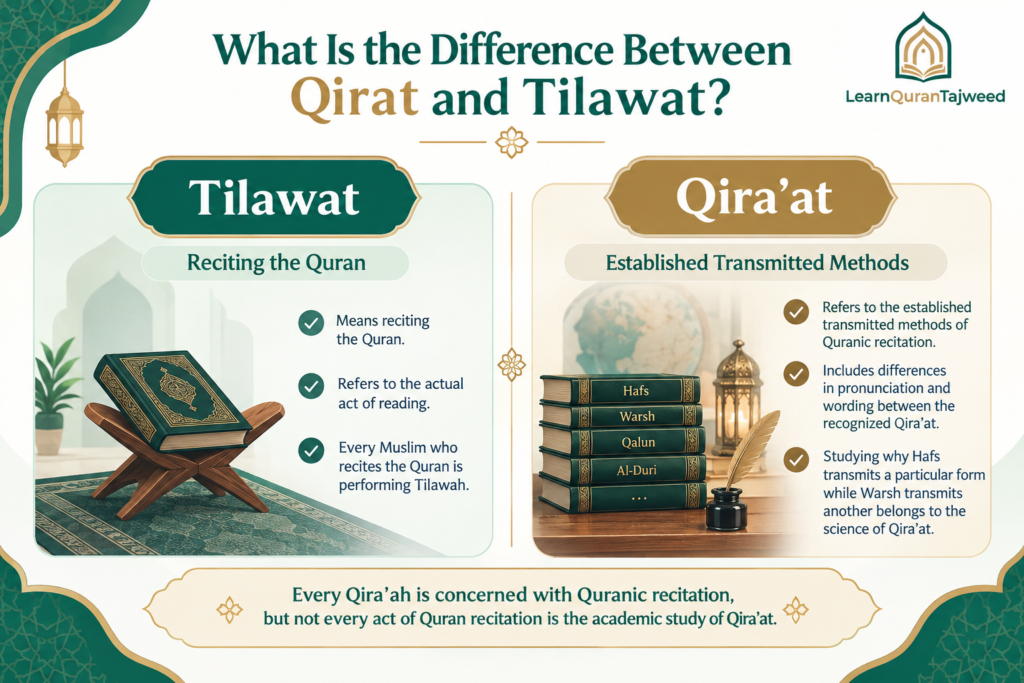
What Is the Difference Between Qirat and Tilawat?
Tilawat means reciting the Quran, while Qira’at refers to the established transmitted methods according to which Quranic recitation may be performed.Someone performing ordinary Quran recitation is engaging in Tilawah.
Studying why Hafs transmits a particular form while Warsh transmits another belongs to the specialized science of Qira’at.
So every Qira’ah is concerned with Quranic recitation, but not every act of Quran recitation is the academic study of Qira’at.
How Should You Start Learning Qira’at?
Learning Qira’at should begin with accurate Quran reading and strong Tajweed, not by immediately memorizing differences between Warsh, Hafs, Qalun, or other narrations.
A practical sequence is:
- Master Arabic letter articulation and Makharij.
- Build reliable Tajweed in your current Riwayah.
- Recite fluently without recurring foundational mistakes.
- Learn Qira’ah, Riwayah, and Tariq terminology.
- Select a Qira’ah or Riwayah with a qualified teacher.
- Listen carefully before attempting unfamiliar recitational forms.
- Practice the differences through direct teacher correction.
- Keep each recitational system distinct rather than mixing rules.
This last point is especially important.
A student may recognize several valid forms but still need to know which form belongs to the Riwayah currently being recited. Advanced Qira’at study is therefore partly a discipline of controlled recall, not merely knowing more variants.
The attached Tajweed material also emphasizes that precise Quran recitation depends on controlling pronunciation, pauses, and elongation rather than merely knowing rule names.
See Our Classrooms in Action
Watch these short clips from our live, interactive Quran courses to see how our students learn and interact with our expert tutors.
Perfect Your Quran Recitation Today
Join expert-led Tajweed classes, and recite the Quran with confidence and clarity.
Start Your Free TrialStart Building the Recitation Skills Needed for Advanced Quran Study
Advanced Qira’at study requires more than memorizing the names of ten imams. You need a strong ear, accurate Makharij, controlled Madd, consistent Tajweed, and the ability to reproduce what a qualified teacher transmits.
Build that foundation with Learn Quran Tajweed, where experienced Quran teachers provide guided instruction and personalized correction to help you identify pronunciation habits that independent study may miss, strengthen your recitation accuracy, and prepare confidently for more advanced Qira’at study.
Courses we offer:
- Online Tajweed Classes
- Learn Quran with Tajweed Online
- Beginner Tajweed Course
- Intermediate Tajweed Course
- Advanced Tajweed Course
- Amali (Practical) Tajweed Course
Courses we offer:
- Tajweed Course for Kids
- Tajweed Course for Adults
- Tajweed Course for Ladies
- Tajweed ul Quran Course
- Quran Recitation with Tajweed Course
- Quran Tarteel Course
- Tajweed Ijazah Program
Perfect Your Quran Recitation Today
Join expert-led Tajweed classes, and recite the Quran with confidence and clarity.
Start Your Free TrialConclusion
The Qira’at of the Quran are authentically transmitted methods of Quranic recitation, preserving recognized differences in pronunciation and recitational performance. Although the 7 Qira’at became especially famous through Ibn Mujahid’s classification, the canonical system includes ten Qira’at: the seven readings plus those of Abu Ja’far, Ya’qub, and Khalaf.
Most importantly, Qira’at should not be confused with the Seven Ahruf, nor should their differences be explained merely by the absence of dots and vowel marks in early Arabic manuscripts. The Quran was transmitted orally, and accepted readings were preserved through established chains of recitation.
For students, the safest learning path remains straightforward: master one recitation accurately, strengthen Tajweed, understand the transmission terminology, and then study additional Qira’at directly with a qualified teacher.
FAQs About the Qirat of Quran
How Many Qira’at of the Quran Are There?
There are ten canonical Qira’at. Seven became especially famous through Ibn Mujahid, while three additional readings — Abu Ja’far, Ya’qub, and Khalaf — complete the ten.
What Are the 7 Qira’at of the Quran?
Nafi’, Ibn Kathir, Abu ‘Amr, Ibn ‘Amir, ‘Asim, Hamzah, and Al-Kisa’i. Each Qira’ah is transmitted through recognized narrators.
Are There 7 or 10 Qira’at?
Ten canonical Qira’at in total. “The seven Qira’at” refers to the famous seven systematized by Ibn Mujahid; the other three canonical readings are Abu Ja’far, Ya’qub, and Khalaf.
Are the Seven Qira’at the Same as the Seven Ahruf?
No. The Seven Ahruf come from Prophetic reports about the Quran’s revelation, while the famous seven Qira’at are a later scholarly grouping of transmitted readings.
Is Hafs One of the Ten Qira’at?
No — Hafs is a narrator, not one of the ten Qira’at imams. The precise expression is “Hafs ‘an ‘Asim,” meaning the Riwayah of Hafs transmitted from the Qira’ah of Imam ‘Asim.
Can a Beginner Learn Different Qira’at?
A beginner should first establish correct Quran reading and Tajweed in one Riwayah before studying multiple Qira’at. Mixing recitational systems before mastering the foundation can make it difficult to remember which rule belongs to which transmission.