 Tajweed Basics
| Key Takeaways |
| Ijazah is a formal certification granted by a qualified scholar after verifying a student’s Quran recitation meets authenticated Tajweed standards. |
| The Ijazah chain connects every certified reciter back to the Prophet Muhammad ﷺ through an unbroken, documented transmission of oral recitation. |
| Holding Ijazah in Hafs ‘an ‘Asim is the globally recognized standard for teaching Quran recitation with full scholarly credibility and accountability. |
| Students pursuing Ijazah develop measurably higher recitation accuracy because the certification process demands error-free mastery, not approximate competence. |
| Online Ijazah programs now make this certification accessible to non-Arabic speakers worldwide without compromising the scholarly rigor of traditional transmission. |
The importance of Ijazah is not a theoretical debate — it is a practical question every serious Quran student eventually faces. When you have invested years learning Tajweed rules, mastering makharij, and refining your recitation, the question becomes: how do you know your recitation is actually correct? Ijazah answers that question with scholarly authority no self-study method can replicate.
Ijazah is the authenticated oral license that certifies your recitation has been heard, corrected, and approved by a qualified scholar whose own recitation traces back to the Prophet ﷺ himself.
1. Ijazah Preserves the Unbroken Chain of Quranic Transmission
Ijazah preservation works because every certified reciter carries a documented chain — called an Sanad — linking their recitation directly back to the Prophet Muhammad ﷺ. This chain is not symbolic. It is a verified, named sequence of teachers and students, generation by generation, each having heard and approved the recitation of the one before them.
This oral transmission system is what distinguishes Quran recitation from every other form of religious or literary preservation. A written text can be copied with errors. An oral tradition anchored in direct teacher-to-student verification cannot drift undetected. The Ijazah system is, functionally, the world’s oldest and most rigorous quality-assurance mechanism for a sacred text.
Why the Sanad Cannot Be Replaced by Self-Study or Recordings
No recording, however high-quality, can replicate what a qualified teacher hears in a live recitation session. Students who learn exclusively from audio — even recordings of master reciters — consistently develop subtle errors in makharij (articulation points) and sifat (letter attributes) that they cannot self-diagnose.
At Learn Quran Tajweed Academy, I have assessed students who spent years listening to Sheikh Husary or Sheikh Al-Minshawi, genuinely believing their recitation was accurate.
In nearly every case, their Ghunnah duration was inconsistent, their Qalqalah was being applied outside its correct positions, or their Ra tafkhim and tarqiq were inverted in specific conditions. A certified teacher catches these immediately. A recording cannot.
Shots Videos from Our Courses
Perfect Your Quran Recitation Today
Join expert-led Tajweed classes, and recite the Quran with confidence and clarity.
Start Your Free Trial2. Ijazah Guarantees That Tajweed Rules Are Applied With Scholarly Accuracy
Ijazah certification requires that a student demonstrate mastery of every Tajweed rule — not theoretical familiarity, but applied, recitation-level accuracy across the entire Quran or a verified portion. This includes rules like Iqlab,Ikhfa,Idgham, and the precise application of Madd rules — areas where student errors are most common and most consequential.
The standard is unambiguous: either the recitation is correct according to the riwayah of Hafs ‘an ‘Asim, or it is not. There is no partial pass.
The Tajweed Rules That Ijazah Candidates Must Master Without Exception
Students preparing for Ijazah through our Tajweed Ijazah Program at Learn Quran Tajweed Academy are required to demonstrate flawless application of the following before certification is considered:
| Rule Category | Key Application Points |
| Noon Sakinah & Tanween | Correct identification of Izhar, Idgham, Ikhfa, Iqlab in all positions |
| Meem Sakinah Rules | Ikhfa Shafawi, Idgham Shafawi, Izhar Shafawi — no overlap or confusion |
| Ghunnah | Consistent two-count nasal resonance in every qualifying position |
| Madd | Precise elongation counts for Madd Tabee’i, Munfasil, Muttasil, ‘Arid |
| Qalqalah | Echo applied correctly at sukoon and waqf positions only |
| Izhar | Clean articulation of Noon before six throat letters — no nasal bleed |
This is not a checklist for a written exam. Every single rule must be demonstrated live, in recitation, under the direct hearing of a qualified examiner.
Join our Tajweed Ijazah Program and get a free trial

3. Establishing Your Credibility and Religious Authority to Teach Quran
Anyone who teaches Quran recitation without Ijazah is, by scholarly consensus, teaching without verified authorization. This is not a modern concern — classical scholars of Tajweed considered it obligatory for a Quran teacher to hold Ijazah before instructing others.
The reason is straightforward: unverified teaching multiplies uncorrected errors.
The Prophet ﷺ said, as narrated by Abdullah ibn Mas’ud (may Allah be pleased with him):
“Learn the Quran from four people: from Ibn Mas’ud, Salim, Mu’adh ibn Jabal, and Ubayy ibn Ka’b.”—Sahih al-Bukhari 3758.
The emphasis on learning from specific, qualified people — not from any available source — reflects the very principle Ijazah institutionalizes.
For students who aspire to teach their children, lead recitation in their communities, or offer online Quran instruction, Ijazah is not optional. It is the scholarly baseline. Our Advanced Tajweed Course at Learn Quran Tajweed Academy is specifically structured to build students toward this level of mastery before they enter formal Ijazah evaluation.
Reserve your free trial lesson for Advanced Tajweed Course

4. Transforming Recitation Quality in Ways That Rules Alone Cannot
Pursuing Ijazah changes how a student recites — permanently. The process of being evaluated by an Ijazah-certified scholar trains a reciter’s ear to a degree of sensitivity that standard Tajweed study rarely reaches.
Students begin hearing their own errors in real time. Their self-correction improves. Their recitation becomes self-sustaining.
Students who complete our Amali (Practical) Tajweed Course at Learn Quran Tajweed Academy before entering Ijazah preparation consistently report the same experience: the Ijazah process does not just test recitation — it rebuilds it at a deeper level.
Join our Practical Tajweed Course and get a free trial

The pressure of live evaluation under a qualified scholar activates a precision that classroom study alone rarely creates.
The Recitation Qualities That Ijazah Candidates Develop That Others Do Not
| Recitation Dimension | Standard Tajweed Student | Ijazah Candidate |
| Makharij precision | Functional accuracy | Anatomically precise articulation |
| Sifat application | Rule-based awareness | Automatic, unconscious application |
| Waqf and Ibtida | Approximate | Scholarly-correct stop and start positions |
| Tarteel pacing | Inconsistent | Measured, controlled, sustainable |
| Self-correction | Delayed or absent | Real-time error detection and repair |
5. Ijazah Connects You Spiritually to the Living Tradition of Quranic Recitation
The importance of Ijazah is not only academic or pedagogical. For a Muslim who takes the Quran seriously as the literal word of Allah, reciting it the way the Prophet ﷺ recited it carries profound spiritual weight. Ijazah is the documented proof that your recitation is, to the highest verifiable degree, that same recitation.
Allah says in the Quran:
وَرَتِّلِ ٱلْقُرْءَانَ تَرْتِيلًا
Wa rattilil-qur’āna tartīlā
“And recite the Quran with measured recitation.” (Al-Muzzammil 73:4)
This is a direct divine instruction — not a recommendation. The word tarteel here refers to slow, deliberate, rule-governed recitation. Ijazah is the scholarly verification that a reciter has fulfilled this instruction as it was transmitted from the Prophet ﷺ, not as they personally interpreted it.
Perfect Your Quran Recitation Today
Join expert-led Tajweed classes, and recite the Quran with confidence and clarity.
Start Your Free Trial6. Ijazah Makes You Accountable to a Standard Beyond Your Own Judgment
One of the most underappreciated aspects of the importance of Ijazah is accountability. Without external scholarly evaluation, every reciter is their own judge — and human beings are notoriously poor at detecting their own errors, especially in recitation habits formed over years. Ijazah removes self-assessment from the equation entirely.
The certification process requires that a qualified examiner — not a peer, not a recording, not a software app — listens to your recitation and issues a formal verdict. This external accountability is irreplaceable.
At Learn Quran Tajweed Academy, our Ijazah-certified instructors apply this same standard to every evaluation session: your recitation is assessed against the scholarly transmission, not against your own progress relative to where you started.
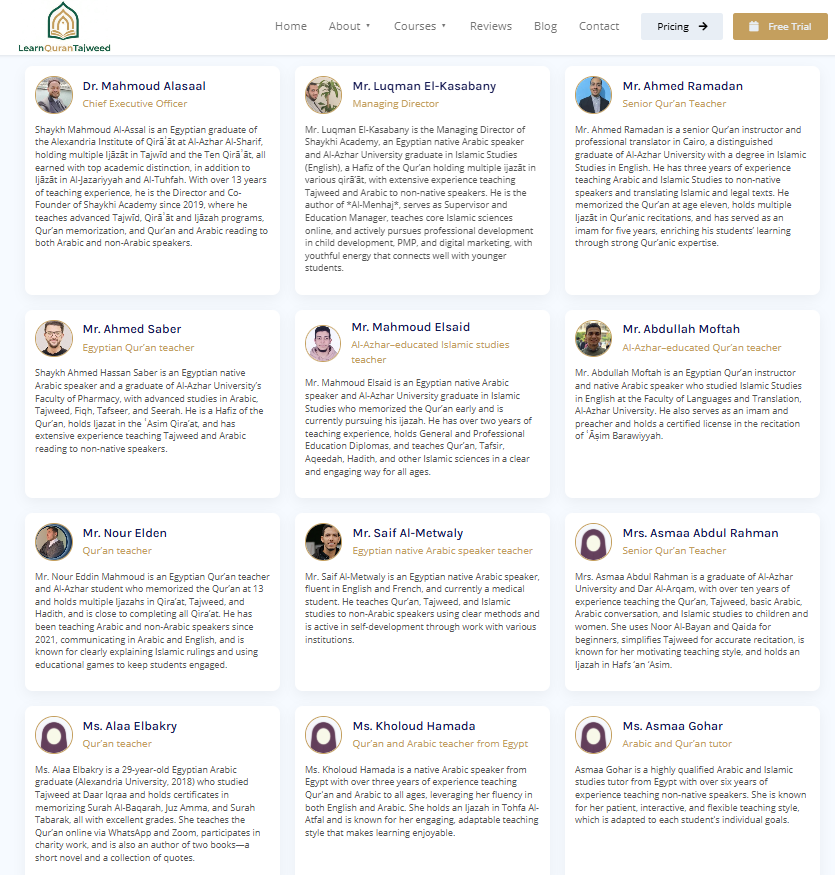
Meet One of our Certified Teachers to Correct Your Pronunciation
Read Also: Types of Ijazah in Tajweed
What Is Matn?
Matn refers to the precise recitation text — the actual words, vowelizations, and articulation patterns — that a student transmits to their teacher and receives authorization to pass forward. It is the content of the transmission, distinct from the chain itself.
When a student receives Ijazah, they are certified in two things simultaneously: that their Matn (the recitation) is accurate according to the rules of a specific narration — most commonly Hafs ‘an ‘Asim — and that their Sanad is connected. Both must be intact for the Ijazah to be valid.
This is why scholars do not grant Ijazah after testing a portion of the Quran. The entire Quran must be recited — because Matn certification is total, not partial. A single uncorrected error in Surah Al-Baqarah invalidates the transmission of that verse.
Students who encounter the rules of Tajweed only through self-study often have gaps they are unaware of — particularly in rules like Ikhfa or Idgham, where correct application is nearly impossible to self-assess. The Ijazah process corrects all of these systematically.
For students still building the foundational recitation skills needed before Ijazah preparation, our Beginner Tajweed Course provides the structured entry point — ensuring every student arrives at advanced study with a clean, corrected foundation.
Read Also: The History of Tajweed
What Is Sanad?
The Sanad is the chain of transmission — the named, documented lineage of scholars through whom the recitation has passed from teacher to student, generation by generation, back to the Prophet ﷺ. Breaking this chain, even once, invalidates the transmission.
A verified Sanad is not symbolic. It is the scholarly proof that every recitation pattern in the certified student’s reading was heard, corrected, and approved by a living human being who themselves received it the same way. This is a standard of verification that no book, app, or recorded course can replicate.
The Prophet ﷺ said:
“The best of you are those who learn the Quran and teach it.” (Sahih al-Bukhari 5027)
Teaching in this hadith implies qualified, authorized transmission — not informal sharing of what one has independently studied. The Sanad is precisely this authorization made visible and documented.
| Sanad Component | What It Guarantees |
| Named scholar chain | Each transmitter is known, verified, and accountable |
| Continuity to the Prophet ﷺ | No gap exists in the oral transmission |
| Specific narration pathway | The recitation follows Hafs ‘an ‘Asim (or another riwayah) precisely |
| Teacher correction | Every error was identified and corrected before passing forward |
Read Also: Hafs An Asim Tajweed
Our Students Reviews
Perfect Your Quran Recitation Today
Join expert-led Tajweed classes, and recite the Quran with confidence and clarity.
Start Your Free TrialStarting Your Path Toward Ijazah Certification at Learn Quran Tajweed Academy
Ijazah is within reach for any committed student — but only with the right instruction from the start.
Learn Quran Tajweed Academy offers:
- Ijazah-certified instructors specializing exclusively in Hafs ‘an ‘Asim recitation
- Personalized 1-on-1 sessions tailored to your current recitation level
- Structured progression from beginner Tajweed through full Ijazah evaluation
- Flexible scheduling available 24/7 for students worldwide
- Specialized Tajweed focus — not a generalist academy
Book your FREE trial lesson today and take the first verified step toward your Ijazah, Insha’Allah.
Check out the best tajweed course for your needs:
- Practical Tajweed Course
- Beginner Tajweed Course
- Intermediate Tajweed Course
- Advanced Tajweed Course
- Quran Tarteel Course
- Tajweed Ijazah Program
- Tajweed Course for Sisters
- Tajweed course for Kids
Book your free trial Tajweed lesson today

Conclusion
Ijazah is not a credential for display — it is a living link in the chain of Quranic preservation that has reached you across fourteen centuries. Every reciter who holds it carries a verified, named connection to the Prophet ﷺ himself, and that weight is real.
For non-Arabic speaking Muslims especially, Ijazah represents the highest form of recitation accountability available. It answers every question about accuracy, authority, and spiritual responsibility in a single, documented certification.
The path requires commitment, qualified instruction, and patience. But the destination — reciting the Quran as it was recited by the Prophet ﷺ, with scholarly verification — is among the most rewarding achievements a Muslim can pursue. May Allah make it easy for every student who seeks it.
Read Also: The Jazariyyah Tajweed Poem
Frequently Asked Questions About the Importance of Ijazah
Is Ijazah Required to Recite Quran Correctly?
Ijazah is not required to recite Quran for personal worship. However, it is the only scholarly-verified proof that your recitation meets the authenticated standard of Hafs ‘an ‘Asim transmission. For anyone who teaches Quran recitation to others, holding Ijazah is considered obligatory by classical Tajweed scholars to prevent the spread of uncorrected errors.
How Long Does It Take to Obtain Ijazah in Hafs ‘an ‘Asim?
The timeline varies significantly depending on the student’s starting level and consistency. Most non-Arabic speaking adult students require two to five years of structured study — moving through beginner Tajweed, intermediate rule mastery, applied recitation, and finally supervised Ijazah evaluation sessions. In most students’ experience, rushing this process produces failed evaluations, not early certification.
Can I Pursue Ijazah Through Online Instruction?
Yes — online Ijazah programs are fully valid when conducted under qualified, Ijazah-certified scholars through live, one-on-one audio or video sessions. The transmission is oral and must be heard directly; pre-recorded materials alone do not qualify. Learn Quran Tajweed Academy’s Tajweed Ijazah Program follows this scholarly standard precisely, with certified instructors conducting every evaluation session live.
What Is the Difference Between Ijazah in Recitation and Ijazah in Tajweed Rules?
Ijazah in recitation (riwayah) certifies that your actual oral recitation of the Quran meets the scholarly transmission standard of a specific riwayah — such as Hafs ‘an ‘Asim. Ijazah in Tajweed rules (dirayah) certifies mastery of the theoretical science of Tajweed. The more significant and widely pursued certification is recitation Ijazah, as it encompasses both theoretical knowledge and applied accuracy.
Does Ijazah Expire or Need Renewal?
Ijazah does not expire — it is a permanent scholarly certification. However, most qualified scholars advise that certified reciters maintain their recitation through regular review and continued contact with Tajweed instruction. A reciter who holds Ijazah but has not recited consistently for years may find their practical accuracy has degraded, even if the certification itself remains valid.