 Tajweed Rules

| Key Takeaways |
| The four lip letters in Tajweed — Fa, Ba, Meem, and non-Madd Waw — are collectively called the Shafawi letters. |
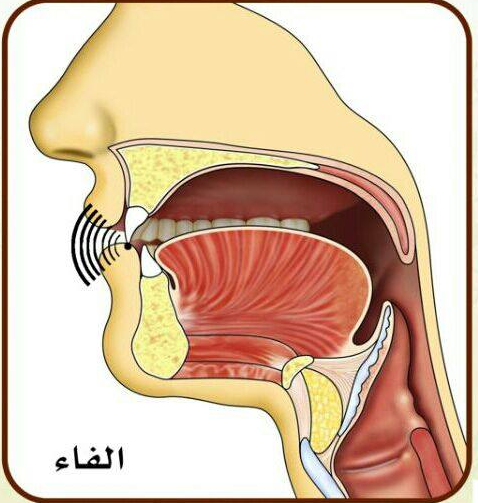
| The letter Fa articulates from the inner lower lip pressing gently against the upper front teeth, producing a distinct friction sound. |
| Ba and Meem share complete lip closure as their articulation point, but Meem adds a nasal resonance called Ghunnah from the nasal passage. |
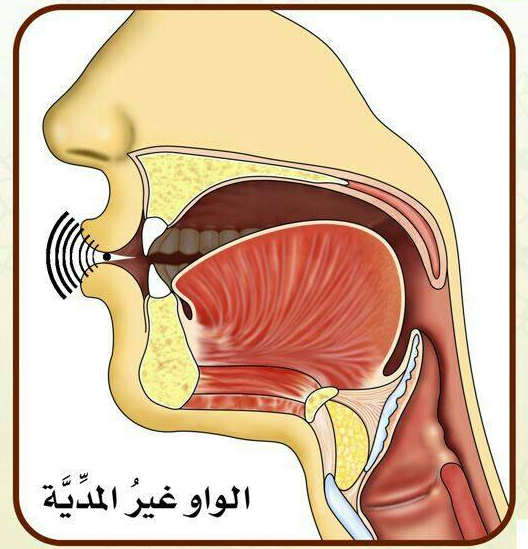
| The non-Madd Waw exits from rounded, forward-pressed lips with a small gap, distinct from the Madd Waw that originates in the Jawf. |
| Errors at lip articulation points — including replacing Fa with the English “v” sound — are among the most correctable mistakes with structured practice. |
Four letters in Arabic Tajweed share a single region of articulation — the lips. Known collectively as the Shafawi (شفوية) letters, these are Fa (ف), Ba (ب), Meem (م), and the non-Madd Waw (و). Mastering their correct exit points directly determines the precision of a significant portion of Quranic recitation.
The lip region (Ash-Shafatan) contains two distinct articulation sub-points. The first is exclusive to the letter Fa, and the second is shared by Ba, Meem, and the non-Madd Waw. Understanding this distinction — and drilling each letter’s precise mechanics — is the foundation of correct lip letters Tajweed application.
What Are the Shafawi Letters?
The four Shafawi letters — Fa, Ba, Meem, and non-Madd Waw — all exit from the region of the two lips (Ash-Shafatan), which scholars classify as the fifth and final major articulation region. Within this region, classical Tajweed scholarship identifies two specific sub-points: one for Fa alone, and one shared among the remaining three. This makes the lip region responsible for four distinct letters but only two exit locations.
Students at Learn Quran Tajweed Academy frequently underestimate the lip region’s precision demands. The lips must perform very different physical actions for each letter — from the asymmetrical Fa position to the complete bilateral closure of Ba and Meem — and blending these actions even slightly produces audible errors in recitation.
Our Beginner Tajweed Course addresses Shafawi letter mechanics from the very first lessons, ensuring students build correct muscle memory before advancing further.
Begin your Tajweed journey with a free lesson

1. The Letter Fa is The First Sub-Point of Ash-Shafatan
Fa (ف) exits from the inner surface of the lower lip coming into light contact with the tips of the upper front teeth (Ath-Thanaaya al-‘Ulya). This is the only letter among the Shafawi group that uses an asymmetrical articulation — it does not involve both lips equally.
The physical gesture is subtle but specific. The lower lip rises slightly, and only its inner (moist) surface — not the outer skin — makes contact with the upper teeth edges. The airflow passes through this narrow point of contact, creating a gentle fricative sound.
The Most Common Error Students Make With the Letter Fa
The single most frequent mistake with Fa is substituting it with the English letter “v” sound. This error occurs when students do not press the articulation with sufficient precision, or when they use the outer lip rather than the inner surface.
The “v” sound is voiced; the Arabic Fa is unvoiced — the vocal cords do not vibrate during its production.
In my years of working with non-Arabic speaking students, I have noticed that English speakers are particularly prone to this substitution because “v” is so deeply embedded in their phonological habits.
The correction always requires conscious, deliberate practice — saying Fa slowly, feeling the inner lip contact the upper teeth, and verifying there is no vocal cord vibration.
Another related error is producing Fa too softly, causing the letter to almost disappear, particularly in doubled or adjacent-letter contexts such as:
يَسْتَعْفِفْنَ Yasta’fif’na “Let them be chaste” (An-Nur 24:33)
Both Fa letters must be fully realized at their articulation point, including the sukoon of the first and the shaddah on the second.
فَلَا يُسْرِف فِّي الْقَتْلِ Falaa yusrif fil-qatl “He should not exceed limits in taking life” (Al-Isra 17:33)
Each Fa demands its complete articulation — neither merged nor weakened by proximity to the other.
The Second Sub-Point is Ba, Meem, and Non-Madd Waw
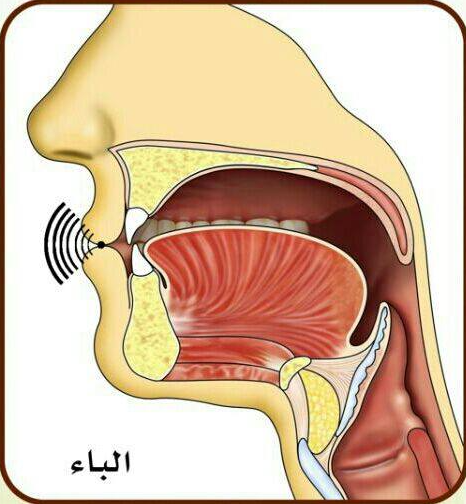
Ba (ب), Meem (م), and the non-Madd Waw (و) all exit from the meeting of both lips together, though each letter requires a distinct physical configuration. This shared region is sometimes called the “bilateral” articulation point, as it engages both lips simultaneously.
| Letter | Lip Action | Additional Feature |
| Ba (ب) | Complete, firm closure of both lips | None — pure stop consonant |
| Meem (م) | Complete closure of both lips | Ghunnah (nasal resonance) accompanies it |
| Non-Madd Waw (و) | Lips round forward with a small gap | Tongue back rises; no closure |
Join our Practical Tajweed Course and get a free trial

2. The Letter Ba Exit From the Lips
Ba (ب) exits through complete bilateral lip closure — both lips press firmly together, blocking airflow entirely, then release with a light plosive sound. There is no nasal component and no rounding — it is a clean, closed stop.
The lips must come together with intention and firmness. A weak or incomplete closure results in a distorted Ba that may merge with adjacent sounds. This becomes especially noticeable in adjacent-Ba contexts:
لذهبَ بِسمعهم Ladhahaba bisam’ihim “He would have taken away their hearing” (Al-Baqarah 2:20)
Both Ba letters must be distinctly produced with their respective vowels — the first with a fatha, the second with a kasra — without merging or skipping the closure.
Qalqalah also interacts with Ba in important ways. Since Ba is one of the five Qalqalah letters, a saakin (vowelless) Ba carries a slight echo-bounce upon release. This adds a layer of precision requirement — the lip closure must be complete enough to produce the Qalqalah when needed.
3. The Letter Meem
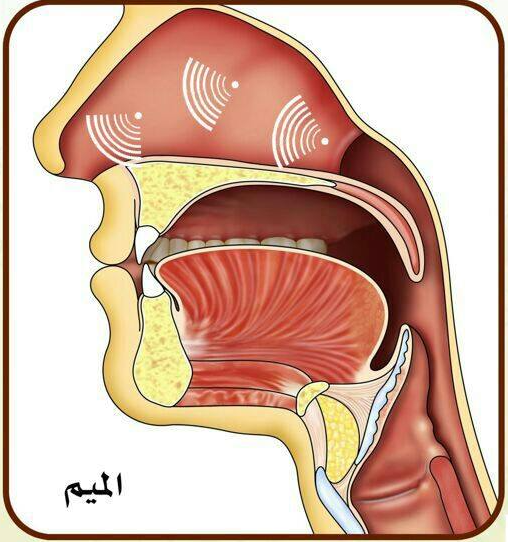
Meem (م) shares the same bilateral lip closure as Ba, but it is accompanied by Ghunnah — a nasal resonance produced through the Khaishoom (nasal passage). The lips close completely, and the sound resonates through the nose rather than releasing as a plosive.
This nasal component is what distinguishes Meem most from Ba. Students often underestimate how much the Ghunnah defines the letter’s quality, especially in the rules of Meem such as Idgham Shafawi, Ikhfa Shafawi, and Izhar Shafawi.
أُمَمٍ مِّمَّن مَّعَكَ Umamin mimman ma’ak “Nations from those with you” (Hud 11:48)
In this example, adjacent Meem letters must be individually articulated with their Ghunnah and separated by their vowel movements. Merging them or losing the nasal resonance is among the most frequently diagnosed errors.
The ghunnah rules that accompany Meem and Noon are a distinct science — a point we are careful to separate from the Waw’s articulation, which carries no Ghunnah whatsoever.
4. The Non-Madd Waw
The non-Madd Waw exits when the lips round forward and press slightly toward each other, leaving a small gap between them, while the back of the tongue rises toward the soft palate. It does not involve full lip closure, and it carries no nasal resonance.
Classical Tajweed scholarship distinguishes three types of Waw:
- Madd Waw: Saakin (vowelless) preceded by a Dammah — exits from the Jawf (empty oral-nasal cavity), not the lips. Its articulation is covered under Madd rules.
- Leen Waw (Soft Waw): Saakin preceded by a Fathah — exits from the lips with a gentle rounding.
- Moving Waw: Carries a vowel — also exits from the lips.
The Madd Waw is explicitly excluded from the Shafawi classification precisely because its articulation point is internal (the Jawf), not the lips.
وَوَرِثَ Wa waritha “And he inherited” (An-Naml 27:16)
وَوُضِعَ الْكِتَابُ Wa wudi’al-kitaab “And the Book will be placed” (Al-Kahf 18:49)
In both examples, each Waw must be shown clearly with its vowel movement — neither Waw may be swallowed or merged with the other.
Read Also: Al-Jawf in Tajweed
The Key Error With the Non-Madd Waw
The most consistent error is adding Ghunnah to the Waw. Because students know Ghunnah accompanies Meem and Noon, they sometimes carry that nasal quality into the Waw — which is entirely incorrect.
The Ghunnah rules apply exclusively to Meem and Noon; the Waw has no nasal resonance of any kind.
A second common error is incomplete lip rounding — producing a Waw that sounds flat, without the forward lip protrusion that defines its correct exit.
Read Also: Sifaat Al Huroof In Tajweed
Shots Videos from Our Courses
Perfect Your Quran Recitation Today
Join expert-led Tajweed classes, and recite the Quran with confidence and clarity.
Start Your Free TrialCommon Errors in Lip Letters Tajweed and Their Corrections
Across hundreds of student sessions, the same patterns appear repeatedly with Shafawi letters. The table below summarizes the key errors and certified corrections:
| Letter | Common Error | Correct Approach |
| Fa | Replacing with English “v” (voiced fricative) | Use inner lower lip on upper teeth edges; keep vocal cords relaxed |
| Fa | Disappearing Fa in doubled contexts | Deliberately hold the articulation point; fully realize sukoon before shaddah |
| Ba | Incomplete lip closure | Press both lips together firmly before releasing |
| Ba | Merging adjacent Ba letters | Separate each Ba clearly with its vowel |
| Meem | Missing the Ghunnah | Consciously redirect sound through the nasal passage |
| Meem | Merging adjacent Meem letters | Keep each Meem’s Ghunnah and vowel separate |
| Waw | Adding Ghunnah to the Waw | Ghunnah is for Meem and Noon only; Waw exits clean |
| Waw | Flat lip position | Round and protrude lips forward with a small gap |
Working with Ijazah-certified instructors at Learn Quran Tajweed Academy through our Intermediate Tajweed Course gives students the individualized feedback needed to diagnose and eliminate these specific errors, which are nearly impossible to self-correct without a qualified listener.
Join our Intermediate Tajweed Course and get a free trial

Read Also: Tajweed Tongue Letters
How Lip Letters Interact With Core Tajweed Rules
The Shafawi letters are not studied in isolation — they interact with several major Tajweed rule systems that every serious student must understand.
Meem Sakinah has its own three rules depending on the letter that follows it: Ikhfa Shafawi,Idgham Shafawi, and Izhar Shafawi. All three rules depend on the Meem’s lip articulation being established correctly first.
Noon Sakinah interacts with several of these same letters. When a Noon Sakinah or Tanween is followed by a Ba, the rule of Iqlab applies — the Noon converts to a Meem sound pronounced with Ghunnah and Ikhfa. This directly engages the lip articulation point.
Students pursuing Ijazah certification will encounter these rule interactions constantly. Our Tajweed Ijazah Program at Learn Quran Tajweed Academy includes dedicated assessment of Shafawi letter precision as part of the recitation evaluation framework.
Join our Tajweed Ijazah Program and get a free trial

Our Students Reviews
Perfect Your Quran Recitation Today
Join expert-led Tajweed classes, and recite the Quran with confidence and clarity.
Start Your Free Trial
Read Also: Throat Letters in Tajweed
Begin Your Shafawi Letter Mastery With Certified Instruction at Learn Quran Tajweed Academy
Correct lip letter production is foundational to every rule system in Tajweed — from Iqlab to Idgham Shafawi to Qalqalah.
- Ijazah-certified instructors specializing in Hafs ‘an ‘Asim
- Personalized 1-on-1 sessions diagnosing your specific articulation errors
- Flexible scheduling available 24/7 for global students
- Structured progression from foundational Makharij to advanced rule mastery
- Specialized Tajweed focus — not a generalist academy
Book your FREE trial lesson today and receive expert assessment of your Shafawi letter articulation in your very first session.
Check out the best tajweed course for your needs:
- Practical Tajweed Course
- Beginner Tajweed Course
- Intermediate Tajweed Course
- Advanced Tajweed Course
- Quran Tarteel Course
- Tajweed Ijazah Program
- Tajweed Course for Sisters
- Tajweed course for Kids
Book your free trial Tajweed lesson today

Conclusion
The four Shafawi letters — Fa, Ba, Meem, and non-Madd Waw — represent one of the most practically significant articulation regions in Quranic recitation. Their correct production requires distinct physical precision for each letter, from the asymmetrical Fa position to the rounded Waw exit.
Errors in this region are common but correctable. Distinguishing the Madd Waw from the lip Waw, keeping Ghunnah confined to Meem and Noon, and fully realizing doubled letters with their articulation points — these are the details that separate accurate recitation from approximation.
Insha’Allah, the clarity you build at this level of Makharij study will strengthen every Tajweed rule you apply afterward, because precision at the articulation point is where correct recitation truly begins.
Perfect Your Quran Recitation Today
Join expert-led Tajweed classes, and recite the Quran with confidence and clarity.
Start Your Free TrialRead Also: What Is Makhraj in Tajweed?
Frequently Asked Questions About Lip Letters in Tajweed
What does Shafawi mean in Tajweed?
Shafawi (شفوية) means “lip-related” in Arabic, derived from the word Shafa (lip). In Tajweed, it refers to the four letters — Fa, Ba, Meem, and non-Madd Waw — whose articulation point lies in the lip region. These letters are grouped together because they all exit from the two lips (Ash-Shafatan), the fifth major Makharij region.
Is the Madd Waw a Shafawi letter?
No. The Madd Waw — a saakin Waw preceded by a Dammah — exits from the Jawf (the empty oral-nasal cavity), not the lips. Only the moving Waw and the Leen Waw are classified as Shafawi letters. This distinction is essential because it affects how the Waw is treated in recitation and rule application.
Why does Meem have Ghunnah but Ba does not?
Ghunnah is a nasal resonance that Tajweed scholarship defines as an attribute of Meem and Noon specifically — it is part of their inherent letter characteristics (Sifat Lazimah). Ba, despite sharing the same lip closure exit point as Meem, does not possess Ghunnah. The sound of Ba releases outward as a plosive stop, while Meem’s sound resonates through the nasal passage.
How long does it typically take to correct lip letter errors?
In most students’ experience at Learn Quran Tajweed Academy, consistent errors with Fa, Ba, Meem, and Waw take approximately three to six weeks of daily focused practice to correct, provided there is qualified feedback after each session. Students who practice without a certified listener often reinforce their errors rather than eliminating them, significantly extending the correction timeline.
How do lip letters connect to the rules of Noon Sakinah and Meem Sakinah?
The Shafawi letters are directly involved in several Noon Sakinah and Meem Sakinah rules. When Noon Sakinah or Tanween precedes a Ba, the Iqlab rule converts the Noon to a Meem with Ghunnah and concealment. When a Meem Sakinah precedes another Meem or Ba, the Idgham Shafawi or Ikhfa Shafawi rules apply. Correct lip articulation is the prerequisite for applying all of these rules accurately.
Related Articles
Tajweed Rules