 Tajweed Rules

| Key Takeaways |
| Arabic Tajweed letters are categorized by two core elements: makhraj (articulation point) and sifat (letter attributes), which together define correct pronunciation. |
| The 29 Arabic letters are grouped into six articulation zones: the throat (halq), tongue (lisan), lips (shafatain), jaw cavity (jawf), nasal passage (khayshum), and specific tongue regions. |
| Every Arabic letter carries between four and six permanent attributes (sifat lazimah) that never change regardless of its position in a word. |
| Throat letters (حروف حلقية) — ء ه ع ح غ خ — are among the most mispronounced by non-Arabic speakers due to the deep articulation required. |
| Mastering letter attributes like qalqalah, tafkhim, and istifal determines whether your Quran recitation is valid or contains mispronunciation errors. |
Every student who sits with me at Learn Quran Tajweed Academy for the first time believes Tajweed is about rules — Ikhfa, Idgham, Madd. What surprises most of them is this: Tajweed begins long before those rules. It begins with the Arabic Tajweed letters themselves, with understanding precisely where each letter is born and what qualities it carries.
The Arabic alphabet in Tajweed isn’t simply a list of 29 letters. Each letter has a fixed articulation point (makhraj) and a set of permanent characteristics (sifat lazimah) that determine how it must sound. Get the letter right, and every Tajweed rule built on top of it becomes significantly easier to apply correctly.
What Is Quranic Alphabet Tajweed?
Quranic alphabet Tajweed refers to the precise science of pronouncing each Arabic letter from its correct anatomical origin, with all of its established sound characteristics active. This is not optional refinement — it is the baseline below which recitation errors become distortion of meaning.
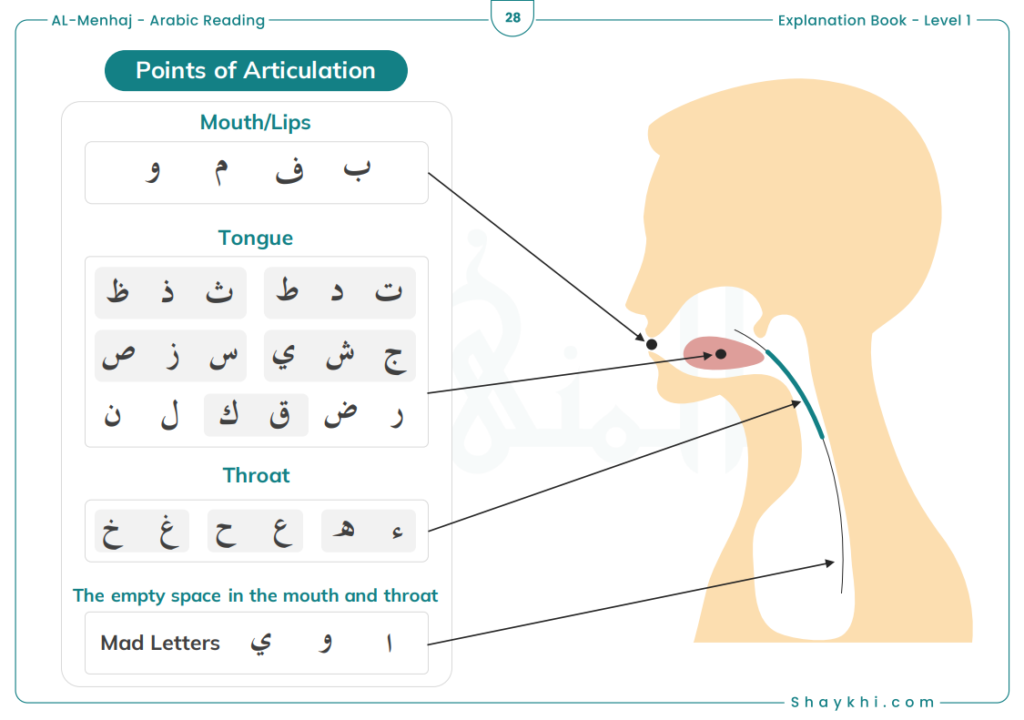
Classical scholars of Tajweed divided the articulation system into 17 specific makhaarij (articulation points) across five major zones.
Before a student can understand why ق and ك sound different despite being neighbors in the mouth, they need to understand this map. At Learn Quran Tajweed Academy, our Beginner Tajweed Course starts every student here — with letter identity, before rules.
Begin your Tajweed journey with a free lesson

What Are the Points of Articulation for Arabic Letters with Tajweed?
The five articulation zones of Arabic Tajweed letters are the jawf (cavity), halq (throat), lisan (tongue), shafatain (two lips), and khayshum (nasal passage). Each zone contains specific letters whose sound cannot be correctly produced from any other region.
| Articulation Zone | Arabic Term | Letters Produced |
| Cavity (Jaw) | الجوف | ا و ي (the three long vowel letters) |
| Throat | الحلق | ء هـ ع ح غ خ |
| Tongue | اللسان | ق ك ج ش ي ض ل ن ر ط د ت ص ز س ث ذ ظ |
| Two Lips | الشفتان | ب م و ف |
| Nasal Passage | الخيشوم | Ghunnah (accompanying ن and م) |
Understanding these zones gives your ear a reference point. When a student mispronounces ع as a plain glottal stop, it is almost always because they have never consciously engaged the mid-throat. The letter has a home — and correct recitation means sending it there.
Explore Al-Menhaj Book for Free (Learn to Read Quran)
How to Pronounce Arabic Letters in Tajweed?
Every Arabic letter in Tajweed carries permanent sound attributes called sifat lazimah. These attributes are not optional — they are part of the letter’s identity and remain active in every position, every word, every recitation. Understanding them is what separates accurate recitation from approximate recitation.
Characteristics of Letters in Tajweed — Sifat al-Huruf
The sifat (characteristics) divide into two main categories:
Sifat with opposites (ten total, forming five pairs):
| Attribute | Arabic | Opposite | Arabic | Core Difference |
| Voicing | الجهر | Breath (Hams) | الهمس | Airflow held vs. released |
| Hardness | الشدة | Softness (Rakhawa) | الرخاوة | Sound stops vs. flows |
| Elevation | الاستعلاء | Depression (Istifal) | الاستفال | Tongue rises vs. lowers |
| Constriction | الإطباق | Openness (Infitah) | الانفتاح | Tongue seals vs. separates |
| Agility | الإذلاق | Heaviness (Ismat) | الإصمات | Fast articulation vs. slow |
Between hardness and softness sits التوسط (Bayniyyah) — the intermediate attribute. Its five letters are collected in the phrase لن عمر (Lam, Nun, Ain, Mim, Ra). These letters neither fully stop the sound like شدة letters, nor let it flow completely like رخاوة letters.
Sifat without opposites (seven total):
| Attribute | Arabic | Letters |
| Whistling | الصفير | ص ز س |
| Echoing | القلقلة | ق ط ب ج د |
| Ease | اللين | و ي (with sukoon after fathah) |
| Deflection | الانحراف | ل ر |
| Repetition | التكرير | ر (tendency, must be avoided) |
| Spreading | التفشي | ش |
| Elongation | الاستطالة | ض |
What Are All the Arabic Tajweed Letters with Their Articulation Points and Full Attributes?
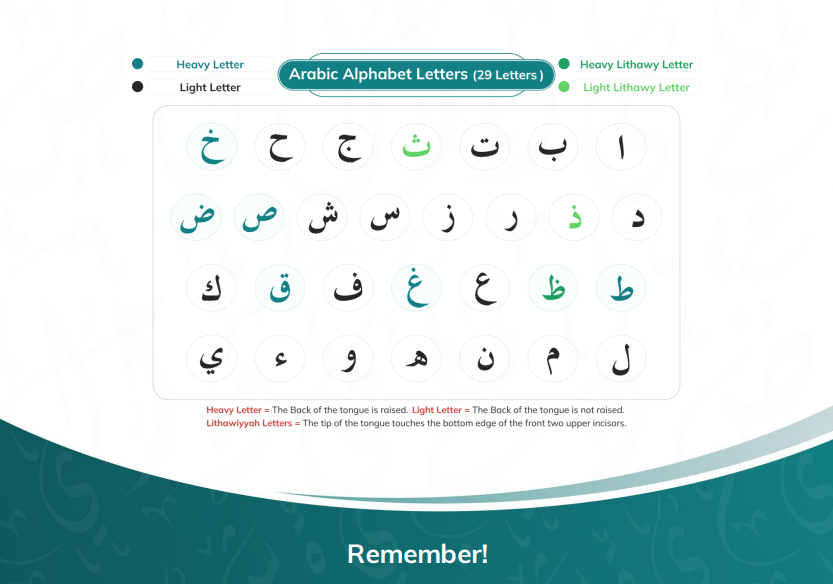
Every Arabic letter in Tajweed has three fixed identifiers: its group nickname (لقب), its articulation point (مخرج), and its permanent attributes (صفات لازمة). The table and entries below document all 29 letters plus the Ghunnah, organized by articulation group — exactly as classical Tajweed scholarship presents them.
1. Hamza (ء)
Group: Throat letter (حرف حلقي) Articulation point: The deepest part of the throat (أقصى الحلق) Attributes: Jаhr (جهر), Shiddah (شدة), Istifal (استفال), Infitah (انفتاح), Ismat (إصمات)
Hamza is produced by a complete closure at the very base of the throat — the glottis — which then releases. Its Shiddah means the sound stops entirely at the moment of production; no airflow escapes during articulation.
Because it shares its makhraj with هـ, the two are most distinguished by their opposing attributes: Hamza is voiced and hard (Jahr + Shiddah), while هـ is breathed and soft (Hams + Rakhawa).
2. Haa (هـ)
Group: Throat letter (حرف حلقي) Articulation point: The deepest part of the throat (أقصى الحلق) Attributes: Hams (همس), Rakhawa (رخاوة), Istifal (استفال), Infitah (انفتاح), Ismat (إصمات)
هـ is one of the most breathed letters in the Arabic alphabet. Its Hams means the breath flows freely without the voice engaging, and its Rakhawa means the sound continues running rather than stopping.
Students at Learn Quran Tajweed Academy consistently find this letter under-produced — they treat it as a simple ‘h’ exhale, when in fact it requires a specifically deep-throat origin. It shares its makhraj with Hamza but belongs to the opposite end of every relevant sifah pair.
Meet One of our Certified Teachers to Correct Your Pronunciation

3. Ain (ع)
Group: Throat letter (حرف حلقي) Articulation point: The middle of the throat (وسط الحلق) Attributes: Jahr (جهر), Bayniyyah (بينية), Istifal (استفال), Infitah (انفتاح), Ismat (إصمات)
ع is one of the defining challenges for non-Arabic speakers. Its Bayniyyah places it between hardness and softness — the sound is neither fully stopped nor fully flowing. Before correcting jaw position, most students produce Ain as a plain open vowel — they have simply never engaged the mid-throat constriction this letter requires.
Its voiced, intermediate character means pressure is needed at the mid-throat without fully cutting off airflow. This distinguishes it sharply from its neighbor ح, which shares the same makhraj but is breathed and soft.
4. Haa (ح)
Group: Throat letter (حرف حلقي) Articulation point: The middle of the throat (وسط الحلق) Attributes: Hams (همس), Rakhawa (رخاوة), Istifal (استفال), Infitah (انفتاح), Ismat (إصمات)
ح originates from the same mid-throat point as ع but is its complete opposite in character. Its Hams means the breath runs without voicing, and its Rakhawa means the sound continues freely. It is the most unique of the six throat letters because it has no equivalent in any Western language.
Producing it correctly requires sustained mid-throat constriction while exhaling — not a glottal stop, not an ‘h’ — but a friction-based breath originating from deep in the pharynx.
5. Ghayn (غ)
Group: Throat letter (حرف حلقي) Articulation point: The nearest portion of the throat (أدنى الحلق) Attributes: Jahr (جهر), Rakhawa (رخاوة), Isti’la (استعلاء), Infitah (انفتاح), Ismat (إصمات)
غ is voiced (Jahr) and flowing (Rakhawa), produced where the back of the tongue approaches the uvula. Its Isti’la means the back of the tongue rises toward the upper palate when this letter is produced, elevating the overall sound quality.
This is what gives غ its characteristic “gargling” resonance. Because it is elevated and voiced, it is a tafkhim (heavy) letter — it cannot be thinned, and any attempt to flatten it pulls the letter away from its correct makhraj.
6. Khaa (خ)
Group: Throat letter (حرف حلقي) Articulation point: The nearest portion of the throat (أدنى الحلق) Attributes: Hams (همس), Rakhawa (رخاوة), Isti’la (استعلاء), Infitah (انفتاح), Ismat (إصمات)
خ shares its makhraj with غ but is breathed (Hams) rather than voiced. The distinction is crucial: غ carries voice and resonance; خ carries only breath from the same throat region.
Its Isti’la keeps the back of the tongue raised, which explains why this letter — like all the elevated letters — carries natural heaviness. Students who blur خ and غ are almost always missing the voicing distinction, not the articulation point.
Shots Videos from Our Courses
Perfect Your Quran Recitation Today
Join expert-led Tajweed classes, and recite the Quran with confidence and clarity.
Start Your Free Trial7. Long Alif (ا)
Group: Cavity letter (حرف جوفي) Articulation point: The open jaw cavity (الجوف) Attributes: Jahr (جهر), Rakhawa (رخاوة), Istifal (استفال), Infitah (انفتاح), Ismat (إصمات)
The long Alif is a pure vowel sound produced from the open cavity of the mouth and throat, without any obstruction point. It is always preceded by a fathah and extends naturally from it.
Because it has no fixed point of contact in the mouth — no tongue, no lips, no throat friction — it belongs to the jawf (cavity) group. This letter connects directly to the rules of Madd and forms the foundation of every long vowel extension in Quran recitation.
Join our Practical Tajweed Course and get a free trial

8. Long Waw (و as a long vowel)
Group: Cavity letter (حرف جوفي) Articulation point: The open jaw cavity (الجوف) Attributes: Jahr (جهر), Rakhawa (رخاوة), Istifal (استفال), Infitah (انفتاح), Ismat (إصمات)
The long Waw — when functioning as a madd letter after a dammah — flows from the open jaw cavity with rounded lips, but its primary origin is the jawf. Like Long Alif, it has no specific point of obstruction in the mouth.
When it appears in this madd capacity, the lips round gently but do not close, allowing the sound to emerge freely. Students often confuse this with the non-madd Waw, which is a lip letter (شفوي) with its own distinct makhraj.
9. Long Yaa (ي as a long vowel)
Group: Cavity letter (حرف جوفي) Articulation point: The open jaw cavity (الجوف) Attributes: Jahr (جهر), Rakhawa (رخاوة), Istifal (استفال), Infitah (انفتاح), Ismat (إصمات)
The long Yaa — when functioning as a madd letter after a kasrah — extends from the open cavity. Like Long Alif and Long Waw, its defining feature is the absence of a specific obstruction point — the sound resonates freely through the entire oral and pharyngeal cavity.
Confusing the madd Yaa with the non-madd Yaa (a middle-tongue letter) is one of the most common structural errors for students beginning to work through Madd rules.
10. Qaf (ق)
Group: Back-of-tongue letter (حرف لهوي) Articulation point: The farthest back of the tongue against the upper palate (أقصى اللسان مع استعلائه وما يقابله من الحنك العلوي) Attributes: Jahr (جهر), Shiddah (شدة), Isti’la (استعلاء), Infitah (انفتاح), Ismat (إصمات), Qalqalah (قلقلة)
ق is one of the five Qalqalah letters and one of the most distinctively Arabic sounds in the entire alphabet. Its makhraj is at the very back of the tongue — distinctly further back than ك — against the upper palate.
The combination of Jahr and Shiddah creates the echo-bounce of Qalqalah when ق sits as sukoon: the voice is held in at a completely sealed point, then released with a strong echo.
Its Isti’la attribute means the back of the tongue rises during articulation, giving it its characteristic elevated, heavy resonance. Students who place ق at the same position as ك lose the letter entirely.
Perfect Your Quran Recitation Today
Join expert-led Tajweed classes, and recite the Quran with confidence and clarity.
Start Your Free Trial11. Kaf (ك)
Group: Back-of-tongue letter (حرف لهوي) Articulation point: The farthest back of the tongue against the upper palate, slightly forward of Qaf (أقصى اللسان مع ما يقابله من الحنك العلوي) Attributes: Hams (همس), Shiddah (شدة), Istifal (استفال), Infitah (انفتاح), Ismat (إصمات)
ك shares the back-of-tongue zone with ق but sits slightly more forward, and its attribute profile is nearly the opposite.
Where ق is voiced, elevated, and produces Qalqalah, ك is breathed (Hams), depressed (Istifal), and carries no Qalqalah. The Shiddah is the one shared attribute — both letters produce a complete stop of the sound at their articulation point.
The Hams of ك means it is produced with airflow rather than vocal resonance, making it much lighter in quality than ق.
12. Jeem (ج)
Group: Middle-tongue letter (حرف شجري) Articulation point: The middle of the tongue against the upper gum ridge Attributes: Jahr (جهر), Shiddah (شدة), Istifal (استفال), Infitah (انفتاح), Ismat (إصمات), Qalqalah (قلقلة)
ج is the voiced, hard letter of the middle-tongue group and one of the five Qalqalah letters. Its Jahr and Shiddah combine to completely hold the sound at the point of contact between the mid-tongue and the upper gum ridge — this creates the echo-bounce of Qalqalah when it sits sukoon.
Non-Arabic speakers often produce ج too far forward or too soft. The correct articulation requires the entire middle section of the tongue to rise and press firmly, then release with a full-voiced bounce.
13. Sheen (ش)
Group: Middle-tongue letter (حرف شجري) Articulation point: The middle of the tongue against the upper gum ridge (وسط اللسان مع ما يحاذيه من اللثة العليا) Attributes: Hams (همس), Rakhawa (رخاوة), Istifal (استفال), Infitah (انفتاح), Ismat (إصمات), Tafashi (تفشي)
ش carries the unique attribute of Tafashi — the spreading of breath across the entire width of the palate during articulation.
Its Hams and Rakhawa mean both breath and sound flow freely, but what distinguishes ش from all other letters is that this airflow fans out sideways across the full interior of the mouth until it approaches the articulation zone of ظ.
Students should consciously feel the breath touching the sides of the upper palate — not just the center. This lateral spreading is the physical signature of Tafashi.
Perfect Your Quran Recitation Today
Join expert-led Tajweed classes, and recite the Quran with confidence and clarity.
Start Your Free Trial14. Non-Madd Yaa (ي)
Group: Middle-tongue letter (حرف شجري) Articulation point: The middle of the tongue against the upper gum ridge (وسط اللسان مع ما يحاذيه من اللثة العليا) Attributes: Jahr (جهر), Rakhawa (رخاوة), Istifal (استفال), Infitah (انفتاح), Ismat (إصمات), Lin (لين) when vowelless
The non-madd Yaa is a middle-tongue letter — entirely different from the long Yaa, which is a cavity letter.
When this Yaa appears sukoon (vowelless) preceded by a fathah — as in قُرَيْش — it gains the additional attribute of Lin (ease), producing a smooth, effortless glide.
This Lin Yaa is one of the two soft letters and connects directly to the Madd rules when specific conditions of extension apply. Students must clearly differentiate between this letter’s two roles: as a regular consonant and as a Lin letter.
15. Dhad (ض)
Group: Middle-tongue letter (حرف شجري) Articulation point: One side of the tongue (preferably the left) against the upper molars. Attributes: Jahr (جهر), Rakhawa (رخاوة), Isti’la (استعلاء), Itbaq (إطباق), Ismat (إصمات), Istitalah (استطالة)
ض is one of the most unique sounds in the Arabic language and carries the exclusive attribute of Istitalah — the sound travels the full length of the side of the tongue from front to back during articulation.
No other Arabic letter possesses this attribute. Its Itbaq means the tongue seals against the upper palate, and its Isti’la raises the back of the tongue simultaneously. The left side of the tongue is easier for most students, though the right is also permitted.
At Learn Quran Tajweed Academy, students in our Intermediate Tajweed Course typically spend the most focused time on ض among all consonants — its combination of four strong sifat with a unique makhraj makes it the most complex letter in the Arabic alphabet for non-native speakers.
Join our Intermediate Tajweed Course and get a free trial

16. Taa (ط)
Group: Upper-root tongue letter (حرف نطعي) Articulation point: The tip of the tongue against the roots of the upper front teeth Attributes: Jahr (جهر), Shiddah (شدة), Isti’la (استعلاء), Itbaq (إطباق), Ismat (إصمات), Qalqalah (قلقلة)
ط is the elevated, sealed counterpart of ت and د — all three share the same makhraj, yet ط is the heaviest of the three by far.
Its Isti’la raises the back of the tongue toward the upper palate while the tip articulates against the upper tooth roots, and its Itbaq seals the tongue against that palate simultaneously.
Add Jahr and Shiddah, and the result is a powerful, bouncing (Qalqalah) letter with a notably thick, heavy quality. The Qalqalah of ط is the strongest among all five Qalqalah letters in terms of its echo quality.
17. Dal (د)
Group: Upper-root tongue letter (حرف نطعي) Articulation point: The tip of the tongue against the roots of the upper front teeth Attributes: Jahr (جهر), Shiddah (شدة), Istifal (استفال), Infitah (انفتاح), Ismat (إصمات), Qalqalah (قلقلة)
د shares its makhraj with ط and ت but carries neither elevation nor sealing. Its Istifal keeps the back of the tongue depressed, and its Infitah means the tongue does not seal against the palate.
Despite being lighter than ط, د remains voiced (Jahr) and hard (Shiddah), which gives it its Qalqalah.
The echo of د when sukoon is less heavy than ط but more resonant than ت, which carries no Qalqalah at all. The ط / د / ت trio at the same makhraj is the clearest classroom demonstration of how sifat determine letter identity.
Perfect Your Quran Recitation Today
Join expert-led Tajweed classes, and recite the Quran with confidence and clarity.
Start Your Free Trial18. Taa (ت)
Group: Upper-root tongue letter (حرف نطعي) Articulation point: The tip of the tongue against the roots of the upper front teeth Attributes: Hams (همس), Shiddah (شدة), Istifal (استفال), Infitah (انفتاح), Ismat (إصمات)
ت is the breathed, light member of the upper-root group. Its Hams distinguishes it immediately from د (voiced) and ط (voiced and elevated).
Both share Shiddah — the sound stops completely at the point of contact — but ت releases with breath rather than voice.
Because ت carries no Qalqalah and no elevation, it is the thinnest and lightest of its group. Students confusing ت with ط are almost always missing the Isti’la and Itbaq of ط — not failing to hear the breath difference between Hams and Jahr.
19. Dhaa (ظ)
Group: Upper-edge tongue letter (حرف لثوي) Articulation point: The tip of the tongue against the edges of the upper front teeth Attributes: Jahr (جهر), Rakhawa (رخاوة), Isti’la (استعلاء), Itbaq (إطباق), Ismat (إصمات)
ظ is the elevated, sealed member of the upper-edge group — the counterpart to ذ and ث, which are lighter. Its Isti’la and Itbaq together give it a thick, heavy quality: the back of the tongue rises and the tongue seals the palate while the tip lightly touches the upper tooth edges.
The combination of Jahr (voiced) and Rakhawa (flowing) means the sound continues — unlike ط, which stops sharply. Students most commonly confuse ظ with ذ, missing the elevation and sealing that distinguish them.
20. Dhal (ذ)
Group: Upper-edge tongue letter (حرف لثوي) Articulation point: The tip of the tongue against the edges of the upper front teeth (طرف اللسان مع أطراف الثنايا العليا) Attributes: Jahr (جهر), Rakhawa (رخاوة), Istifal (استفال), Infitah (انفتاح), Ismat (إصمات)
ذ is the voiced, depressed, open counterpart of ظ. It shares the same upper-edge makhraj but carries neither Isti’la nor Itbaq — the tongue does not rise or seal.
The result is a lighter, thinner sound than ظ despite both being voiced and flowing. This letter is the voiced equivalent of ث: same makhraj, same Rakhawa and Istifal and Infitah, but ذ has Jahr (voiced) while ث has Hams (breathed).
Perfect Your Quran Recitation Today
Join expert-led Tajweed classes, and recite the Quran with confidence and clarity.
Start Your Free Trial21. Thaa (ث)
Group: Upper-edge tongue letter (حرف لثوي) Articulation point: The tip of the tongue against the edges of the upper front teeth Attributes: Hams (همس), Rakhawa (رخاوة), Istifal (استفال), Infitah (انفتاح), Ismat (إصمات)
ث is the breathed member of the upper-edge group — the lightest of the ظ / ذ / ث trio. All three share the same makhraj (tip of tongue against upper tooth edges) and the same Rakhawa (flowing sound), but ث is whispered (Hams), depressed (Istifal), and open (Infitah).
Non-Arabic speakers often mistake ث for a plain ‘s’ sound — the correction is to place the tongue tip gently between or just behind the upper front teeth while exhaling, not keeping the tongue inside.
22. Faa (ف)
Group: Lip letter (حرف شفوي) Articulation point: The inner surface of the lower lip against the tips of the upper front teeth Attributes: Hams (همس), Rakhawa (رخاوة), Istifal (استفال), Infitah (انفتاح), Idhlaq (إذلاق)
ف is the only lip letter that involves the teeth, making its makhraj unique among the شفوي group. Its Idhlaq (agility) classifies it among the six light, fast-articulating letters (فر من لب).
Because the inner lower lip — rather than both lips — engages with the upper tooth tips, ف has a distinctly forward, light quality. Its Hams and Rakhawa mean breath flows freely and continuously. The correct articulation should produce a clear fricative — not a bilabial stop, and not a ‘v’ sound.
23. Baa (ب)
Group: Lip letter (حرف شفوي) Articulation point: Both lips pressing together Attributes: Jahr (جهر), Shiddah (شدة), Istifal (استفال), Infitah (انفتاح), Idhlaq (إذلاق), Qalqalah (قلقلة)
ب is the only lip letter that produces Qalqalah. Its Jahr (voiced) and Shiddah (hard stop) combine at the point of both lips pressing completely together — this complete seal followed by a voiced release creates the distinctive echo-bounce of Qalqalah when ب sits sukoon.
Its Idhlaq keeps it agile and light despite the strong stop. The rules of Meem interact directly with ب — specifically the rule of Iqlab, where a ن before ب transforms and acquires Ghunnah. See our guide on Iqlab rules for the full treatment.
24. Meem (م)
Group: Lip letter (حرف شفوي) Articulation point: Both lips pressing together (ما بين الشفتين بانطباقهما) Attributes: Jahr (جهر), Bayniyyah (بينية), Istifal (استفال), Infitah (انفتاح), Idhlaq (إذلاق)
م shares its makhraj with ب — both lips press together — but its Bayniyyah (intermediate attribute) means the sound is neither fully stopped nor fully flowing.
This is what allows م to carry Ghunnah in its nasal resonance: the lips seal while the sound continues to ring through the nasal passage.
When م is mushaddad (doubled) or meets specific conditions, the Ghunnah of م becomes a central Tajweed rule. Our full guide on Meem rules in Tajweed covers all the scenarios in which this letter’s nasal quality activates and governs recitation.
25. Sad (ص)
Group: Whistling letter (حرف أسلي) Articulation point: The tip of the tongue above the lower front teeth, with a narrow channel for airflow Attributes: Hams (همس), Rakhawa (رخاوة), Isti’la (استعلاء), Itbaq (إطباق), Ismat (إصمات), Safir (صفير)
ص is the heavy, sealed whistling letter — the only one among the three Safir letters (ص ز س) that carries Isti’la and Itbaq. Its whistle is described classically as resembling the sound of a goose.
The Itbaq seals the tongue against the upper palate while the tongue tip sits above the lower front teeth, creating a narrow channel through which pressurized breath escapes — this is what generates the Safir. The elevation (Isti’la) and sealing (Itbaq) make ص noticeably heavier than its companion س, which shares the same makhraj but is depressed and open.
Perfect Your Quran Recitation Today
Join expert-led Tajweed classes, and recite the Quran with confidence and clarity.
Start Your Free Trial26. Sin (س)
Group: Whistling letter (حرف أسلي) Articulation point: The tip of the tongue above the lower front teeth, with a narrow channel for airflow Attributes: Hams (همس), Rakhawa (رخاوة), Istifal (استفال), Infitah (انفتاح), Ismat (إصمات), Safir (صفير)
س is the depressed, open whistling letter — the lightest of the three Safir letters. Its whistle resembles the sound of locusts.
While it shares the same makhraj with ص and ز, it carries neither elevation nor sealing — its Istifal and Infitah keep it thin and light.
The breath (Hams) and flowing sound (Rakhawa) mean س produces a sustained, thin, high-frequency whistle. Students confusing س and ص are almost always missing the Isti’la and Itbaq of ص — the makhraj is identical; the sifat are not.
27. Zaay (ز)
Group: Whistling letter (حرف أسلي) Articulation point: The tip of the tongue above the lower front teeth, with a narrow channel for airflow (طرف اللسان فوق الثنايا السفلى مع إبقاء حيز ضيق) Attributes: Jahr (جهر), Rakhawa (رخاوة), Istifal (استفال), Infitah (انفتاح), Ismat (إصمات), Safir (صفير)
ز is the voiced whistling letter — the only one of the three Safir letters that carries Jahr. Its whistle is described classically as resembling the buzzing of bees. The voicing (Jahr) combined with the flowing sound (Rakhawa) and the narrow-channel whistle (Safir) produces a buzzing fricative with continuous resonance. This is what distinguishes ز from س: same makhraj, same Rakhawa, same Istifal and Infitah — but ز adds the voice while س remains entirely breathed.
28. Lam (ل)
Group: Agile-tongue letter (حرف ذلقي) Articulation point: The near edge of the tongue against the upper gum line (أدنى حافتي اللسان مع ما يحاذيه من لثة الأسنان العليا) Attributes: Jahr (جهر), Bayniyyah (بينية), Istifal (استفال), Infitah (انفتاح), Idhlaq (إذلاق), Inhiraf (انحراف)
ل carries the attribute of Inhiraf — deflection — meaning after the sound leaves its makhraj, the tongue tip tilts toward its own edge, approaching the articulation zone of ن. This is why those with certain speech patterns may render ل as ن — the two sounds are anatomically adjacent.
The Lam of Allah (لفظ الجلالة) has a special Tajweed rule: it is tafkhim (heavy) when preceded by a fathah or dammah, and tarqiq (light) when preceded by a kasrah. At Learn Quran Tajweed Academy, our Beginner Tajweed Course treats the Lam of the Majestic Name as a foundational early rule precisely because of how often students encounter it.
Begin your Tajweed journey with a free lesson

29. Raa (ر)
Group: Agile-tongue letter (حرف ذلقي) Articulation point: The tip of the tongue with a slight back surface, against the upper gum line (طرف اللسان مع شيء من ظهره وما يحاذيه من لثة الأسنان العليا) Attributes: Jahr (جهر), Bayniyyah (بينية), Istifal (استفال), Infitah (انفتاح), Idhlaq (إذلاق), Inhiraf (انحراف), Takrir (تكرير) — tendency only, must be suppressed
ر carries the Takrir attribute — the capacity for the tongue tip to vibrate or trill — but this is listed as a tendency to be suppressed, not a quality to produce. A fully trilled ر distorts the letter.
The correct ر is a single-contact tap at the upper gum line, not a sustained trill. Its Inhiraf means the sound deflects toward the back of the tongue after leaving the makhraj, in the direction of ل.
This is why those with certain speech patterns may produce ر as ل. The tafkhim and tarqiq rules for ر are among the most nuanced in all of Tajweed — governed by its vowel, what precedes and follows it, and whether it is at a stop or in continuation.
Our Students Reviews
Perfect Your Quran Recitation Today
Join expert-led Tajweed classes, and recite the Quran with confidence and clarity.
Start Your Free TrialBegin Your Mastery of Arabic Tajweed Letters at Learn Quran Tajweed Academy
Every letter in the Arabic alphabet carries a precise sound identity that correct Tajweed requires you to honor in every recitation.
- Ijazah-certified instructors specializing in Hafs ‘an ‘Asim
- Personalized 1-on-1 sessions diagnosing and correcting your letter-level pronunciation
- Structured progression from letter mastery to full Tajweed rule application
- Flexible scheduling available 24/7 for students worldwide
- Specialized Tajweed focus — not a generalist academy
Book your FREE trial lesson today and let a certified instructor assess your letter pronunciation directly.
Check out the best tajweed course for your needs:
- Practical Tajweed Course
- Beginner Tajweed Course
- Intermediate Tajweed Course
- Advanced Tajweed Course
- Quran Tarteel Course
- Tajweed Ijazah Program
- Tajweed Course for Sisters
- Tajweed course for Kids
Book your free trial Tajweed lesson today

Conclusion
The Arabic alphabet in Tajweed is not merely an alphabet. It is a precise acoustic system, designed so that every letter is unmistakably itself.
Students who invest time in this foundation find that advanced Tajweed rules become clearer, faster, and more natural to apply.
May Allah grant every reciter ease, accuracy, and the reward of careful, reverent Quran recitation. Ameen.
Read Also: Tafkheem Rules in Tajweed With Examples
Frequently Asked Questions About Arabic Tajweed Letters
What Is the Difference Between Makhraj and Sifah in Tajweed?
Makhraj is the anatomical location where a letter is produced — such as the mid-throat or tip of the tongue. Sifah (attribute) is the sound quality the letter carries at that point — such as voicing, breathiness, or elevation. Both must be correct simultaneously for a letter to be accurately pronounced.
How Many Articulation Points Exist in the Arabic Tajweed Alphabet?
Classical Tajweed scholarship identifies 17 specific articulation points grouped across five major zones: the jaw cavity, throat, tongue (with multiple sub-points), lips, and nasal passage. These 17 points cover all 29 Arabic letters plus the Ghunnah sound.
Which Arabic Letters Are the Hardest to Pronounce for Non-Arabic Speakers?
The throat letters — especially ع (Ain) and ح (Haa) — consistently present the greatest difficulty for non-Arabic speakers because they require muscle engagement in the mid-throat that has no equivalent in most Western languages. ض (Dhad) and ق (Qaf) also require significant focused practice.
What Are the Qalqalah Letters in Arabic Tajweed?
The five Qalqalah letters are ق ط ب ج د, collected in the phrase قطب جد. They produce an echoing bounce when vowelless because they combine the attributes of voicing (Jahr) and hardness (Shiddah), making a complete stop necessary before the sound can escape cleanly.
Can I Learn Arabic Letter Tajweed Pronunciation Without a Teacher?
Self-study can build theoretical awareness, but physical articulation errors in letters like ع, ض, and ر cannot be reliably self-corrected without live feedback. An Ijazah-certified instructor can identify subtle makhraj errors within minutes that a student might practice incorrectly for months without realizing. Live instruction is the most reliable path to genuine accuracy.
Related Articles
Tajweed Rules