 Tajweed Rules
| Key Takeaways |
| Madd Muttasil occurs when a madd letter (ا، و، ي) is immediately followed by a hamzah within the same word. |
| Hafs ‘an ‘Asim recitation requires extending madd muttasil for four or five harakaat during connected recitation. |
| When the hamzah appears at the word’s end and recitation pauses there, six harakaat extension becomes permissible. |
| Madd muttasil is called “wajib” because all Quranic reciters unanimously agree on extending it beyond two harakaat. |
| Madd muttasil differs from madd munfasil in that both the madd letter and hamzah must reside within one word. |
Among the madd rules every serious Tajweed student encounters, madd muttasil stands out as one of the most frequently applied — and most frequently mispronounced. Nearly every Surah contains examples of it, yet students consistently underextend it, rushing through the elongation as though it were a simple natural madd. That single habit affects the entire quality of their recitation.
Madd wajib muttasil is a secondary madd caused by hamz (the hamzah letter). It requires extending the madd letter for four or five harakaat in connected recitation under Hafs ‘an ‘Asim. Its ruling is obligatory — not optional — because every scholar of recitation agrees the extension must exceed the natural two-harakaat baseline.
What Is Madd Muttasil?
Madd muttasil is defined as the occurrence of any madd letter — alif (ا), waaw (و), or yaa (ي) — immediately followed by a hamzah, with both letters present in the same single word. No other letter may separate them.
The term muttasil means “connected,” referring to the hamzah being connected to the madd letter within one word.
Why Is the Madd Wajib Muttasil Ruling Called Wajib?
The term wajib means “obligatory,” and scholars of recitation applied it here because there is unanimous scholarly consensus (ijma’) that this madd must be extended beyond the natural madd level. No reciter of the ten readings shortens it to two harakaat.
This unanimity is what separates madd wajib muttasil from madd jaa’iz munfasil, where scholarly disagreement permits variation in extension length.
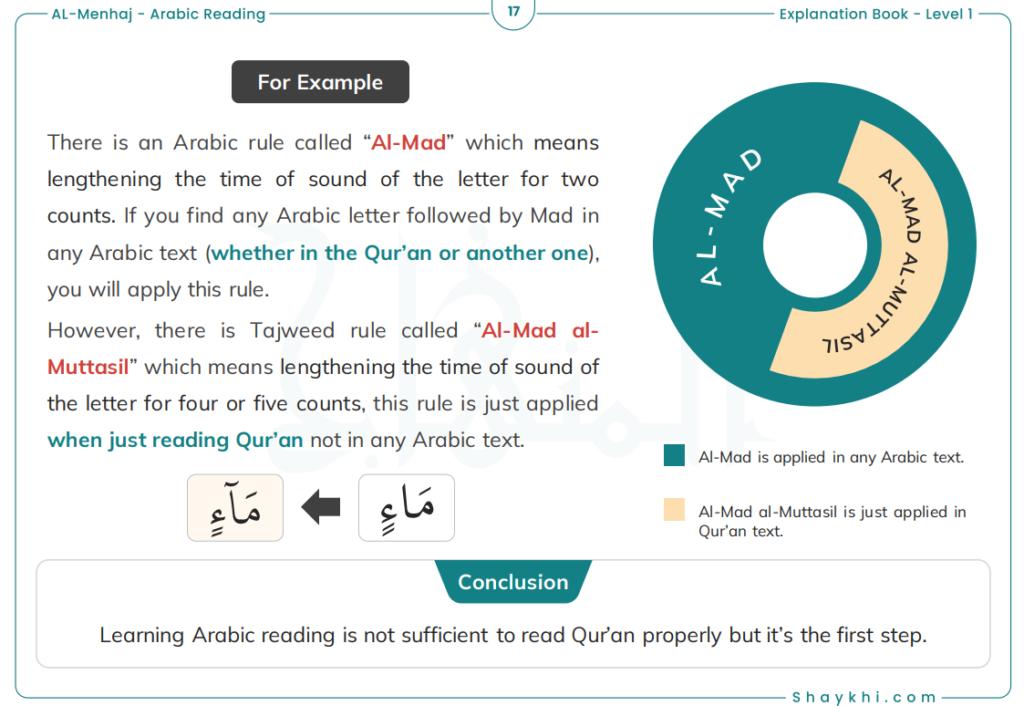
Explore Al-Menhaj Book (Learn to Read Quran)
How Long Is Madd Muttasil?
Madd muttasil is extended for four or five harakaat during connected recitation (wasl) under the Hafs ‘an ‘Asim narration via the Shatibiyyah path. Four harakaat is the more widely practiced and commonly transmitted option, though five harakaat remains valid.
When Does Six Harakaat Become Permissible Madd Muttasil?
When the hamzah falls at the end of the word (mutarrif) and the reciter pauses on it, the extension of Madd Muttasil becomes more flexible, the madd letter before it may be held for four, five, or six harakaat — all three are valid according to the rules of waqf under Hafs.
The example students most often encounter here is the word يَشَاءُ — when stopping at the final hamzah, the alif madd before it may carry six harakaat. This is an important distinction for students preparing for recitation evaluation or Ijazah examination.
Shots Videos from Our Courses
Perfect Your Quran Recitation Today
Join expert-led Tajweed classes, and recite the Quran with confidence and clarity.
Start Your Free TrialWhat is The Core Condition That Defines Madd Muttasil?
Understanding madd muttasil examples correctly requires one non-negotiable condition: the madd letter and the hamzah must exist within one word — not across two adjacent words. The moment they separate across a word boundary, the rule changes entirely.
Madd Muttasil Examples
Here are verified examples directly from the Quran:
جَاءَتْهُمُ
Jaa’at-hum
“…came to them…” (Al-Bayyinah 98:4)
Madd letter: alif — followed by hamzah — in جَاءَتْ
يُؤْتِيهِ مَن يَشَاءُ
Yu’teehi man yashaa’u
“He grants it to whom He wills.” (Al-Jumu’ah 62:4)
يَشَاءُ contains alif-madd before final hamzah
وَجِيءَ يَوْمَئِذٍ بِجَهَنَّمَ
Wa jee’a yawma’idhin bi-jahannama
“And Hell is brought forth that Day.” (Al-Fajr 89:23)
جِيءَ: yaa-madd immediately followed by hamzah within one word
إِنَّمَا النَّسِيءُ زِيَادَةٌ فِي الْكُفْرِ
Innama an-nasee’u ziyaadatun fil-kufr
“Indeed, the postponement of sacred months is an increase in disbelief.” (At-Tawbah 9:37)
النَّسِيءُ: yaa-madd before hamzah — one word
At Learn Quran Tajweed Academy, students in our Intermediate Tajweed Course work through exactly this identification process — learning to distinguish genuine madd letters from visually similar non-madd waaws and yaas before advancing to timed extension practice.
Join our Intermediate Tajweed Course and get a free trial

What Is the Difference Between Madd Muttasil and Madd Munfasil?
Madd muttasil and madd munfasil share the same triggering mechanism — a madd letter followed by hamzah — but differ in one critical structural point: their location relative to word boundaries.
| Comparison Point | Madd Muttasil (Wajib) | Madd Munfasil (Jaa’iz) |
| Definition | Madd letter and hamzah in the same word | Madd letter ends one word; hamzah begins the next |
| Ruling | Wajib — obligatory extension | Jaa’iz — permissible variation |
| Extension (Hafs — Shatibiyyah) | 4 or 5 harakaat (6 at pause on final hamzah) | 2, 4, or 5 harakaat |
| Example | جَاءَ (one word) | إِنَّا أَعْطَيْنَاكَ (two words) |
| Reason for Name | Hamzah is connected within the same word | Hamzah is separated into the following word |
| Scholarly Consensus | Full ijma’ on extension beyond 2 harakaat | Legitimate disagreement — some recite with 2 |
This distinction must be clear before any student attempts timed recitation or Tajweed examination. Confusing the two produces consistent errors in both the muttasil’s obligatory extension and the munfasil’s permitted variation.
For a broader understanding of all madd types and their interactions, visit the complete guide on tajweed madd rules: types of Madd, with chart.
The Most Common Mistakes Students Make Applying Madd Muttasil
Over years of working with non-Arabic speaking students, the same patterns repeat with madd muttasil. Knowing them in advance helps you avoid them.
1. Shortening the Extension to Two Harakaat
This is the most frequent error. Students who have recently learned the natural madd (two harakaat) default to it everywhere. When they encounter جَاءَ, they extend the alif for two counts and move on — unaware they’ve just reduced a wajib madd to a natural madd.
The correction requires deliberate counting practice: four clear, consistent beats before landing on the hamzah. Students at Learn Quran Tajweed Academy who practice with a metronome during early stages of this rule tend to overcome the shortening habit significantly faster than those who rely on feel alone.
2. Confusing Muttasil with Munfasil Mid-Recitation
In fast-flowing recitation, students sometimes misidentify word boundaries. They apply munfasil rules (and its flexibility of two harakaat) to a muttasil example where four harakaat is obligatory — or vice versa.
Slowing recitation to tarteel pace is the most reliable diagnostic. If you’re regularly misidentifying madd categories mid-recitation, our Quran Tarteel Course specifically develops the measured pace that prevents this category of error.
Join our Quran Tarteel Course and get a free trial

3. Inconsistency Between Wasl and Waqf Extension
Many students extend correctly during waqf (pause) but compress the extension during wasl (connection). The rule during wasl for Hafs is firm: four or five harakaat — no reduction is permitted
Our Students Reviews
Perfect Your Quran Recitation Today
Join expert-led Tajweed classes, and recite the Quran with confidence and clarity.
Start Your Free TrialHow to Learn Madd Muttasil?
Learning madd muttasil is not simply about memorizing a definition — it requires building a fast, accurate identification reflex and then training consistent, measured extension. Here is the sequence that works most reliably:
| Step | Action | Goal |
| 1. Identify | Scan a passage and mark every madd letter followed by hamzah in one word | Build visual recognition |
| 2. Isolate | Read each example in isolation, holding four clear beats | Establish the feel of the extension |
| 3. Contrast | Read muttasil alongside munfasil examples back to back | Sharpen the distinction |
| 4. Connect | Read full verses at tarteel pace, applying the rule in context | Build recitation fluency |
| 5. Verify | Record yourself and review, or present to a certified instructor | Catch compression and inconsistency |
The fifth step is non-negotiable. Self-assessment alone rarely catches madd extension errors because the student’s perception of their own harakaat count is usually inflated. A certified instructor hears what the student cannot.
For structured progression through this and all related madd rules, the Practical Tajweed Course at Learn Quran Tajweed Academy is built around applied recitation — not just theoretical rule memorization.
Join our Practical Tajweed Course and get a free trial

Read Also: Madd Iwad
Begin Mastering Madd Muttasil with Certified Instruction at Learn Quran Tajweed Academy
Madd muttasil appears in virtually every page of the Quran. Applying it correctly — consistently — transforms the quality of your recitation from acceptable to precise.
Learn Quran Tajweed Academy offers:
- Ijazah-certified instructors specializing in Hafs ‘an ‘Asim
- Personalized 1-on-1 sessions tailored to your current recitation level
- Flexible scheduling available 24/7 for students worldwide
- Structured progression from foundational madd rules to full Ijazah certification
- A FREE trial lesson — no commitment required
Book Your Free Trial Lesson Today →
Check out the best tajweed course for your needs:
- Practical Tajweed Course
- Beginner Tajweed Course
- Intermediate Tajweed Course
- Advanced Tajweed Course
- Quran Tarteel Course
- Tajweed Ijazah Program
- Tajweed Course for Sisters
- Tajweed course for Kids
Book your free trial Tajweed lesson today to assess your current application of Tajweed rules and receive a customized learning path toward recitation mastery.

Conclusion
Madd muttasil is not a complex rule — its condition is precise, its extension is defined, and its application is obligatory. What makes it challenging is the discipline required to apply it consistently across thousands of recitation hours without defaulting to the natural madd out of habit.
The difference between a student who merely knows this rule and one who has truly internalized it is audible. Four deliberate harakaat in Madd Mutasil, held with calm control before landing on the hamzah — that is where correct Tajweed lives.
Alhamdulillah, every rule mastered brings your recitation closer to the standard the Quran deserves. Start with recognition, build with practice, and verify with a qualified teacher.
Read Also: Tajweed Madd Rules: Types of Madd with Chart
Frequently Asked Questions About Madd Muttasil
What is the simplest definition of madd muttasil?
Madd muttasil occurs when a madd letter (alif, waaw, or yaa) is immediately followed by a hamzah within the same single word, with no other letter between them. Under Hafs ‘an ‘Asim via Shatibiyyah, this madd is extended for four or five harakaat — obligatorily — during connected recitation.
Is madd muttasil the same as madd wajib muttasil?
Yes — both terms refer to the same rule. “Madd wajib muttasil” is the full classical name: wajib (obligatory) because all reciters must extend it, and muttasil (connected) because the madd letter and hamzah reside in one word. In common usage, “madd muttasil” is the shortened form.
How do I tell madd muttasil and madd munfasil apart quickly?
Check the word boundary. If the madd letter and hamzah are in one word — it is muttasil (four to five harakaat, obligatory). If the madd letter ends one word and the hamzah begins the next — it is munfasil (two, four, or five harakaat, permissible). Word boundary identification is the only test needed.
Can madd muttasil ever be recited with only two harakaat?
No. Under any recognized narration of Hafs ‘an ‘Asim, two harakaat for madd muttasil is not a valid option. The minimum is four harakaat. This is precisely why the rule is named wajib — scholarly consensus prohibits reducing it to the natural madd level.
How long does it take to apply madd muttasil correctly in full recitation?
Most non-Arabic speaking students at Learn Quran Tajweed Academy can identify madd muttasil reliably within two to three weeks of targeted practice. Consistent, accurate application during connected recitation — without compression — typically develops over four to eight weeks of daily recitation with instructor feedback. Individual timelines vary based on prior recitation experience.